
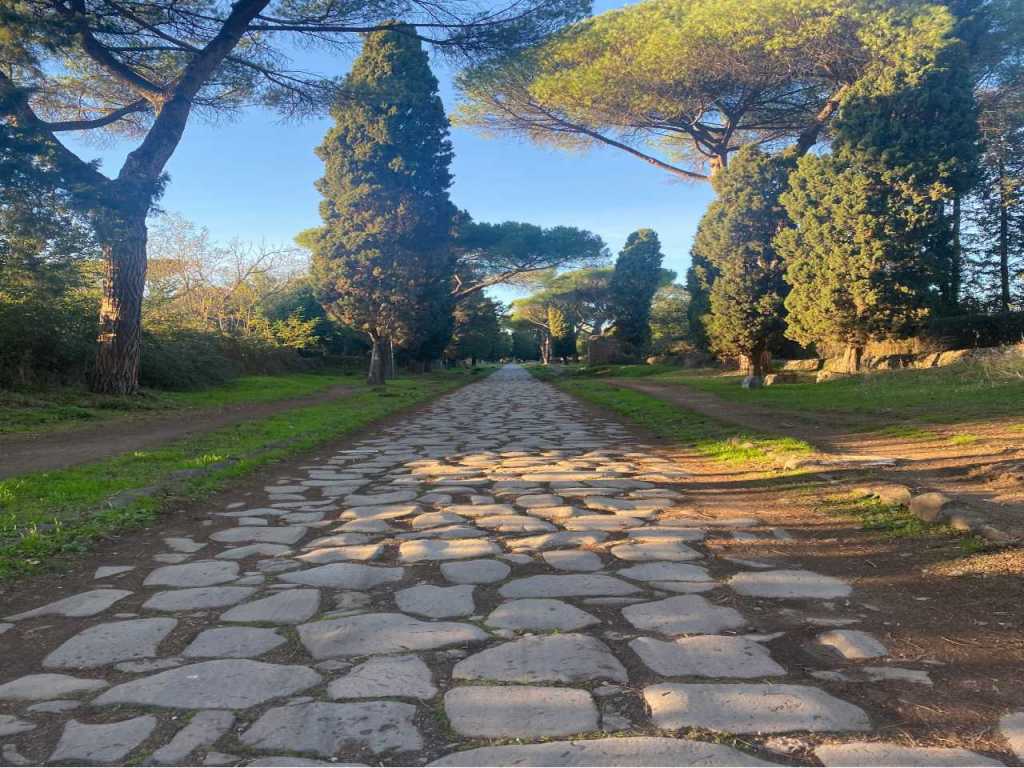
Few roads in history are as famous—or as evocative—as the Appian Way. Known to the Romans as the Via Appia, it was celebrated as the “Regina Viarum”: the Queen of Roads. Stretching from Rome toward Italy’s southern shores, it was more than a track of stone; it was a powerful instrument of conquest, commerce, culture, and faith.
In this article, we’ll explore how the Appian Way was built, why it mattered so much to Rome, and what you can still see of it today.
Origins: Why the Appian Way Was Built
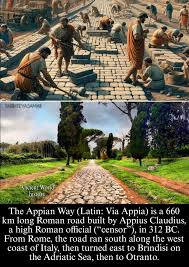
The Appian Way was begun in 312 BCE under the censor Appius Claudius Caecus, from whom it takes its name. At the time, Rome was still consolidating its control over the Italian peninsula and was engaged in a long struggle with the Samnites, a powerful people in central and southern Italy.
The early Roman Republic faced a strategic problem: moving legions quickly and reliably across difficult terrain. Roads before the Via Appia were often muddy, narrow, and vulnerable to weather. The solution was ambitious: a paved, durable highway leading straight from Rome to the front lines.
Initially, the road ran from Rome to Capua, near modern-day Naples—about 190 kilometers (roughly 120 miles). Over time it was extended farther south to the port of Brundisium (modern Brindisi) on the Adriatic Sea, becoming a crucial link between Rome and the eastern Mediterranean.
Engineering an Ancient Superhighway
Roman roads are legendary for their durability, and the Appian Way is a textbook example of why.
Key engineering features included:
- Careful surveying: Roman engineers aimed for the most direct route possible, cutting through hills and bridging valleys rather than winding around obstacles.
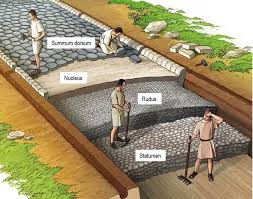
- Layered construction: The roadbed was built in layers—large stones at the bottom, followed by gravel and sand, with heavy paving stones on top. This created a stable, well-drained surface.
- Cambered surface: The road was slightly curved in the middle (crowned) so rainwater would run off into side ditches instead of pooling.
- Stone paving: Large, flat basalt stones were tightly fitted together to create a hard surface that could bear the weight of armies, supply wagons, and travelers for centuries.
Remarkably, parts of that original pavement are still visible and walkable around Rome today. The survival of these sections is a testament to the precision and quality of Roman engineering.
A Road of War, Power, and Control
The Appian Way was first and foremost a military road.
- Rapid troop movement: It allowed Roman legions to march far more quickly and predictably than their enemies, providing a critical advantage in the Samnite Wars and later conflicts.
- Supply lines: Reliable roads meant that food, weapons, and reinforcements could reach the front with far less delay, sustaining long campaigns.
- Symbol of authority: Wherever the road extended, it signaled Rome’s presence and control. Its very existence proclaimed that Roman rule—and Roman order—had arrived.
Over time, as Rome’s frontiers expanded beyond Italy, the Appian Way became part of an immense network of roads radiating from the capital. The old saying, “All roads lead to Rome,” had a real practical basis: the road system was designed so that information, people, and goods could always find their way back to the center.
Commerce, Travel, and Everyday Life
Once the immediate military need was met, the Appian Way quickly took on a broader role in civilian life.
- Trade route: Merchants used it to move agricultural products from southern Italy to Rome and to ship goods from Rome to ports like Brundisium, where they could be sent on to Greece, Egypt, and the Near East.
- Communication: Envoys, couriers, and officials traveled along the road carrying messages and decrees. Faster communication meant tighter control over distant regions.
- Travelers and pilgrims: Over time, not only soldiers and merchants but also scholars, entertainers, and ordinary people used the road for work, migration, or pilgrimage.
Along the roadside, a whole landscape developed: inns and taverns for travelers, stables for changing horses, and milestones marking distances from Rome. It was a living artery of the Republic and later the Empire.
The Appian Way and the World of the Dead
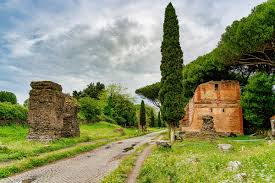
Roman law generally forbade burials inside city walls. As a result, major roads leading out of cities, including the Appian Way, became lined with tombs and funerary monuments.
These monuments ranged from simple stone markers to grand mausoleums, reflecting the wealth and status of the people buried there. To be interred along such an important road was a way to remain visible—literally—to generations of passersby.
In late antiquity and the early Christian era, the landscape around the Appian Way gained additional layers of meaning:
- Catacombs: Beneath the fields along the Via Appia, early Christians built extensive underground burial networks. Some of these catacombs—like those of San Callisto and San Sebastiano—are still major sites of religious and historical interest.
- Christian memory: Martyrs and saints associated with these catacombs turned the area into a place of pilgrimage, weaving Christian history into the older Roman landscape.
Thus, the Appian Way became not only a path of armies and traders, but also a corridor of memory and faith.
Decline, Rediscovery, and Preservation
With the fall of the Western Roman Empire in the 5th century CE, the maintenance of the road network declined. Without centralized authority and resources, many stretches of the Appian Way fell into disrepair:
- Paving stones were removed and reused in new buildings.
- Sections became overgrown or were incorporated into fields.
- New medieval paths and routes often bypassed or cut across the old Roman alignment.
Yet the memory of the Via Appia never completely vanished. Renaissance scholars and antiquarians, fascinated by classical Rome, sought out ancient remains, including stretches of the old road and its funerary monuments.
Serious efforts at preservation and restoration began in the 19th and 20th centuries. In modern times, large portions of the Appian Way near Rome have been protected as part of the Parco Regionale dell’Appia Antica—a regional park dedicated to conserving this unique historical landscape.

Walking the Appian Way Today
For visitors to Rome, the Appian Way offers a powerful, tangible connection to antiquity. Just a few kilometers from the city center, you can walk on original Roman paving stones, surrounded by fields, pine trees, and ancient ruins.
What you can see along the Via Appia Antica near Rome:
- Original road surface: Irregular but remarkably solid basalt paving stones dating back over two millennia.
- Tombs and mausoleums: Impressive remains like the Tomb of Cecilia Metella and many less famous but evocative structures.
- Christian catacombs: Several major catacomb complexes, where guided tours explain early Christian burial practices and art.
- Villas and ruins: Scattered remains of Roman villas, baths, and farmsteads that once lined the road.
Practical tips for visiting (if you’re planning a trip):
- Plan your route: The Appian Way extends a long distance, so decide whether you want a short walk near key sites or a longer hike.
- Footwear: Wear comfortable walking shoes; the ancient stones are uneven and can be slick.
- Timing: Mornings or late afternoons are often more pleasant, especially in summer.
- Transport options: Buses or bikes can help you reach the park and explore more of the road than you might on foot alone.
Even a short visit can create a vivid sense of stepping back into Roman history.
Legacy: More Than Just a Road
The Appian Way’s legacy is both practical and symbolic.
Practically, it demonstrated how powerful infrastructure can be in shaping a state’s destiny. The road enabled Rome to project military power, integrate new territories, and sustain long-distance trade and communication. It was a model for road building that influenced later civilizations and still impresses engineers today.
Symbolically, the Appian Way represents:
- Connectivity: The idea that roads can bind far-flung regions into a single political and cultural sphere.
- Endurance: The survival of its stones across so many centuries reflects the lasting impact of Roman engineering.
- Layered history: Pagan Rome, Republican power, imperial grandeur, early Christianity, medieval decline, and modern preservation all coexist along its route.
Walking the Appian Way is to move through these layers of time. Beneath your feet lies the path of soldiers, magistrates, merchants, pilgrims, and everyday Romans whose lives were shaped by this ancient highway to the world.
8/4/2026
 Fortisetliber.com
Leave a comment