
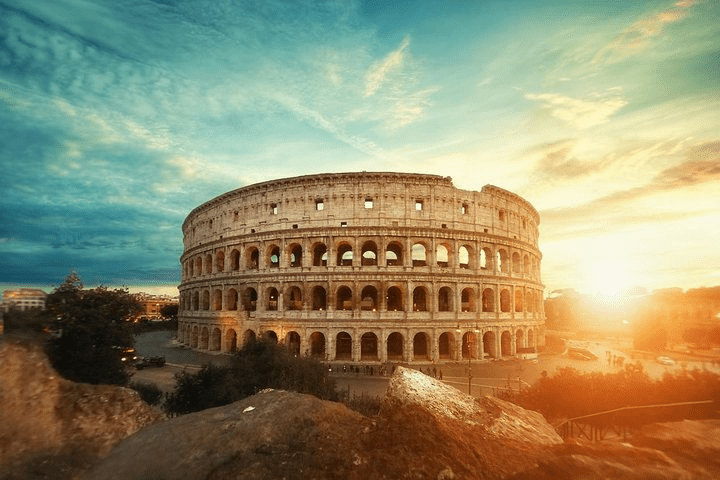
The Colosseum in Rome, also known as the Flavian Amphitheatre, is one of the most iconic structures of the ancient world. Completed nearly 2,000 years ago, it stands not only as a symbol of Roman power and entertainment, but also as a masterpiece of engineering and construction. Understanding how it was built reveals much about Roman technology, society, and politics.
1. Historical Background: Why the Colosseum Was Built
The story of the Colosseum begins with Emperor Vespasian, founder of the Flavian dynasty. After the chaotic reign of Nero and the civil wars that followed, Vespasian needed to restore stability and win public support.
- Replacing Nero’s private extravagance: Nero had built a huge private palace complex, the Domus Aurea (Golden House), which included an artificial lake in the valley between Rome’s hills. Vespasian reclaimed this space for the people, ordering that the lake be drained and an amphitheatre be built in its place.
- Financed by war spoils: Ancient sources suggest that much of the funding came from the spoils of the First Jewish–Roman War (66–73 CE), particularly the sack of Jerusalem in 70 CE.
- Timeline:
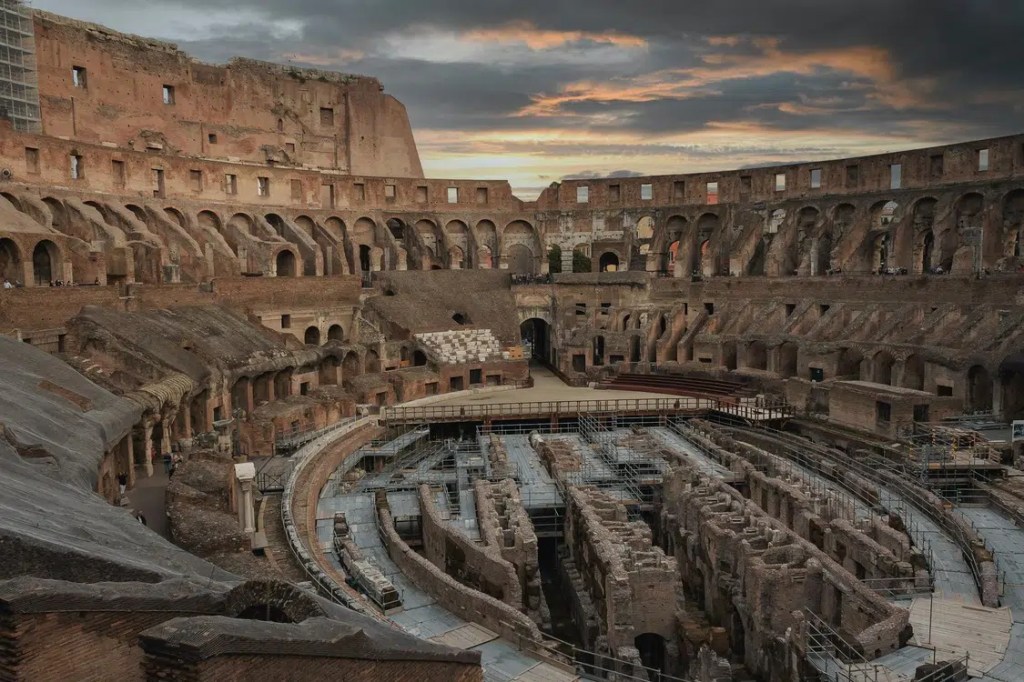
- Construction begins: c. 70–72 CE under Vespasian
- Inauguration: 80 CE under his son Titus
- Further modifications: under Domitian (81–96 CE)
By building the Colosseum, the Flavian emperors sent a clear message: Rome’s rulers would give back to the people and celebrate Roman power in a very public way.
2. Location and Foundations
The site chosen for the Colosseum was both symbolic and practical.
- From lake to arena: The amphitheatre was built on the drained bed of Nero’s artificial lake, right in the heart of Rome, close to the Roman Forum.
- Challenging ground: Building on an old lakebed required careful planning. To avoid subsidence, Roman engineers created a solid foundation:
- A massive ring-shaped foundation of concrete (opus caementicium), about 12–13 meters deep in some areas.
- Layers of concrete poured into trenches and supported by stone and brickwork.
- Shape: The amphitheatre’s elliptical plan (about 189 meters long and 156 meters wide) helped distribute weight evenly and reduced stress on any single point of the structure.
3. Materials and Building Techniques
The Colosseum showcases the Romans’ skill in combining different materials according to their properties.
3.1 Main Materials
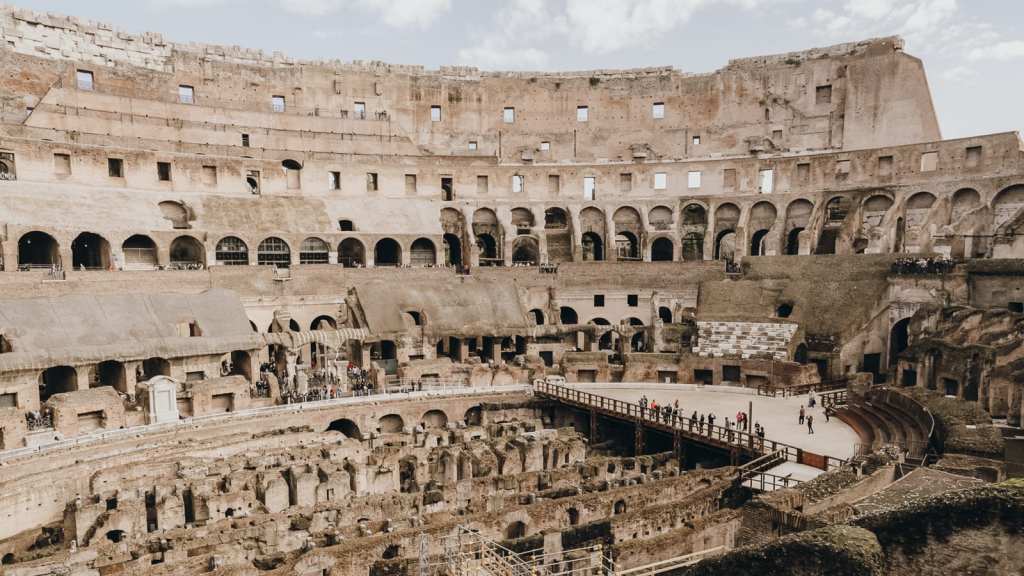
- Concrete: Roman concrete, made from lime, water, sand, and volcanic ash (pozzolana), was used extensively for the core of the structure and foundations. It could be poured into wooden forms, making complex shapes and vaults possible.
- Travertine limestone: Large blocks of travertine from quarries near Tivoli formed the outer walls and main structural framework. These blocks were carefully cut and set without mortar, held together by iron clamps.
- Tuff and brick: Lighter volcanic stone (tuff) and brickwork were used for internal walls, radially arranged walls, and vaults to reduce weight.
- Marble: Marble was used for seating in the most prestigious areas, decorative elements, and some internal finishes.
3.2 Vaults and Arches
Arches and vaults were central to the Colosseum’s stability:
- Arches support heavy loads by channeling weight down into the supporting piers.
- Barrel and groin vaults allowed builders to create corridors, stairways, and passageways that could handle massive crowds.
- The repetitive pattern of arches around the exterior forms a rigid skeleton that holds the whole structure together.
4. Organization of Labor
Constructing the Colosseum was a huge logistical undertaking that likely involved a wide range of workers:
- Skilled architects and engineers: Responsible for the design, calculations, and overall planning.
- Master builders and craftsmen: Stonemasons, carpenters, metalworkers, and decorative artists handled the precise cutting of stone, carpentry for scaffolding and seating, and metal fittings.
- Unskilled labor and enslaved people: Many of the hardest physical tasks—quarrying stone, transporting materials, mixing concrete, and lifting blocks—were likely carried out by enslaved people and lower-status laborers.
- Military involvement: Roman soldiers sometimes participated in major construction projects, contributing manpower and organization.
The entire process required coordination between quarries, transport along roads and rivers, on-site fabrication, and careful staging of building phases.
5. Step-by-Step Construction Process
While we don’t have a detailed construction diary, archaeological evidence and knowledge of Roman techniques allow us to reconstruct the general sequence:
5.1 Preparing the Site
- Draining Nero’s lake and leveling the ground.
- Marking the ellipse using geometric techniques, likely with ropes, stakes, and a central focus point.
- Digging the foundation trench following the elliptical outline.
5.2 Foundations and Lower Levels
- Pouring concrete foundations in sections, reinforced by stone and brickwork.
- Erecting the radial walls that radiate from the arena outward, supporting the seating tiers.
- Building corridors and vaults beneath the seating; these substructures formed a stable platform for the tiers above.
5.3 Raising the Outer Walls
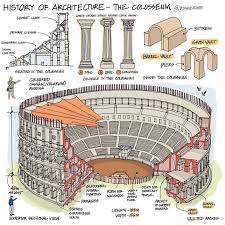
- Setting travertine piers and arches for the three main stories of the outer facade.
- Adding decorative elements such as half-columns and entablatures in the Doric, Ionic, and Corinthian orders on successive levels.
- Constructing the attic story, which included small windows and sockets for masts that supported the awning system.
5.4 Interior Seating and Arena
- Installing seating tiers (cavea) arranged by social class:
- Senators and elites closest to the arena,
- Ordinary male citizens above,
- Women and the poor in the highest, least comfortable seats.
- Laying the arena floor, originally made of wood and covered with sand, over the substructure.
- Adding access routes: staircases, vomitoria (entry/exit passages), and corridors designed to move tens of thousands of spectators efficiently.
6. The Hypogeum: Underground Engineering
The complex beneath the arena floor, known as the hypogeum, was added or expanded under Domitian.
- Two-level underground network: A maze of corridors, cells, storage rooms, and mechanical devices.
- Animal cages and gladiator holding areas: Beasts and fighters could wait below before being brought suddenly into the arena.
- Elevators and trapdoors: Wooden platforms operated by winches and pulleys raised animals, scenery, or performers through trapdoors in the arena floor.
- Water management: The presence of the hypogeum made full-scale naval battles difficult in later years, but earlier in the Colosseum’s history, the arena may have been flooded for mock sea battles (naumachiae). Later, a more permanent underground structure required careful drainage instead.
This hidden machinery allowed Roman organizers to stage elaborate and surprising spectacles, enhancing the drama of the games.
7. Crowd Management and Practical Design
The Colosseum was not just impressive; it was highly functional.
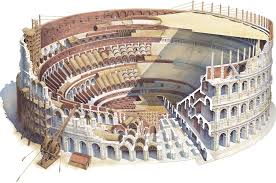
- Capacity: Estimates range from about 50,000 to over 70,000 spectators.
- Multiple entrances: 80 numbered entrances (vomitoria) permitted rapid access. Two special entrances were reserved:
- One for the emperor and elite guests.
- One for performers and possibly condemned prisoners.
- Circulation system: Corridors and staircases were designed so that people could find their assigned section quickly and leave the building in a relatively short time.
- Sunshade system (velarium):
- A large retractable awning system made of canvas.
- Supported by wooden masts fitted into sockets around the top of the Colosseum.
- Operated by sailors from the Roman navy, it provided shade for spectators on hot days.
All these features show that Roman builders understood not just how to build large structures, but how to manage large crowds safely and efficiently.
8. Symbolism and Legacy
The construction of the Colosseum was as much about image as it was about function.
- Political propaganda: Standing on the site of Nero’s private lake, the amphitheatre symbolized a return of public space to the people.
- Imperial generosity: Lavish games held in the Colosseum—often free to attend—projected the emperors as generous providers.
- Engineering prestige: The mastery of concrete, arches, and vaults turned the Colosseum into a showpiece of Roman architectural skill.
Despite damage from earthquakes, stone robbing, and time, the Colosseum remains a powerful reminder of Rome’s ability to organize labor, exploit resources, and design complex buildings on a monumental scale.
Conclusion
The construction of the Colosseum was a remarkable achievement that combined political ambition, technical innovation, and vast human effort. From its solid foundations and advanced use of concrete to its sophisticated crowd management and underground machinery, the amphitheatre embodies the strengths of Roman engineering.
To study how the Colosseum was built is to glimpse the society that created it: a world of emperors and engineers, enslaved laborers and skilled artisans, all contributing—willingly or unwillingly—to one of history’s most enduring monuments.
8/4/2026
 Fortisetliber.com
Leave a comment