Introduction
Who were the first Greeks, and where did they come from?
The origins of the ancient Greeks lie in a long, complex process that unfolded over thousands of years in the lands around the Aegean Sea. Rather than a single “moment of birth,” Greek civilization emerged from the interaction of earlier cultures, migrating peoples, shared language, and evolving traditions.
This article traces that story from the earliest settlers in the region to the formation of a distinct Greek identity.
1. The Earliest Inhabitants of the Aegean
Long before we can speak of “Greeks,” the lands that would become Greece were inhabited by Stone Age farming communities.
- Neolithic period (c. 7000–3000 BCE)
The first farmers arrived in mainland Greece and the Aegean islands from Anatolia (modern Turkey) and the Near East.
They:- grew cereals and kept animals,
- built small villages,
- made pottery and stone tools.
These people were not yet “Greek” in language or culture, but they formed the human and economic base on which later societies would develop.
2. Early Bronze Age Cultures
In the Early Bronze Age (c. 3000–2000 BCE), more complex societies appeared around the Aegean.
- Trade networks connected the Aegean with:
- Anatolia,
- the Near East,
- and especially Egypt.
- Metalworking (bronze tools and weapons) became more common.
- Settlements grew larger and more organized.
Again, we still cannot speak confidently of “Greeks” in the strict sense, but the region was already part of a wider world of early civilizations.
3. The Minoans and Mycenaeans
Two major Bronze Age civilizations shaped what would later become Greek culture: the Minoans and the Mycenaeans.
3.1 The Minoans (c. 2000–1450 BCE)
- Centered on the island of Crete.
- Known for:
- large palace complexes (e.g. Knossos),
- vibrant frescoes,
- extensive trade across the eastern Mediterranean.
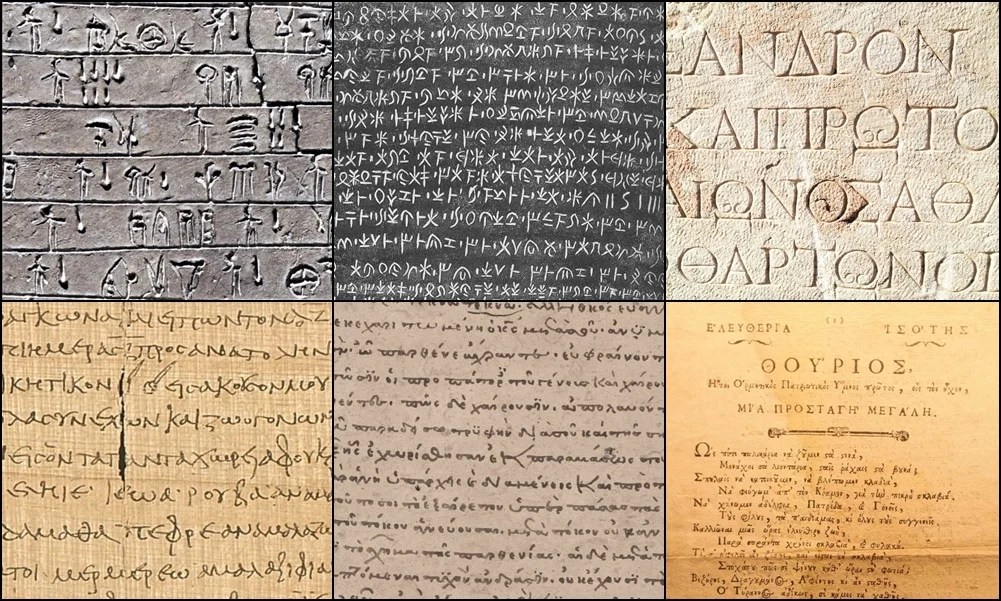
- Used a script known as Linear A, which is still undeciphered.
- Their language is unknown, but most scholars think it was not an early form of Greek.
The Minoans greatly influenced later Greek art, religion, and myth, but they were probably not “Greeks” by language.
3.2 The Mycenaeans (c. 1600–1100 BCE)
On the mainland, a different culture rose to power: the Mycenaeans.
- Named after the city of Mycenae in the Peloponnese.
- Built fortified palace centers at places like:
- Mycenae,
- Pylos,
- Tiryns,
- Thebes.
- Used a script called Linear B, which has been deciphered.
The breakthrough came in the 1950s, when scholars discovered that Linear B records an early form of the Greek language. This means:
The Mycenaeans were the first people we can confidently identify as Greek-speakers.
Their world of palace kings, warriors, and chariots is echoed in later Greek myths and in epic poems like Homer’s Iliad.
4. Collapse and the Greek “Dark Age”
Around 1200–1100 BCE, Mycenaean palace civilization collapsed.
- Palaces were destroyed or abandoned.
- Long-distance trade shrank.
- Writing in Linear B disappeared.
- Population likely declined in many areas.
Historians sometimes call the following centuries the Greek Dark Age (c. 1100–800 BCE), not because nothing happened, but because we have fewer written sources and monumental remains.
During this time:
- People lived mostly in smaller, simpler communities.
- Iron replaced bronze as the main metal for tools and weapons.
- New groups, such as the Dorians (in later Greek tradition), were remembered as having arrived or moved within Greece, though the exact historical reality is debated.
Despite the hardships, this period laid the foundations for a new kind of society that would emerge in the Archaic period.
5. The Formation of Greek Identity
By the Archaic period (c. 800–500 BCE), we can clearly see the features of what we call Greek civilization.
5.1 A Shared Language (Greek Dialects)
Different regions spoke distinct dialects—such as Attic, Ionic, Doric, and Aeolic—but they were all forms of Greek. This common language helped bind the people together.
Greek tradition remembered legendary ancestors like:
- Hellen,
- his sons Dorus, Xuthus, and Aeolus,
as the founders of the main Greek-speaking groups (Dorians, Ionians, Aeolians). While mythological, these stories reflect a sense of shared origin.
5.2 Common Religion and Myths
The Greeks developed a shared religious framework:
- Worship of gods such as Zeus, Hera, Athena, Apollo, Artemis, Poseidon, and others.
- Panhellenic sanctuaries and festivals (e.g. Olympia, Delphi).
- Myths and epics (like Homer’s Iliad and Odyssey) that told stories of a heroic past, often set in a Mycenaean-like world.
These shared stories and rituals reinforced the idea of a common Hellenic identity.
5.3 The Polis (City-State)
Another crucial development was the rise of the polis, or city-state:
- Independent communities with their own laws, governments, and armies.
- Examples: Athens, Sparta, Corinth, Thebes.
- Each polis had its own customs, but they all saw themselves as Hellenes (Greeks), especially when compared with non-Greek “barbarians.”
6. Did the Greeks “Come From” Somewhere Else?
Ancient and modern thinkers have offered different ideas about Greek origins.
6.1 Ancient Greek Views
Ancient Greeks themselves had mixed traditions:
- Some claimed to be autochthonous—literally “sprung from the earth” of their own land (for example, Athenians liked to say this).
- Others spoke of migrations and arrivals of different groups, such as:
- Achaeans,
- Dorians,
- and other tribes moving into Greece at various times.
These stories were partly myth and partly memories of real population movements.
6.2 Modern Scholarly Perspectives
Modern scholars examine:
- Archaeology (settlement patterns, pottery styles, architecture),
- Linguistics (changes in the Greek language and its Indo-European roots),
- Genetics (when available).
The current broad picture is:
- Greek is an Indo-European language, which means the ancestors of Greek-speakers were related, at a distant level, to other Indo-European groups (such as early speakers of Latin, Sanskrit, etc.).
- These Indo-European ancestors likely entered the Greek world during the Late Neolithic to Early Bronze Age, mixing with the earlier farming populations already living there.
- Over centuries, this mixture produced the people we recognize, archaeologically and linguistically, as the Mycenaeans, and later the Greeks of the Archaic and Classical periods.
So rather than simply “coming from one place” at one moment, the Greeks emerged from the gradual blending of incoming Indo-European–speaking groups with the long-established populations of the Aegean.
7. Greek Colonization and the Spread of Greek Culture
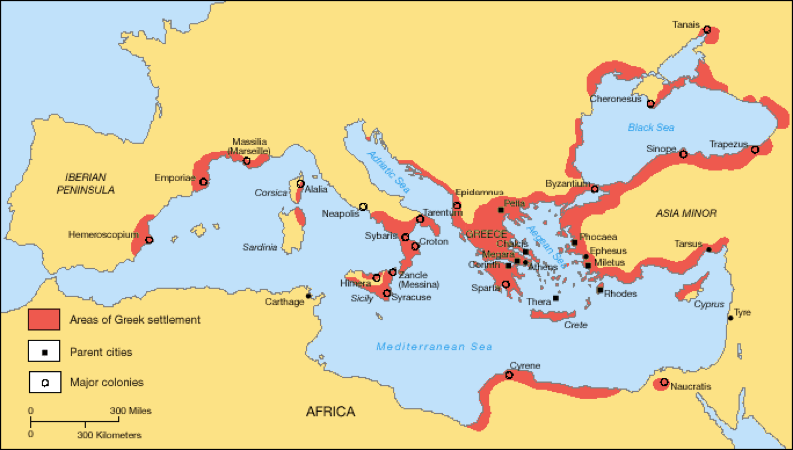
By the 8th–6th centuries BCE, the Greeks were not just a people of one region; they were spreading across the Mediterranean.
- Founded colonies in:
- western Asia Minor (Ionia),
- the Black Sea,
- southern Italy and Sicily (“Magna Graecia”),
- parts of North Africa and the western Mediterranean.
- These colonies carried Greek language, religion, and customs far beyond the Greek mainland and islands.
This expansion helped fix and spread a recognizable Greek identity, even though local variations remained strong.
8. Conclusion
The origins of the Greeks cannot be reduced to a simple answer like “they came from the north” or “they were always there.” Instead, Greek civilization emerged through:
- The early farming communities of the Neolithic Aegean,
- The rise and influence of Minoan Crete,
- The Mycenaean palaces, whose people spoke the earliest known form of Greek,
- The collapse of that world and the transformations of the Dark Age,
- The gradual formation of a shared language, religion, mythology, and way of life in the Archaic period.
By the time of classical Athens and Sparta, the Greeks saw themselves as Hellenes, a people united by language and culture, though divided into many city-states. Their origins lie in thousands of years of migration, mixture, adaptation, and creative cultural development around the Aegean Sea.
10/04/2026
 Fortisetliber.com
Leave a comment