
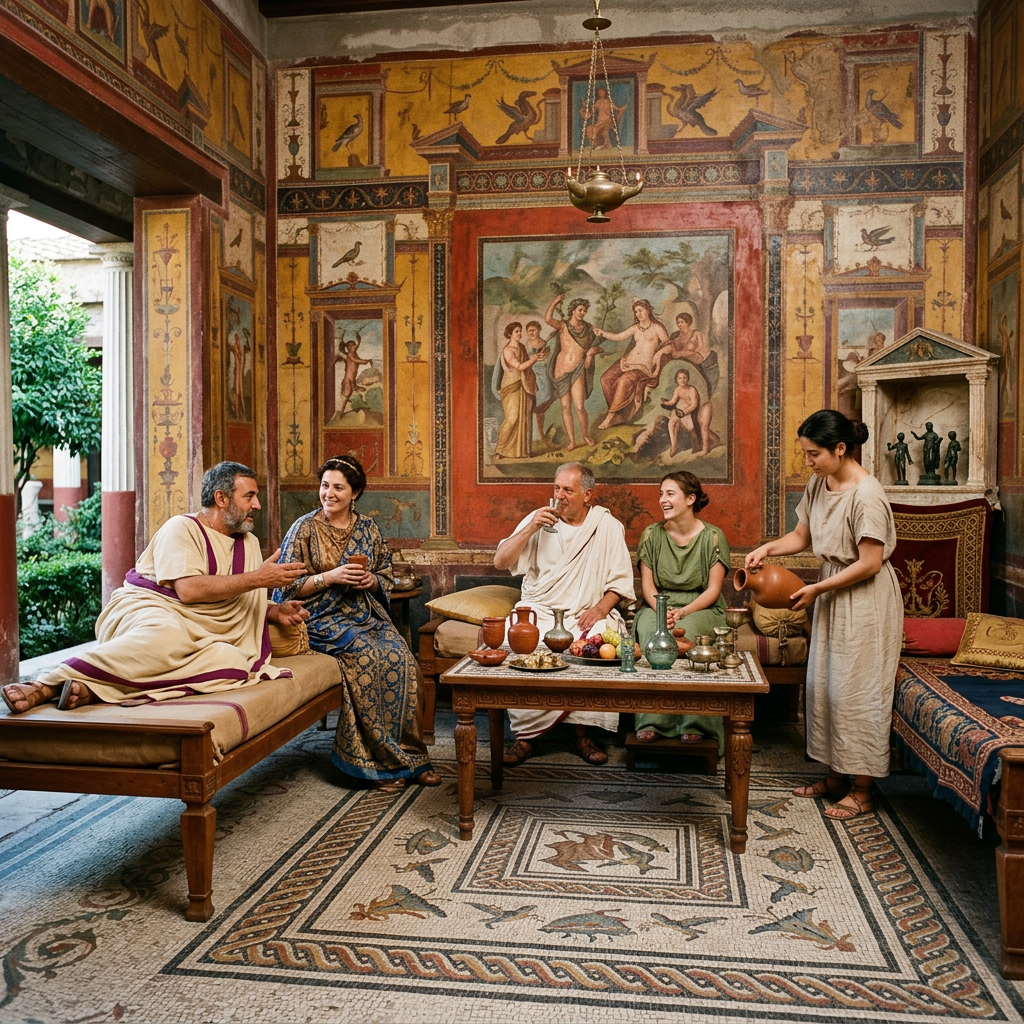
Sexual life in ancient Rome was at once familiar and deeply foreign to modern readers. Many behaviors that Romans viewed as normal would be seen as immoral or illegal today, while some modern norms would have puzzled them.
Understanding Roman sexuality means entering a world structured by status, power, gender, and ideas of honor rather than by our modern concepts of consent, orientation, or privacy.
This article explores how sex fit into Roman society: in marriage and family life, in law and politics, in religion and public spectacle, and in relationships that crossed lines of class, gender, and freedom.
1. Key Principles: Status, Power, and Control
For Romans, the central question about sex was not “Is this morally right in itself?” but rather “Who is doing what to whom?” and “Does this respect social order?”
Several basic ideas shaped Roman attitudes:
- Status hierarchy
Roman society divided people into freeborn citizens, freedmen (former slaves), and slaves, with further distinctions of class (senators, equestrians, commoners). Sexual norms were different for each group; free male citizens were at the top of this hierarchy. - Active vs. passive roles
For elite Roman men, the “active” sexual role (penetrating) was associated with power and dominance. The “passive” role (being penetrated) could be tolerated for slaves, prostitutes, and certain outsiders, but not for a freeborn male citizen without risking his reputation. - Reputation (fama) and shame (pudor)
What mattered most was how behavior affected one’s public reputation. Sexual conduct that signaled weakness, lack of self-control, or dishonor could damage a man’s political and social standing. - Double standards for men and women
Freeborn women were expected to be chaste, modest, and sexually faithful to one man (their husband). Freeborn men were expected to be discreet and self-controlled but were allowed considerable freedom, especially with partners of lower status.

2. Marriage and Family Life
2.1 The Purpose of Marriage
In elite Roman culture, marriage was less about romantic love and more about:
- Producing legitimate heirs
- Creating alliances between families
- Managing property and inheritance
- Reinforcing social status and political networks
Love and affection certainly could exist in Roman marriages, and some literary sources celebrate devoted couples, but in law and custom, marriage was above all a social and economic institution.
2.2 Marriage, Age, and Choice
- Age: Elite Roman girls might marry in their mid-teens, while men often married later, sometimes in their late 20s or 30s, after they had begun their public careers.
- Parental control: Marriages, especially among the upper classes, were usually arranged by families. The consent of the bride and groom mattered less than the interests of the household.
- Dowry: The bride’s family provided a dowry, which could be large among the elite. It helped support the new household and was often at the center of legal disputes if a marriage broke down.
2.3 Expectations of Fidelity
- Wives: A freeborn Roman wife was expected to be sexually exclusive to her husband. Adultery was defined primarily as a married woman having sex with a man who was not her husband.
- Husbands: Men were expected not to violate another citizen’s wife, but they could legally have sexual relationships with slaves, prostitutes, and certain lower-status partners, so long as this did not disrupt social order or dishonor other citizens.
3. Law and Morality: Regulating Sexual Behavior
Roman law did not try to police all sexual acts, but certain behaviors were legally punished, especially when they threatened family honor or public order.
3.1 Adultery and Honor
In the late Republic and early Empire, laws such as the Lex Iulia de adulteriis coercendis (Augustan adultery law) targeted:
- Married women who committed adultery
- Their male partners, if they were freeborn citizens
Penalties could include:
- Divorce
- Loss of dowry
- Social stigma and loss of certain legal privileges
- In severe cases, exile or confiscation of property
Male adultery with slaves or prostitutes did not count as a crime under this law.
3.2 Sexual Violence
Sources show that sexual violence existed, especially against slaves and those of lower status, who had few legal protections. For freeborn citizens, sexual assault could be treated as a serious offense against the family’s honor, but our evidence is fragmentary, and victims’ voices are largely missing.
3.3 Prostitution and Legal Status
Prostitution was legal, taxed, and widespread. Those who registered as prostitutes (often women, but also men and boys) occupied a low social status and were excluded from many legal protections and honors. Yet brothels could be found in cities across the Empire, including near public spaces and baths.

4. Sexuality and Slavery
Slavery was a central feature of Roman society, and it profoundly shaped sexual life.
- Owners’ control: Enslaved people had no legal control over their own bodies. Owners could compel sexual services, pair slaves to produce more slaves (“breeding”), or rent them out as prostitutes.
- Household dynamics: In elite households, slaves could be sexual partners for their owners or their owners’ sons. Such relationships were usually understood in terms of power and property, not mutual consent.
- Freedmen and freedwomen: After manumission, former slaves became freedmen or freedwomen. They gained more rights, but their past could still affect their social reputation, especially if they had been associated with sex work.
When we read about Roman sexuality, we must remember that many “acceptable” practices depended on the extreme power imbalance of slavery.
5. Same-Sex Relations
Romans did not categorize people according to sexual orientation in the modern sense. Instead, they judged sexual behavior through the lenses of status and active/passive roles.
5.1 Male–Male Relations
- Active role: A freeborn Roman male could have sex with male partners of lower status—slaves, freedmen, or prostitutes—so long as he took the active, penetrative role.
- Passive role and stigma: A freeborn adult male who was thought to regularly take the passive role could be mocked, stigmatized, or legally disadvantaged. Satirical texts and invective speeches often accuse political enemies of being “unmanly” in this way.
- Love and affection: Poetry (e.g., Catullus, Martial) sometimes depicts intense emotional relationships between men, though these sources often mix genuine feeling with literary exaggeration and social norms about dominance and mockery.
5.2 Female–Female Relations
Evidence for sexual relationships between women is much scarcer. Roman writers occasionally mention women with female lovers, usually as objects of fascination or moral anxiety rather than understanding. Legal texts, too, pay much less attention to female same-sex relations than to male ones. As a result, reconstructing women’s same-sex experiences is difficult and relies heavily on indirect or hostile sources.
6. Religion, Ritual, and Sexuality
Sex and religion were closely intertwined in Roman culture.
6.1 Fertility and the Gods
Many Roman festivals and cults included themes of fertility, marriage, and renewal:
- Venus: Goddess of love, beauty, and in some aspects sexuality and fertility. Her temples and festivals could involve offerings related to love, marriage, and desire.
- Priapus: A minor fertility god depicted with exaggerated male genitals, often used as a comic or protective figure in gardens and household spaces.
- Marriage rituals: Weddings themselves were religiously charged, involving sacrifices, oaths, and rituals that connected the couple’s union to divine favor and the continuity of the family.
6.2 Sacred Chastity
At the opposite extreme, some religious roles emphasized sexual abstinence:
- Vestal Virgins: Priestesses of Vesta in Rome were required to remain chaste during their years of service (often 30 years). Violating this vow was seen not just as a personal sin but as a dangerous offense against the safety of the city.
This combination of fertility symbolism and demands for ritual purity reveals how Romans viewed sex as a powerful force that had to be controlled and channeled properly.

7. Public Spaces: Baths, Theaters, and Brothels
Sexual life in Rome was not purely private; it intersected with many public or semi-public spaces.
7.1 Public Baths
- Social hubs: Public baths (thermae) were places to bathe, exercise, socialize, and conduct business.
- Mixed signals: While baths were officially for hygiene and recreation, sources hint at flirtation, prostitution, and sometimes illicit sexual encounters taking place there.
- Gender separation: Men and women typically bathed at different times or in separate rooms, though practices varied over time and place.
7.2 Theaters and Games
- Entertainment culture: Theaters, amphitheaters, and circus games drew large crowds. Performers, dancers, and actors were often associated with sexual availability and low status.
- Moralists’ complaints: Conservative writers sometimes complained that too much exposure to entertainment, luxury, and erotic performances corrupted morals and distracted citizens from their duties.
7.3 Brothels and Street Life
- Brothels (lupanaria): Archaeological remains, especially in Pompeii, show small rooms, sometimes with painted scenes on the walls. These were commercial spaces where sex was openly sold.
- Street prostitution: Sex workers could also be found near taverns, inns, and busy streets. Lamps, symbols, or informal signals might mark locations where they worked.
8. Literature, Art, and Eroticism
Roman art and literature offer a rich—if biased—window into sexual attitudes.
8.1 Erotic Poetry and Satire
- Poets like Catullus, Ovid, Propertius, and Tibullus wrote love poetry that depicts longing, jealousy, adultery, and desire.
- Satirists such as Juvenal and Martial use sexual themes for humor and sharp social critique, often exaggerating or inventing scandals to attack others.
These works are literary creations, not simple mirrors of reality, but they reveal what topics audiences found engaging, shocking, or amusing.
8.2 Visual Art and Domestic Decoration
- Wall paintings and mosaics, especially from Pompeii and Herculaneum, sometimes show explicit sexual scenes, mythological seductions, or playful erotic imagery.
- Erotic imagery could appear in bedrooms, baths, taverns, and brothels, but also in some ordinary houses, suggesting that sexual themes were not always hidden or taboo in the way they might be in some later societies.

9. Change Over Time: From Republic to Late Empire
Roman attitudes were not static. Over the centuries, political changes, cultural influences, and the spread of new religions (especially Christianity) reshaped norms.
- Republican and early imperial periods: Emphasis on traditional virtues (gravitas, disciplina), but also a lively urban culture with theaters, baths, and brothels.
- Moral legislation under Augustus: Attempted to promote marriage and childbirth among the elite and to punish adultery more severely.
- Growth of Christianity: From the 3rd–4th centuries CE onward, Christian ideas increasingly challenged earlier Roman norms, emphasizing sexual restraint, the spiritual value of celibacy, and new moral frameworks for marriage and desire.
By late antiquity, many older practices were being reinterpreted or condemned within a Christianized Roman world.
10. Conclusion: A World Both Familiar and Strange
The sexual life of ancient Rome was shaped less by private romantic ideals and more by public values: honor, status, control, and the stability of the household and state.
Many features—double standards, social pressure, commercial sex—may feel disturbingly familiar. Others, like the extreme legal power of male heads of household or the central role of slavery, underline how different Roman society was from most modern ones.
When we study Roman sexuality, we are not simply looking for scandalous stories from the past. We are also asking how any society uses sex to express its values:
who holds power, whose bodies are controlled, and what counts as honor or shame. In that sense, exploring sexual life in ancient Rome is also a way of better understanding our own world.
Fortisetliber’s View
From a modern vantage point, the sexual world of ancient Rome feels at once familiar and profoundly alien. We recognize some of the same human impulses—desire, jealousy, affection, vulnerability—but they were filtered through a social order that accepted radical inequalities of power as normal.
Roman writers rarely asked whether a sexual act was “consensual” in our sense; they asked whether it was fitting for someone of a given status and gender, and whether it preserved the public reputation of the household. That difference in basic questions should unsettle us.
At Fortisetliber, we think it is essential to take Roman norms seriously on their own terms without romanticizing them. The brutality of slavery, the double standards for men and women, and the legal asymmetry that protected free bodies while exposing enslaved and marginalized people to exploitation are not incidental details; they are structural features of Roman society.
When ancient texts joke about sexual violence or treat the bodies of slaves as available, they reveal not individual depravity alone but a broader system in which some people’s suffering scarcely counted.
Yet Roman sources also show that norms were contested. Moralists complained about luxury and promiscuity; poets imagined tender attachments that did not fit comfortably into rigid hierarchies of active and passive roles; religious practices tried to discipline or sublimate erotic energy.
These tensions remind us that no society is morally monolithic. Even within an unjust order, people negotiated, resisted, and sometimes reimagined what intimacy and honor might mean.
Studying Roman sexuality, then, is not an exercise in voyeurism or in reassuring ourselves that we are more “civilized.” It is an invitation to examine the ways power, law, and culture still shape whose desires are celebrated, whose bodies are protected, and whose experiences remain invisible.
By looking unflinchingly at the Roman world, we gain a sharper lens for viewing our own—and for asking whether the inequalities embedded in our sexual norms will seem, to future readers, as troubling as Rome’s now appear to us.
Fortisetliber.com
Leave a Reply