
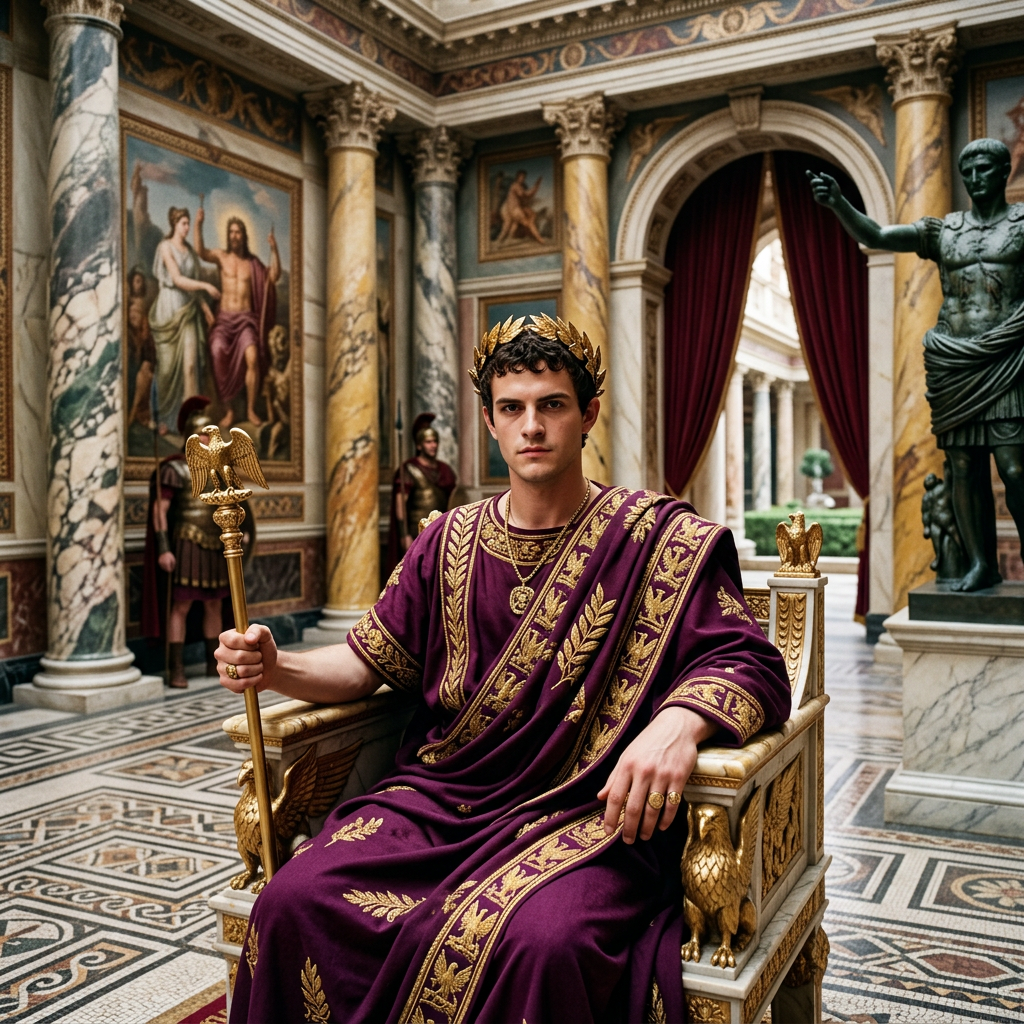
Few Roman emperors have a reputation as dark and sensational as Gaius Julius Caesar Germanicus, better known by his nickname Caligula. To many, he is the mad emperor who made his horse a consul, ordered statues of himself as a god, and turned the Roman palace into a place of fear and excess. But who was Caligula really, and how much of his reputation is based on fact versus rumor?
Early Life and the Origin of “Caligula”
Caligula was born in 12 CE into one of the most famous families in Rome.
His father, Germanicus, was a celebrated general and a popular member of the imperial family. His mother, Agrippina the Elder, was the granddaughter of the first emperor, Augustus.
As a child, Gaius spent time with his father on military campaigns along the Rhine frontier. The soldiers adored seeing a small boy dressed in a miniature soldier’s outfit, including tiny boots called caligae. From this came his nickname Caligula, meaning “little boot.” Although the name stuck in later history, it was probably not used to his face when he became emperor.
Path to Power
After Germanicus died under suspicious circumstances in 19 CE, Caligula’s family fell into political danger. His mother and some of his brothers were accused of plotting against the emperor Tiberius, and several relatives died in exile or prison.
Caligula, however, survived by keeping a low profile. Eventually, he was brought to live with Tiberius on the island of Capri. Ancient sources describe Capri as a place of moral corruption, but we must remember that these stories come from writers who disliked both Tiberius and Caligula.
When Tiberius died in 37 CE, Caligula, then in his mid‑20s, was named co-heir along with Tiberius’ grandson Gemellus. In practice, Caligula quickly became the sole ruler. The Roman people welcomed him enthusiastically, seeing in him the beloved memory of Germanicus and the promise of a fresh start after Tiberius’ gloomy reign.
A Promising Beginning
The first months of Caligula’s rule were surprisingly positive:
- He ended treason trials that had caused fear under Tiberius.
- He paid bonuses to the soldiers, securing the loyalty of the army.
- He organized games and public entertainments, pleasing the crowds.
- He honored his late family members, bringing back their ashes and restoring their memory.
For a short time, Caligula looked like the ideal young prince: generous, energetic, and popular.
Illness and the Turn Toward Tyranny
According to ancient writers, everything changed when Caligula fell seriously ill only a few months into his reign. He eventually recovered, but they claim that his personality darkened afterward.
From this point, sources describe him as:
- increasingly suspicious and cruel
- demanding divine honors for himself
- spending lavishly on palaces, games, and projects
It is hard to know how much of this transformation is real and how much is exaggerated. Roman historians often liked to explain a bad ruler by pointing to a moment of “madness” or moral collapse.

Scandals, Cruelty, and Strange Stories
The most famous stories about Caligula come from later authors like Suetonius, Cassius Dio, and Tacitus (though Tacitus’ account is mostly lost). They paint a picture of an emperor who abused power in shocking ways.
Some of the most notorious claims include:
- Humiliation of the Senate: Caligula is said to have mocked senators publicly, forced them to run beside his chariot, or made them watch degrading spectacles.
- Extravagant Spending: He supposedly built luxurious villas, floating palaces on ships, and staged extremely costly games, driving the imperial finances toward crisis.
- Divine Pretensions: He reportedly dressed as gods like Jupiter or Apollo, set up statues of himself in temples, and demanded worship while still alive.
- The Horse Incitatus: According to Suetonius, Caligula loved his horse Incitatus so much that he gave it a marble stable, jeweled harnesses, and even planned to make it a consul. Modern historians suspect this story may be satire or exaggeration, meant to show his contempt for the political class rather than an actual legal appointment of a horse.
- Sexual Scandals: Ancient authors accuse him of incest, adultery, and public indecency. These types of accusations were common weapons in Roman political writing, so they must be treated with caution.
Relationship with the People and the Army
Caligula’s relationship with different groups in Roman society was complex:
- The Roman People often enjoyed the games, distributions of food, and spectacular shows he provided. However, heavy taxes and shortages could quickly turn opinion against any emperor.
- The Senate increasingly resented Caligula’s behavior. By humiliating them and ignoring traditional political forms, he undermined the old aristocracy’s sense of dignity and influence.
- The Praetorian Guard (the emperor’s elite soldiers) were crucial. At first they benefited from his generosity, but as tensions rose in the palace, some officers began to see him as a danger to their own power and security.

Assassination in 41 CE
After less than four years in power, Caligula was assassinated in January 41 CE. The conspiracy involved members of the Praetorian Guard and perhaps some senators.
- He was killed in a passageway near a theater in Rome.
- His wife Caesonia and their young daughter were also murdered soon afterward.
- In the chaos that followed, the Praetorians found Caligula’s uncle Claudius hiding in the palace and proclaimed him the next emperor.
The fact that the Guard and some elites moved against him suggests that Caligula had truly lost the support of key power holders—even if the exact reasons and stories were later colored by propaganda.
Caligula’s Legacy: Madman, Monster, or Political Victim?
Caligula’s reign was short, but his legend is long. Later writers turned him into a symbol of:
- the dangers of absolute power
- the corruption that can arise when one man controls the state
- the contrast between the promise of youth and the reality of misrule
However, modern historians are more cautious. They point out:
- Our main sources wrote decades after his death and often disliked the Julio‑Claudian dynasty.
- Roman historians loved dramatic, moralizing stories that made emperors into villains or heroes.
- Some of the wildest tales (like making a horse consul) may be exaggerations, jokes, or metaphors rather than literal facts.
Still, even if only part of the tradition is accurate, Caligula seems to have been a ruler who used fear, humiliation, and spectacle to maintain power—and who ultimately pushed Rome’s elite too far.

Why Caligula Still Fascinates Us
Caligula remains one of the most discussed emperors because his story raises timeless questions:
- How much power can one person safely hold?
- How do rumors, propaganda, and hostile sources shape the way we remember historical figures?
- Where is the line between political theater, eccentric behavior, and true madness?
For students of history, Caligula offers not only a shocking story, but also a lesson in critical reading of sources. To understand him, we must look beyond the sensational tales and ask: who is telling this story, and why?
Fortisetliber.com
15/4/2026
Leave a Reply