
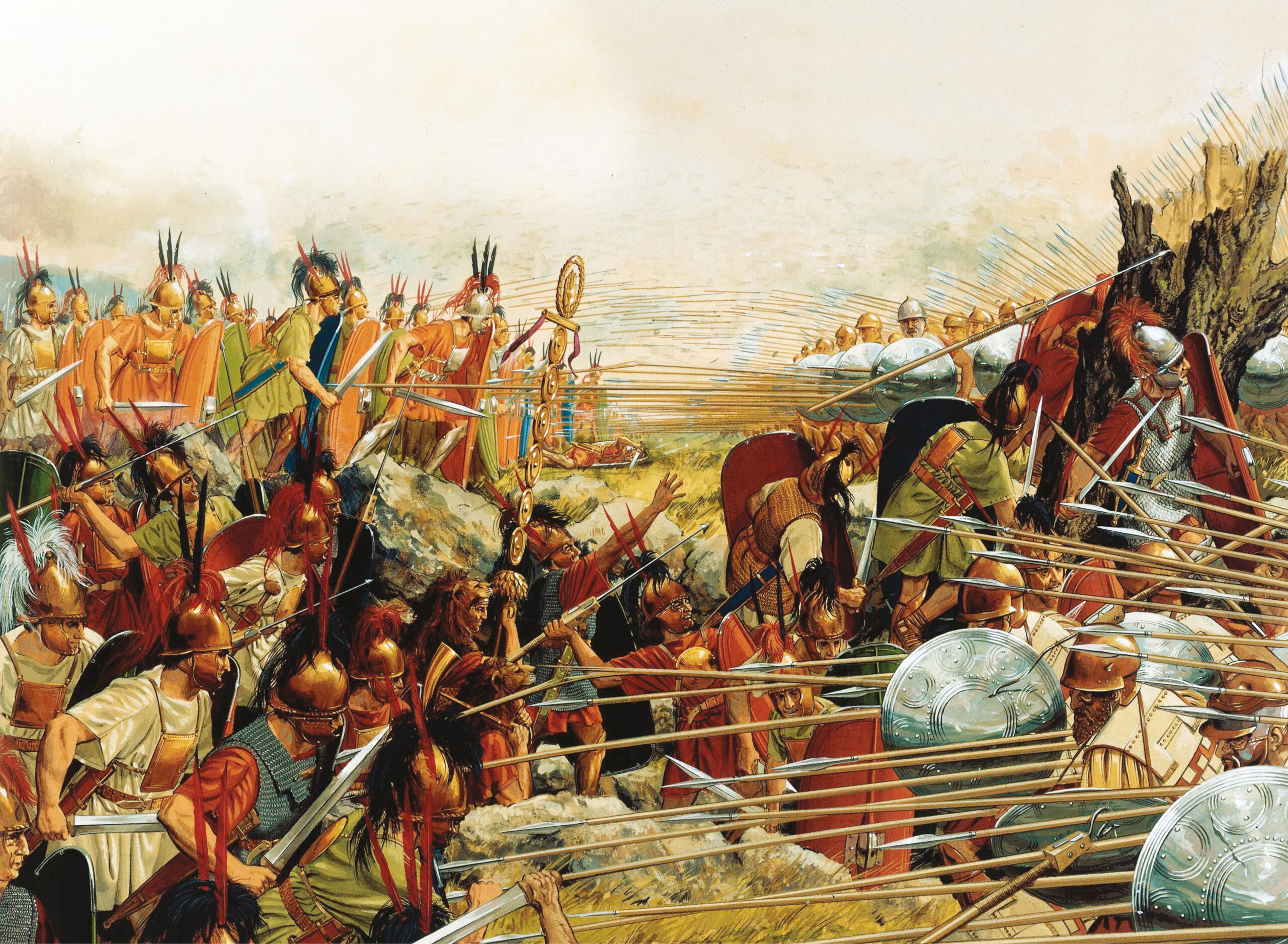
The Battle of Cynoscephalae: Rome Meets the Macedonian Phalanx
The Battle of Cynoscephalae, fought in 197 BC on the rolling hills of Thessaly in northern Greece, was one of those rare moments when military systems, political ambitions, and personal leadership all collided in a single morning.
On one side stood the long-dominant Macedonian phalanx, heir to Alexander the Great; on the other, the upstart Roman legion, fresh from victory over Carthage. The clash ended Macedon’s bid to dominate Greece, revealed the strengths and weaknesses of both styles of warfare, and nudged Rome toward becoming the decisive power in the eastern Mediterranean.
Background: Rome Looks East, Macedon Stands Guard
At the start of the 2nd century BC, the Mediterranean world was still shaped by the legacy of Alexander the Great. His empire had fractured into several Hellenistic kingdoms: Macedon in Greece and the Balkans, the Seleucid Empire stretching across much of the Near East, and the Ptolemaic Kingdom in Egypt, among others. Macedon, ruled by King Philip V, remained a formidable military power and a traditional guardian of Greek affairs.
Rome, meanwhile, had just survived and ultimately triumphed in the Second Punic War against Hannibal and Carthage (218–201 BC). Emerging from that struggle more confident and with a veteran military machine, Roman leaders began to see threats and opportunities beyond Italy. The eastern Mediterranean, long a battleground of Greek kings, now attracted Roman attention.
Philip V had already alarmed the Romans once by aligning with Hannibal early in the Second Punic War, though little had come of that alliance. Afterward, Philip looked to expand his influence in the Aegean and Asia Minor. His ambitions brought him into conflict with a group of Greek states and smaller kingdoms, including the Aetolian League, Pergamum, and Rhodes. These powers, worried about Macedonian pressure on their autonomy and trade, turned to Rome for help.
For Roman decision-makers, this request for aid came at a time when their view of security was changing. Instead of waiting for dangers to grow, many senators believed it was safer to confront potential rivals early, on foreign soil if possible. Philip, with a strong army and a record of opportunistic alliances, looked like the kind of monarch who might one day threaten Roman interests.
The result was the Second Macedonian War (200–197 BC). The opening years involved scattered campaigning in Greece, minor battles, and negotiations. Progress was slow until a young Roman aristocrat, Titus Quinctius Flamininus, was elected consul and given command against Philip. Energetic, ambitious, and politically astute, Flamininus would be the man who steered Rome to a decisive victory at Cynoscephalae.

Commanders and Armies: Flamininus vs Philip V
Philip V of Macedon: Defender of a Fading Tradition
Philip V was in many ways a typical Hellenistic monarch: personally brave, politically calculating, and committed to preserving his kingdom’s prestige. He inherited a powerful military tradition descended from Philip II and Alexander the Great. That tradition centered on the Macedonian phalanx, a dense formation of infantry armed with extraordinarily long pikes called sarisas. In battle, a well-handled phalanx could form a bristling wall of spear points that was almost impossible to penetrate from the front.
Yet Philip’s situation in 197 BC was not ideal. Years of campaigning had strained Macedon’s finances and manpower. His army still included a hardened core of phalangites, but many troops were less experienced or hastily gathered. He also faced the problem that every Hellenistic king did: coordinating a mixture of heavy infantry, light infantry, cavalry, and allied contingents with different interests and levels of loyalty.
Titus Quinctius Flamininus: Rome’s Young Liberator
Titus Quinctius Flamininus was in his early thirties when he took command in Greece—young by Roman standards for such responsibility. He was ambitious, cultivated friendships with Greek elites, and was eager to present himself not as a conqueror but as a liberator of Greece from Macedonian dominance. This image would matter greatly after the war, but it also shaped his strategy during it.
The army Flamininus commanded reflected the experience Rome had gained in generations of warfare on the Italian peninsula and against Carthage. Its basic unit was the legionary infantryman, armed with a large shield, short stabbing sword (gladius), and heavy javelins (pila). Roman infantry fought in maniples—small, flexible units that could move independently, adjust formation, and exploit gaps in an enemy’s line.
Alongside the legions fought Rome’s Italian allies, often equipped in similar fashion, and a variety of Greek and local auxiliary troops. Flamininus also had some cavalry and light infantry, though Roman cavalry was not usually the main striking arm in this period. Instead, Roman strength lay in steady infantry, organizational resilience, and the ability to adapt quickly as a battle unfolded.

Phalanx vs Legion: Two Ways of Making War
The confrontation at Cynoscephalae is often remembered as a duel between two military systems: the Macedonian phalanx and the Roman legion. In reality, both armies were more complex than that, but the contrast is useful.
The phalanx worked best on level ground, advancing as a single, massive front. Its long pikes gave it reach and momentum; it was like a moving fortress of spear points. However, this power came at a cost. Turning, wheeling, or climbing broken ground tended to disrupt its cohesion. Gaps between units could easily develop, and once an enemy slipped into those gaps or reached the phalanx’s flanks, the heavily armed phalangites, encumbered by their long weapons and small shields, were vulnerable.
The Roman legion, organized into maniples, traded some of the phalanx’s frontal power for flexibility. Roman infantry could fight in looser order, rearrange their lines, and send units forward or backward as needed. This made them better suited to broken terrain and to exploiting local opportunities. Cynoscephalae would become a textbook demonstration of the strengths and weaknesses of both systems.
Terrain and the Course of the Battle
The “Dogs’ Heads” of Thessaly
The name Cynoscephalae means “Dogs’ Heads” and refers to a chain of low, uneven hills in Thessaly. This was not the smooth, open plain ideal for a phalanx. Instead, the ground was broken, with ridges and folds that made it difficult to maintain a perfectly straight battle line. Mist and poor visibility reportedly added to the confusion on the day of combat.
In the campaign leading up to the battle, both armies maneuvered for advantage in central Greece. Eventually, they found themselves near Cynoscephalae, each seeking to locate and probe the other’s position. The initial clashes did not involve full battle lines, but rather advance guards and reconnaissance forces groping for information in the hills and fog.

Skirmishes Turn into Full Battle
As dawn broke, neither side had planned a major engagement, but small-scale encounters escalated quickly. Light troops and advance parties from both armies bumped into each other on the ridges, and reinforcements were fed into the fight piecemeal. Communication was imperfect; commanders often relied on incomplete or outdated reports from the front.
Philip initially hesitated to commit his full army, wary of the terrain and the unclear situation. However, his forward elements became engaged, and the pressure to support them grew. On one wing, Macedonian forces gained the upper hand in the skirmishing, convincing Philip that conditions might favor a general attack after all. He ordered the phalanx forward on that side, trying to seize the high ground and roll up the Roman line.
Flamininus, for his part, reacted dynamically to the unfolding situation. When he saw parts of his line under pressure, he brought up more cohorts of legionaries to stabilize the defense. At the same time, he looked for chances to exploit Macedonian overextension, particularly in areas where the ground hindered the tight formation of the phalanx.
The Phalanx Advances – and Stalls
On Philip’s right wing, the Macedonian phalanx advanced in imposing fashion. Where the ground allowed them to keep formation, they drove back the Roman troops in front of them. The sheer reach of the sarisas meant that Romans could be struck before they were close enough to use their swords. In these sectors, the traditional strengths of the phalanx shone through, and for a time it seemed that Philip might win the day by weight of armor and discipline.
However, the line was uneven. On Philip’s left wing and in the center, the phalanx was slower to form, delayed by rough ground and confusion. Some units had not fully deployed before pressure from Roman forces began to build. Gaps appeared between Macedonian formations, and not all phalangites were facing forward in a solid wall. The phalanx, so effective when unified, began to reveal its vulnerability when broken into separate parts.

Roman Flexibility Tips the Balance
Flamininus exploited this unevenness with a combination of opportunism and initiative from his subordinates. On the Roman right, where Philip’s phalanx was pressing hardest, he fought a hard, holding action to prevent a collapse. On the other side of the field, however, Roman and allied troops found themselves facing less well-formed Macedonian units over difficult terrain.
Here, the Roman manipular system came into its own. Smaller, more agile units could maneuver around broken ground, surge forward into gaps, and fall back if necessary without disrupting the entire line. At a critical moment, a Roman officer—later celebrated in Roman accounts—took the initiative to lead part of his command around the flank and rear of the Macedonian phalanx that was still pressing ahead.
This move was devastating. The phalanx, with its long pikes pointing forward and its troops packed closely together, could not easily pivot or present a new front to an enemy striking from behind. Romans were now attacking from the flank and rear, where the long sarisas were more hindrance than help.
Panic spread among the Macedonians as the apparent solidity of their formation gave way to chaos. Once the carefully ordered ranks were broken, individual phalangites, burdened by heavy equipment and long weapons, were at a severe disadvantage against the more lightly equipped and sword-armed Romans.
As Roman successes on one wing spread and Macedonian cohesion collapsed, the situation on Philip’s stronger flank deteriorated as well. Soldiers who had been pushing forward successfully now heard rumors of disaster elsewhere along the line. Fear and confusion began to ripple through the ranks. Eventually, the Macedonian army broke. Philip, recognizing the battle was lost, fled the field with some of his cavalry, leaving thousands of his infantry dead or captured.

Results: The End of Macedonian Dominance in Greece
The immediate result of the Battle of Cynoscephalae was a decisive Roman victory and a crushing defeat for Philip V. Macedon’s once-proud phalanx had been beaten not just by courage or numbers, but by a different way of organizing and fighting a battle. Casualties on the Macedonian side were heavy; many of Philip’s best troops were lost. Rome, although not unscathed, emerged with its main forces intact and its reputation for military effectiveness enhanced.
Politically, Flamininus used the victory to recast Rome’s image in Greek eyes. Rather than annexing Macedon outright, Rome imposed a settlement that stripped Philip of his naval power, reduced his territory, demanded a large indemnity, and limited the size of his army. Macedon remained a kingdom, but it was now firmly subordinate to Roman wishes.
Flamininus then staged one of the most famous public declarations in ancient history. At the Isthmian Games in 196 BC, he proclaimed the “freedom of the Greeks”—announcing that many Greek cities would be autonomous and free from Macedonian garrisons. This pronouncement was greeted with wild enthusiasm, and for a brief moment it seemed that Rome had come not as a conqueror, but as a champion of Greek liberty.
In reality, Roman influence would soon weigh heavily on Greek politics. Yet at Cynoscephalae, and in its immediate aftermath, many Greeks saw Rome as the power that had humbled an overbearing king and opened the path for a new balance of forces in the region.
Long-Term Significance: A Turning Point in Mediterranean History
Rome Steps into the Greek World
Cynoscephalae did not make Rome the formal ruler of Greece overnight, but it marked a decisive step in that direction. By defeating Macedon and dictating terms, Rome became the ultimate arbiter of Greek affairs. City-states and leagues now courted Roman favor, appealed to Roman authority in their disputes, and attempted to draw Rome into their rivalries.
This pattern would repeat itself with other Hellenistic powers. Over the following decades, Rome fought further wars in Greece and Asia Minor, against Macedon again and eventually against the Seleucid Empire. Each conflict ended with Rome stronger, its enemies weakened, and its sphere of influence expanded. Cynoscephalae was one of the first major battles to demonstrate that trend clearly.
Legion vs Phalanx: A Lesson in Military Adaptation
Militarily, the battle became famous as evidence of the superiority of the Roman legion over the Macedonian phalanx. Later Roman writers especially liked to frame it this way, celebrating their system’s flexibility and initiative in contrast to what they saw as the rigid, old-fashioned phalanx. While this view may be somewhat simplified, Cynoscephalae does illustrate the problems of relying heavily on a formation that needed perfect order and ideal terrain to shine.
It would be wrong, however, to imagine the phalanx as obsolete in 197 BC. Under good conditions, it remained formidable, and Macedonian troops fought bravely at Cynoscephalae. The crucial difference was that Rome’s system proved more adaptable. Its emphasis on smaller units, local initiative, and the combined use of different troop types allowed Roman commanders to respond more creatively to unexpected developments on the battlefield.
In this sense, the battle offers a broader lesson about military history: no formation or weapon is invincible in all circumstances. Effectiveness depends on terrain, leadership, organization, and the willingness to innovate. At Cynoscephalae, it was Rome that better matched its methods to the environment and the unfolding chaos of war.

A Step Toward Roman Hegemony
In the longer view, Cynoscephalae was one link in the chain that led from a city-state on the Tiber to an empire spanning the Mediterranean. By demonstrating that Rome could defeat one of the great Hellenistic monarchies on its own ground, the battle discouraged potential challengers and encouraged others to seek Roman protection or alliance. It also accustomed Roman leaders to thinking of the Greek East as part of their natural sphere of activity.
Within half a century, Rome would fight two more major wars with Macedon, eventually abolishing the monarchy altogether and turning the region into a Roman province. Farther east, Roman armies would confront and defeat the Seleucid king Antiochus III, extending Roman influence deep into the Near East. The path to these later conquests was paved in part by the reputation for invincibility that Rome gained at battles like Cynoscephalae.
Conclusion: A Morning on the “Dogs’ Heads”
On a misty morning among the “Dogs’ Heads” hills of Thessaly, two military worlds collided. The Macedonian phalanx, symbol of an era when kings and their spear-armed infantry had ruled the battlefields of the eastern Mediterranean, met the Roman legion, product of a republic hardened by years of struggle in Italy and beyond. The outcome was not merely a battlefield upset, but a sign that the balance of power in the Mediterranean was shifting decisively toward Rome.
The Battle of Cynoscephalae showed how terrain, organization, and leadership could overturn expectations. It ended Macedon’s dominance in Greece, elevated Rome as the key power in the Greek world, and provided later generations with a vivid example of how a more flexible system of warfare could outmaneuver a seemingly stronger but less adaptable rival. From that day onward, anyone contemplating resistance to Rome had to reckon with what had happened on those Thessalian hills in 197 BC.
16/04/2026
Leave a Reply