
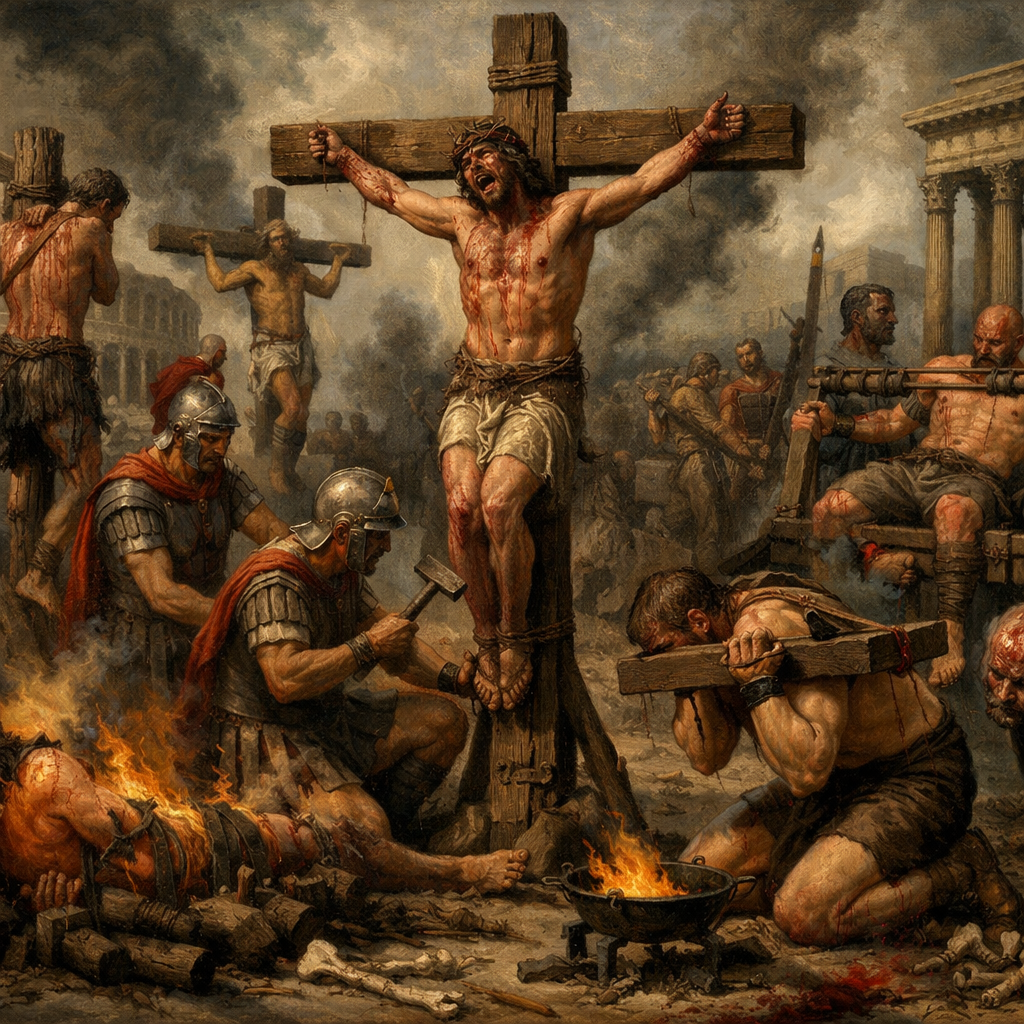
Tortures and Executions in the Roman Empire
The Roman Empire is often remembered for its roads, laws, and monumental architecture—but it was also a society where violence was a public tool of control. Torture and execution were not only punishments; they were instruments of investigation, intimidation, and social order.
This article explores how and why the Romans used torture and executions, who was most at risk, and what these practices reveal about Roman society.
1. Legal Background: Who Could Be Tortured or Executed?
Roman law made sharp distinctions between different social groups:
- Citizens vs. non‑citizens
- Free people vs. enslaved people
- Elite (senators, equestrians) vs. lower classes
These distinctions heavily influenced exposure to torture and the form of execution used.
1.1 Torture (Quaestio) and the Legal System
In principle, Roman citizens were not supposed to be tortured during legal investigations. Torture (called quaestio per tormenta) was mainly used on:
- Enslaved people, whose testimony was often considered unreliable unless extracted under torture.
- Non‑citizens, who lacked the legal protections of citizenship.
- Low‑status individuals, especially in major criminal cases, including treason or conspiracy.
However, in times of crisis—civil wars, alleged plots against the emperor, or periods of political repression—even citizens and elites could be tortured, especially on charges of maiestas (treason).
1.2 Executions as Public Spectacle and Deterrent
Executions in Rome were rarely private affairs. They were often:
- Public – carried out in front of crowds to send a message.
- Symbolic – the method of execution often reflected the crime or the status of the condemned.
- Entertaining (for some) – especially in the context of the games, where punishment blended with spectacle.
Roman authorities believed public brutality could maintain order by instilling fear.

2. Common Forms of Execution
Not all executions were equally brutal. Status often determined how someone died.
2.1 Beheading
Beheading (decollatio) was considered one of the “more merciful” forms of execution and was often reserved for:
- Roman citizens
- Higher‑status individuals
It was relatively quick and lacked the prolonged suffering associated with other methods. When emperors or senators were condemned, they might be forced to commit suicide or executed by the sword as a “dignified” death compared to other penalties.
2.2 Crucifixion
Crucifixion was one of the harshest and most notorious Roman methods of execution.
- Typically reserved for:
- Enslaved people
- Non‑citizens
- Bandits, rebels, and dangerous criminals
- The condemned was usually:
- Beaten or scourged beforehand
- Affixed to a cross or stake and left to die slowly from exhaustion, exposure, and asphyxiation
Crucifixion was deliberately public and humiliating. Victims were displayed along roads or outside city walls as warnings. It was less about killing efficiently and more about sending a powerful message of domination.
2.3 Damnatio ad Bestias (Condemnation to the Beasts)
In damnatio ad bestias, the condemned were killed by wild animals in the arena.
- Often applied to:
- Enslaved people
- Criminals
- Prisoners of war
- Members of despised groups (for instance, some early Christians)
- Took place in:
- Amphitheatres, during public games
- Mixed in with other entertainments: gladiatorial combat, theatrical shows
These executions were staged performances. The condemned might be:
- Exposed unarmed to animals such as lions, leopards, or bears
- Forced to participate in myth-themed re‑enactments that ended with their deaths
The goal was not only to punish but to entertain crowds and reinforce the power of the state.

2.4 Burning, Drowning, and Other Methods
Other forms of execution included:
- Burning (crematio) – sometimes used for arsonists or in religiously charged cases.
- Drowning – occasionally employed, for example, putting the condemned in a sack with animals (the poena cullei in some forms of parricide punishment).
- Throwing from a height – such as being hurled from the Tarpeian Rock in early Rome, especially for traitors.
These methods often carried symbolic weight, linking the manner of death to the nature of the crime.
3. Torture as a Tool of Power
While most modern legal systems officially reject torture, for the Romans it was a recognized—though debated—part of the justice system.
3.1 Purposes of Torture
Torture was used to:
- Extract confessions
- Identify accomplices in a crime or conspiracy
- Confirm or refute testimony, especially from enslaved people
- Enforce discipline on estates, in households, and in the military
Roman writers were aware that torture did not necessarily produce truth—people might say anything to stop the pain—but it remained embedded in legal practice.
3.2 Who Was Vulnerable?
The people most exposed to torture were:
- Enslaved men, women, and children
- Roman law saw them as property and denied them legal personhood.
- Their bodies were available to owners and authorities for punishment and coercion.
- Provincials and non‑citizens
- Especially in frontier regions or rebellious provinces, where governors wielded wide powers.
- Suspected traitors
- During political purges, even senators could face torture if accused of plotting against the emperor.
In practice, torture reinforced social hierarchies: the powerful seldom suffered it; the powerless often did.

4. Executions in the Arena
The Roman arena is one of the most visible stages for state violence.
4.1 The Games and Punishment
Public games (ludi and munera) combined:
- Gladiatorial combat
- Animal hunts (venationes)
- Public executions
Executions were often scheduled at midday, when many spectators went to eat or rest, suggesting that even some Romans found them less appealing than gladiatorial contests. Yet they remained part of the expected program.
4.2 Symbolism and Social Messages
Executions in the arena sent clear messages:
- The emperor as provider and punisher – controlling life and death.
- The boundaries of belonging – criminals, rebels, and “enemies of the gods” were killed as outsiders.
- Affirmation of Roman order – the spectacle demonstrated the power of the law and of the state.
The line between punishment and entertainment was blurred: the crowd could cheer punishments, mock the condemned, or sometimes show pity—though mercy remained at the discretion of the authorities.
5. Religion, Politics, and Death
Torture and execution also had religious and political dimensions.
5.1 Executions as Ritual Acts
Some punishments carried religious meaning:
- Vows and rituals could be linked to warfare and punishment of enemies.
- Desecration of the body—denying burial, for example—could mark someone as accursed.
These measures reinforced a sense that the condemned were not just criminals, but people who had violated the gods’ or the community’s norms.
5.2 Political Repression
Emperors and political rivals used execution to eliminate opponents:
- Accusations of treason, impiety, or plotting against the emperor were common tools.
- Prominent senators or equestrians could be:
- Forced to commit suicide
- Executed publicly
- Have their property confiscated
The boundary between legal punishment and political violence was often thin, especially under emperors known for suspicion or cruelty.

6. Changing Attitudes Over Time
The Roman world lasted for centuries, and practices evolved.
6.1 From Republic to Empire
- Republican Rome: Emphasis on traditional penalties, with citizens somewhat more protected (at least in theory).
- Imperial Rome: Emperors gained wider authority to punish, and spectacular forms of execution in the arena became more common.
6.2 The Influence of New Religions
As Christianity spread, attitudes toward punishment and the body slowly began to shift:
- Some early Christian writers criticized the brutality of games and executions.
- Christians themselves sometimes suffered harsh punishments, including crucifixion and condemnation to beasts, becoming martyrs in the process.
By Late Antiquity, official attitudes toward gladiatorial games and certain forms of punishment began to soften, though harsh penalties did not disappear overnight.
7. What Torture and Execution Reveal About Roman Society
The Roman use of torture and execution tells us several key things about their society:
- Violence was public and political
Punishment was meant to be seen. It communicated the power of the state, the emperor, and the legal order. - Status mattered enormously
Citizenship, freedom, and social rank shaped how a person might be tortured or killed—or whether they could be at all. - Law and cruelty coexisted
The Romans prized law, order, and procedure, yet accepted brutality as a normal part of justice and entertainment. - The body was a canvas for power
Punishment was inscribed on the body: crucifixion, branding, mutilation, and public exposure turned individuals into symbols.
Conclusion
Tortures and executions in the Roman Empire were not random acts of cruelty; they were deeply embedded in the legal system, social hierarchy, and political culture. They reveal a world in which public suffering was used to enforce order, define who belonged, and display the might of Rome.
Studying these practices helps us understand both the achievements and the darker side of Roman civilization—and invites reflection on how modern societies use, justify, and display punishment today.
Leave a Reply