
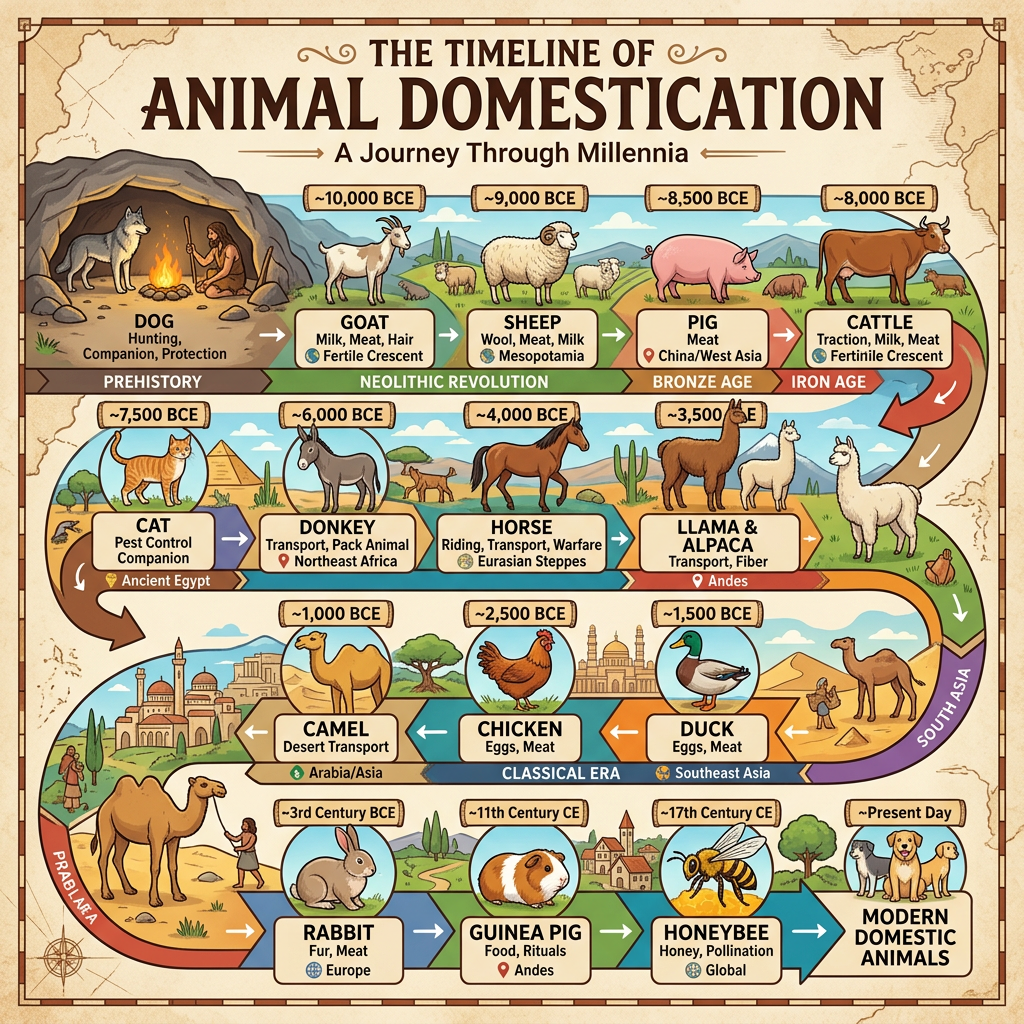
Domestication of animals is one of the most important turning points in human history. It transformed small, mobile bands of hunter-gatherers into settled farming communities, then into complex civilizations. Over thousands of years, humans have selectively bred animals for food, labor, companionship, protection, and even prestige. The story of domestication is not only about control over nature, but also about a deep, evolving relationship between humans and other species.
Origins: The First Steps Toward Domestication
Archaeological evidence suggests that the earliest domestication events took place at the end of the last Ice Age, roughly 12,000–10,000 BCE. As climates warmed and wild resources changed, some human groups began to experiment with managing plants and animals more directly.
- Dogs are generally considered the first domesticated animal. Genetic and archaeological studies point to domestication from wolves at least 15,000 years ago, and possibly much earlier. Dogs provided early humans with help in hunting, protection, and companionship, and in return received food, shelter, and care.
- Sheep and goats followed, domesticated in the Fertile Crescent region (modern-day Middle East) around 9,000–8,000 BCE. They provided meat, milk, hides, and wool, supporting the shift to settled agricultural life.
- Cattle and pigs were domesticated somewhat later, also in the Near East and independently in other regions (for example, pigs in East Asia). These animals increased the productivity of early farms and provided draft power, fertilizer, and reliable sources of protein.
These early domestications were not sudden events. They likely began when humans started tolerating certain animals near their settlements, feeding them scraps, or penning them temporarily. Over generations, calmer, less fearful individuals were favored, leading to genetic and behavioral changes.

Ancient Civilizations and the Expansion of Domestication
As farming spread and civilizations emerged in Mesopotamia, Egypt, the Indus Valley, China, and beyond, the variety and roles of domestic animals expanded as well.
- In Mesopotamia and Egypt, cattle, sheep, goats, and donkeys were essential. Donkeys, domesticated in northeastern Africa, became crucial pack animals for trade across deserts.
- In the Indus Valley and later in South Asia, zebu cattle, water buffalo, and chickens were domesticated or adopted, supporting irrigated agriculture and rice cultivation.
- In China, pigs and chickens were particularly important, along with water buffalo for plowing wet fields.
In the Americas, independent centers of domestication emerged:
- Llamas and alpacas in the Andes were used for wool, meat, and as pack animals.
- Guinea pigs served as a food source in Andean cultures.
- Turkeys were domesticated in Mesoamerica and became important in ritual and diet.
During this era, animals were not merely economic assets. They acquired religious and symbolic significance. Bulls were associated with strength and fertility, cats in Egypt were revered and protected, and many societies integrated animals into myths, rituals, and art.

The Medieval World: Work, War, and Status
In medieval Europe, the Middle East, and parts of Asia, domesticated animals were woven into almost every aspect of daily life.
- Horses became central to warfare, agriculture, and transportation. Selective breeding produced warhorses capable of carrying armored knights and later, lighter breeds for speed and endurance.
- Oxen were the primary draft animals for plowing and hauling in many agrarian societies, valued for their strength and patience.
- Pigeons were used for communication, carrying messages over long distances in times of both war and peace.
- Falcons and hunting dogs became symbols of nobility and status, as falconry and hunting were elite pastimes.
Domestication in this period was strongly shaped by social structures. The rights to keep certain animals, graze them on specific lands, or hunt wild game were often restricted to particular classes. Animals became markers of wealth and power, from the number of cattle owned to the quality of one’s horses.
Early Modern Era: Exploration, Exchange, and Breeding
The early modern era (roughly 15th–18th centuries) brought about vast changes through global exploration, colonization, and the Columbian Exchange.
- European explorers and colonists introduced horses, cattle, sheep, and pigs to the Americas, dramatically reshaping landscapes and indigenous ways of life.
- In return, New World species like turkeys and some varieties of beans and maize became integrated into Old World farming systems.
At the same time, more systematic approaches to selective breeding emerged:
- Farmers began to keep records and deliberately mate animals for desired traits: higher milk yield, faster growth, stronger bodies, or particular coat colors.
- In Europe, this led to the development of recognizable breeds of cattle, sheep, horses, and dogs, each adapted to specific tasks and environments.
Domestication was now driven not only by survival but by efficiency, profit, and specialization.

The Industrial Revolution and the Age of Science
The 19th and early 20th centuries transformed the relationship between humans and domestic animals again, this time through industrialization and scientific progress.
- Mechanization reduced reliance on animal labor in many areas. Tractors and machines began to replace horses and oxen in the fields.
- Urbanization separated many people from direct contact with farm animals. Meat, milk, and eggs were increasingly produced in rural or specialized regions and transported to growing cities.
- Advances in genetics and veterinary science allowed for more precise control over breeding, disease prevention, and nutrition. This led to rapid increases in productivity but also raised new ethical questions about intensive animal use.
The rise of pet keeping as a widespread practice, especially in urban middle-class households, also changed. Cats and dogs, once primarily functional animals (rat catchers, guards, or herders), became companions, family members, and subjects of emotional investment.
Modern Domestication: Industry, Ethics, and Conservation
In the contemporary era, domestication is shaped by large-scale industry, global trade, and growing ethical awareness.
On one hand, industrial agriculture has intensified:
- Many farm animals are raised in high-density systems designed for maximum productivity.
- Selective breeding has produced animals that grow faster or produce more milk and eggs than ever before, sometimes at the cost of their long-term health and welfare.
On the other hand, there is a strong and growing movement toward:
- Animal welfare and rights, questioning the moral status of animals and advocating for better living conditions, reduced suffering, and in some cases, an end to certain uses.
- Sustainable and traditional farming, which aims to balance productivity with environmental and ethical concerns.
- Conservation breeding programs, where domestication techniques and genetic management are used to preserve endangered species or reintroduce them into the wild.
Domestication has also extended into new areas:
- Laboratory animals (such as mice, rats, and zebrafish) are bred for research, raising complex ethical debates.
- Exotic pets and designer breeds highlight how aesthetic preferences and trends can drive breeding, sometimes with serious health consequences for the animals.

A Shared History and an Uncertain Future
From the first wolves that lingered near human campsites to the highly specialized breeds of today, domestication is a story of mutual adaptation. Humans shaped animals, but animals also shaped human societies—our diets, work, cultures, and even our identities.
Today, the legacy of domestication confronts us with challenging questions:
- How do we balance human needs with the welfare of animals?
- What responsibilities do we have toward species we have shaped so profoundly?
- How can we ensure that future domestication and breeding practices are both ethical and sustainable?
As our scientific understanding deepens and our moral perspectives evolve, the relationship between humans and domestic animals continues to change. Yet one thing remains constant: their presence has been, and will likely remain, central to the human story.
Leave a Reply