
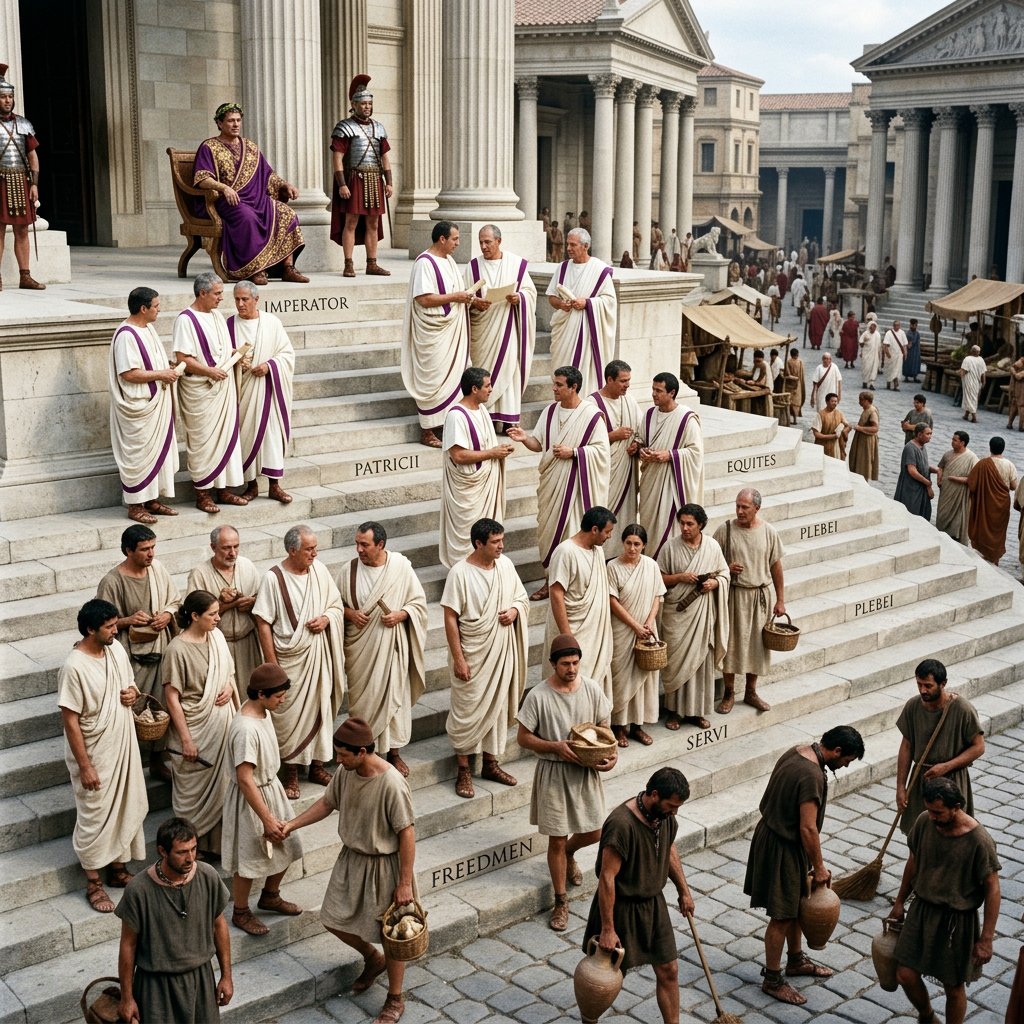
The Roman Empire was not just a vast territory ruled by emperors and legions; it was also a complex and highly stratified society. Status, birth, wealth, gender, and citizenship all shaped a person’s place in the Roman world. Understanding this social structure helps explain how Rome maintained control over so many different peoples for so long.
1. Orders and Legal Status
Roman society was organized around two key ideas: legal status and social order.
Legal status divided people broadly into:
- Citizens (cives), who enjoyed legal rights and protections.
- Non‑citizens, including provincial subjects and foreigners.
- Slaves (servi), legally property, with no personal rights.
- Freedpersons (liberti/libertae), former slaves who had been manumitted.
Alongside legal status were the orders (ordines), which classified citizens by rank and prestige:
- The senatorial order (ordo senatorius)
- The equestrian order (ordo equester)
- The broad mass of ordinary citizens, sometimes called the plebs.
In the later empire, a sharper distinction developed between the honestiores (the “more honorable,” essentially upper classes) and the humiliores (the lower orders). Laws and punishments increasingly reflected this divide.

2. The Senatorial Elite
At the very top stood the senatorial aristocracy. Senators were the political and social elite of the empire.
Key features of the senatorial class:
- Required a very high property qualification.
- Held the highest offices in government: consuls, praetors, provincial governors, and various priesthoods.
- Often owned vast estates in Italy and the provinces, worked by tenants and slaves.
- Enjoyed great prestige, legal privileges, and direct access to imperial power.
Although emperors held ultimate authority, they relied on senatorial families for administration, diplomacy, and military command. Marriage alliances between senatorial families and the imperial family were common, tying the elite closely to the regime.
3. The Equestrian Order
Below the senators were the equites (the equestrian order). Originally tied to cavalry service in the Republic, under the Empire they formed a wealthy and influential middle elite.
Characteristics of the equestrian class:
- Considerable wealth, but below senatorial level.
- Often served as:
- Imperial administrators and financial officials,
- Commanders of auxiliary military units,
- Governors of smaller provinces,
- Managers of imperial estates and enterprises.
- Active in commerce, banking, tax farming, and large‑scale trade more than senators, who were theoretically discouraged from certain commercial activities.
Equestrians were crucial for running the imperial bureaucracy. Many emperors promoted loyal equestrians, blurring the old boundaries between the elite orders over time.

4. Local Elites and Municipal Councils
Outside Rome itself, city life was dominated by local aristocracies. These local elites sat on city councils (curiae) as decurions.
Their role included:
- Managing local finances, public works, and religious festivals.
- Sponsoring buildings, games, and distributions of food (a practice known as euergetism) to gain honor and influence.
- Serving as intermediaries between their communities and imperial officials.
For many provincial nobles, gaining Roman citizenship and perhaps eventually entering the equestrian or even senatorial orders represented a path of upward mobility. Rome integrated conquered elites rather than simply replacing them.
5. The Urban Masses: The Plebs
Beneath the elite orders were the urban masses, particularly in Rome and other major cities.
This group included:
- Small tradesmen and shopkeepers
- Artisans and craftsmen
- Laborers and porters
- Freedpersons engaged in various occupations
- The urban poor and unemployed
In Rome, the plebs urbana were numerous and politically sensitive. Emperors and magistrates provided:
- Free or subsidized grain distributions,
- Public games and spectacles (chariot races, gladiatorial combats),
- Occasional cash handouts.
These measures, often summed up as “bread and circuses”, helped maintain urban stability and loyalty to the imperial regime.

6. The Rural Population and Peasantry
The majority of people in the Roman Empire lived in the countryside. This rural population provided the agricultural surplus that sustained the cities and the army.
They consisted mainly of:
- Small free peasants, farming their own plots or paying rent to landlords.
- Tenant farmers on large estates, sometimes bound by long‑term obligations.
- Agricultural laborers, including many slaves.
Over time, especially in the later empire, a growing number of rural workers found themselves tied to the land. Legal restrictions made it harder for them to move or change status, foreshadowing the later system of medieval serfdom.
7. Slavery in Roman Society
Slavery was fundamental to Roman social and economic life. Slaves came from many sources: war captives, piracy, the slave trade, and sometimes the children of enslaved people.
Roles of slaves:
- Domestic servants in urban households.
- Agricultural workers on estates.
- Skilled laborers, clerks, teachers, doctors, and secretaries.
- Miners and workers in state projects, often in harsh conditions.
Despite their lack of legal personhood, slaves were deeply embedded in Roman households and daily life. Importantly, manumission (the freeing of slaves) was common. Freedpersons became liberti, gaining limited citizenship and often continuing to work for their former owners as clients or employees.
8. Freedpersons: Between Slavery and Freeborn Status
Freedpersons occupied an intermediate level in Roman society.
They:
- Gained legal personhood and, in many cases, Roman citizenship.
- Still had obligations to their former masters, now their patroni.
- Often worked in trade, crafts, and business, sometimes becoming very wealthy.
- Could not normally hold the highest public offices, but their children, born free, had access to full citizen privileges.
In Rome and other cities, freedpersons formed a significant and dynamic segment of the population, especially in commercial and artisanal sectors.

9. Family, Gender, and the Paterfamilias
Roman social structure was also organized around the family, dominated by the paterfamilias—the male head of household.
Key aspects:
- The paterfamilias had legal authority over wife, children, and household slaves, especially in early Roman law.
- Marriage was often arranged to strengthen alliances and secure property or political advantages.
- Women had limited formal political rights but could inherit property, manage households, and, in some cases, exercise real influence behind the scenes.
Elite women, in particular, could be powerful figures in family and court politics. Across all classes, women played crucial roles in economic life, religion, and family networks, even if the law and literature rarely gave them equal status.
10. Social Mobility and Change
Despite the rigid appearance of Roman social hierarchies, there were paths for social mobility:
- Military service could lead to citizenship and land grants, especially for non‑citizen soldiers in the auxiliary forces.
- Economic success in trade or business could elevate a family into the equestrian order over generations.
- Granting of citizenship to individuals, communities, and eventually large groups of provincials expanded the citizen body.
- Manumitted slaves improved their status and, more significantly, the status of their descendants.
Over the centuries, the Roman social system evolved. By the 3rd and 4th centuries CE, differences between Italians and provincials diminished, while the divide between rich and poor and between honestiores and humiliores became more important. New elites, often provincial and sometimes military, rose to prominence in imperial politics.

11. Ideology and Social Control
Roman elites justified and maintained this hierarchy through:
- Law, which encoded different penalties and rights for different classes.
- Religion, presenting the existing order as part of the will of the gods.
- Patronage, where powerful patrons offered protection and benefits to clients in exchange for loyalty and service.
- Public display, including monuments, triumphs, and spectacles that reinforced the prestige of the emperor and elites.
This combination of material benefits, religious sanction, and social expectations helped bind together a diverse empire under a shared political and cultural framework.
Conclusion
The social structure of the Roman Empire was layered and intricate, balancing rigid hierarchies with limited opportunities for mobility. From emperors and senators at the top to slaves and rural laborers at the bottom, every group had a recognized place—and a role to play in sustaining imperial power.
By integrating local elites, expanding citizenship, and maintaining a powerful ideology of order and hierarchy, Rome created a social system that, despite tensions and inequalities, endured for centuries and left a lasting mark on later European societies.
Leave a Reply