
Introduction
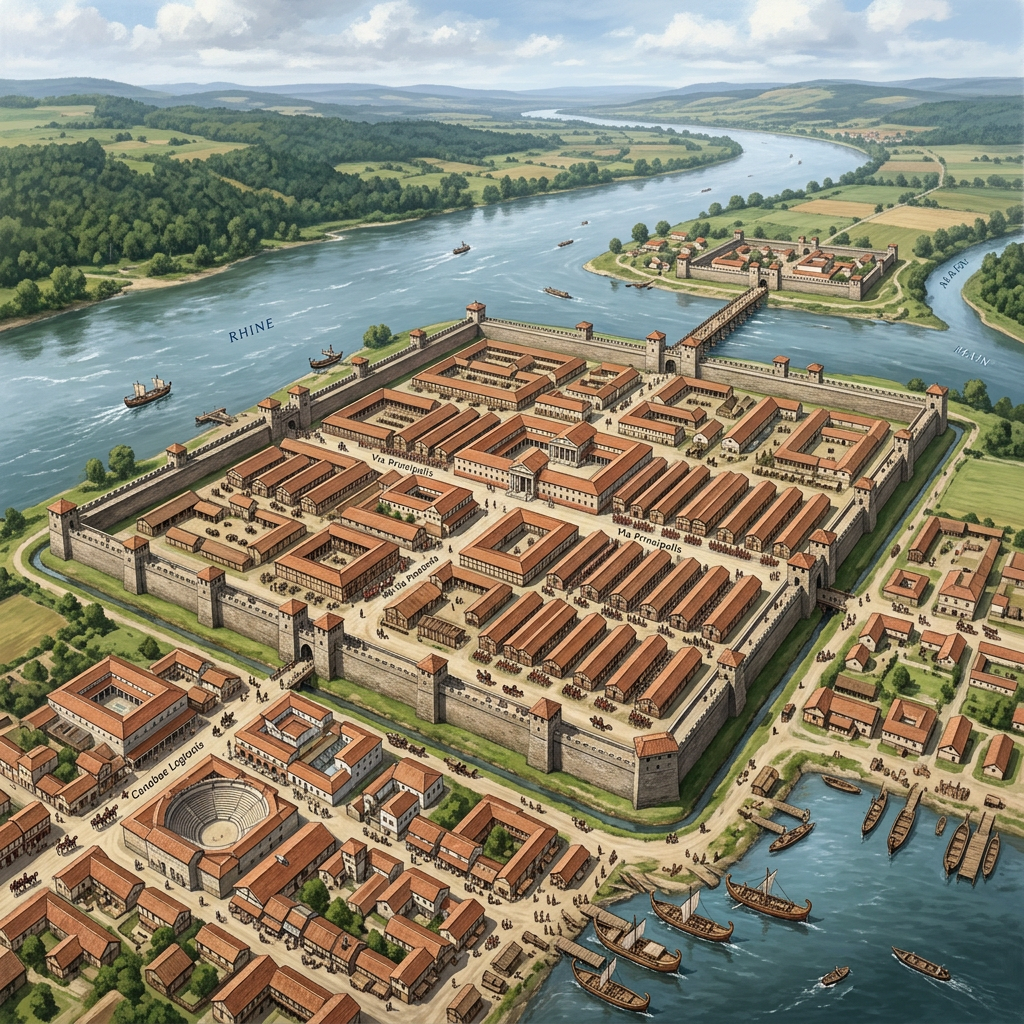
Mogontiacum, the precursor of modern Mainz in Germany, was one of the most important military strongholds on the Roman frontier. Situated on a promontory above the confluence of the Rhine and Main rivers, it served for centuries as a major legionary fortress, command center, and later as the capital of the province Germania Superior. More than just a town with troops, Mogontiacum was fundamentally a fortress-city: its layout, economy, and political role all revolved around the Roman army.
Strategic Location on the Rhine Frontier
The choice of Mogontiacum’s site was primarily strategic:
- River junction: The meeting of the Rhine and Main rivers created a natural transport hub. Troops, supplies, and information could move quickly along the waterways into the interior of the Roman Empire or up toward the frontier.
- Elevated position: The main legionary base occupied a plateau overlooking the rivers, providing excellent visibility and a defensible position.
- Border zone: The Rhine formed a long stretch of the Roman limes, the frontier boundary with the Germanic tribes. From Mogontiacum, the Romans could monitor crossings, launch campaigns east of the Rhine, and coordinate frontier defenses.
Because of this, Mogontiacum became not just one fortress among many, but a key node in the entire defensive system of the northwestern provinces.
Foundation and Early Military Role
Mogontiacum was founded in the late 1st century BC:
- Around 13/12 BC, the Roman general Drusus, stepson of Emperor Augustus, established a military base on the site as he prepared campaigns into Germania.
- Early on, multiple legions were stationed there. Over time, units such as Legio XIV Gemina, Legio XVI Gallica, Legio XXII Primigenia, and Legio I Adiutrix are all attested in or near Mogontiacum at different periods.
From this stronghold:
- Drusus launched expeditions across the Rhine.
- Later commanders used the fortress as a staging point for operations deep into Germanic territories.
- It remained an operational base for offensives and punitive expeditions, as well as a defensive anchor when Rome abandoned more ambitious conquest plans east of the Rhine after the disaster in the Teutoburg Forest (AD 9).
The fortress thus crystallized Rome’s shift from offensive expansion to a more stable, fortified frontier policy.

Fortress Architecture and Layout
Like other legionary fortresses, Mogontiacum followed standard Roman military principles, though adapted to the local terrain.
1. Overall Plan
- The fortress was roughly rectangular, oriented to make best use of the plateau above the river.
- It was enclosed by earthen ramparts and wooden palisades in the earliest phase, later replaced or strengthened with stone walls and towers.
- Four main gates (one in each wall) connected the interior with roads leading to other forts, supply zones, and river landings.
2. Defensive Works
- Ramparts and walls: Early turf-and-timber constructions evolved into masonry fortifications, with towers placed at intervals for archers and artillery (ballistae).
- Ditches (fossae): One or more V-shaped ditches ran in front of the walls, making direct assault more difficult.
- Gate complexes: The gates were heavily fortified, featuring flanking towers and gatehouses that allowed control of entry and exit.
3. Internal Structures
Inside the walls, the arrangement was highly organized and standardized:
- Principia (headquarters): The central building housed the aedes (shrine of the legion’s standards), administrative offices, parade courtyard, and meeting rooms. This was the symbolic and administrative heart of the fortress.
- Praetorium: The residence of the commanding officer (legatus) was a large, villa-like complex, reflecting both his rank and the semi-permanent nature of the fortress.
- Barracks: Long, narrow buildings housed the legionaries. Each contubernium (squad of about 8 men) had its own small set of rooms. Stables, workshops, and storage areas adjoined many of these.
- Granaries (horrea): Elevated floors and ventilation slots protected grain stores from damp and pests, ensuring reliable provisions.
- Workshops (fabricae): Inside the fortress were facilities for weapon repair, metalworking, carpentry, and leather-working, supporting ongoing military needs.
- Baths: Military baths provided hygiene and social space for soldiers; such complexes were often substantial, including hot and cold rooms, exercise areas, and sometimes attached latrines.
Over time, as the frontier stabilized and the fortress became semi-permanent, construction shifted more and more from wood to stone, underlining the long-term strategic commitment to the site.

Garrison and Daily Life
As a legionary fortress, Mogontiacum typically hosted one or two legions at certain periods, meaning 5,000–10,000 legionaries, not counting auxiliary troops and support personnel.
Composition of the Garrison
- Legionaries: Heavy infantry citizens, the core of the Roman army.
- Auxilia: Non-citizen troops providing cavalry, archers, and specialist units.
- Support Staff: Engineers, medical personnel, clerks, craftsmen, and administrative officials.
Daily Routine
Life in the fortress was highly regimented:
- Training: Regular drills, weapons practice, and formation exercises kept the troops ready for combat.
- Construction and maintenance: Soldiers were frequently employed in building or repairing fortifications, roads, bridges, and civilian infrastructure.
- Patrols and river control: Troops monitored crossings, patrolled the rivers, and maintained watchtowers and signal posts.
Civilian Life Around the Fortress
Outside the walls grew a substantial canabae legionis (settlement of civilians linked to the legion):
- Families of soldiers (even though formal marriage was technically restricted until later imperial reforms).
- Traders, craftsmen, tavern-keepers, and service providers who depended on the purchasing power of the troops.
- Over time, this settlement blended into a proper town, giving Mogontiacum a dual character: fortress and urban center.
Mogontiacum in Crises and Reforms
Mogontiacum’s importance meant it often featured in times of crisis and imperial change.
- Year of the Four Emperors (AD 69): Troops on the Rhine, including those at Mogontiacum, played roles in the shifting allegiances between claimants to the throne (Galba, Otho, Vitellius, and Vespasian). The political weight of such a large fortress garrison was considerable.
- Revolts and invasions: The fortress helped suppress uprisings and repel incursions by tribes across the Rhine. Its presence deterred large-scale incursions but also made it a primary target during major raids.
- 3rd–4th centuries: As pressure from Germanic peoples increased and internal instability grew, Mogontiacum’s fortifications were strengthened again. The defensive role became even more central as Rome moved from high imperial expansion to late antique survival.
Despite these efforts, Mogontiacum, like much of the frontier, was increasingly vulnerable. Major raids, particularly around AD 260 and later during the invasions of the early 5th century, caused destruction and disruption.

From Fortress to Late Antique and Medieval City
Even as the Western Roman Empire declined, the site of Mogontiacum retained importance:
- The military fortress gradually transformed into a fortified late antique town.
- Christianity took root, with bishops of Mogontiacum (Mainz) appearing in sources, and ecclesiastical buildings eventually occupying parts of the former military area.
- The continuity of occupation meant that Roman walls, street grids, and building foundations influenced the later medieval city plan of Mainz.
Thus, while the legions departed and formal Roman administration collapsed, the role of Mogontiacum as a fortified, strategic settlement did not disappear. It evolved into one of the key cities of the early medieval Rhineland.
Legacy of Mogontiacum as a Roman Fortress
As a Roman fortress, Mogontiacum illustrates several key aspects of Roman power on the frontier:
- Military permanence: Transition from temporary marching camps to massive stone fortresses anchored Roman control for centuries.
- Integration of military and urban life: The fortress generated a thriving civilian community whose fortunes rose and fell with the garrison.
- Strategic adaptability: Over time, the fortress adjusted to new threats, new army structures, and new political realities.
Modern Mainz still preserves traces of this military past—fragments of walls, archaeological remains of legionary buildings, and the urban layout influenced by the Roman stronghold that once stood at the heart of the Rhine frontier.
Leave a Reply