
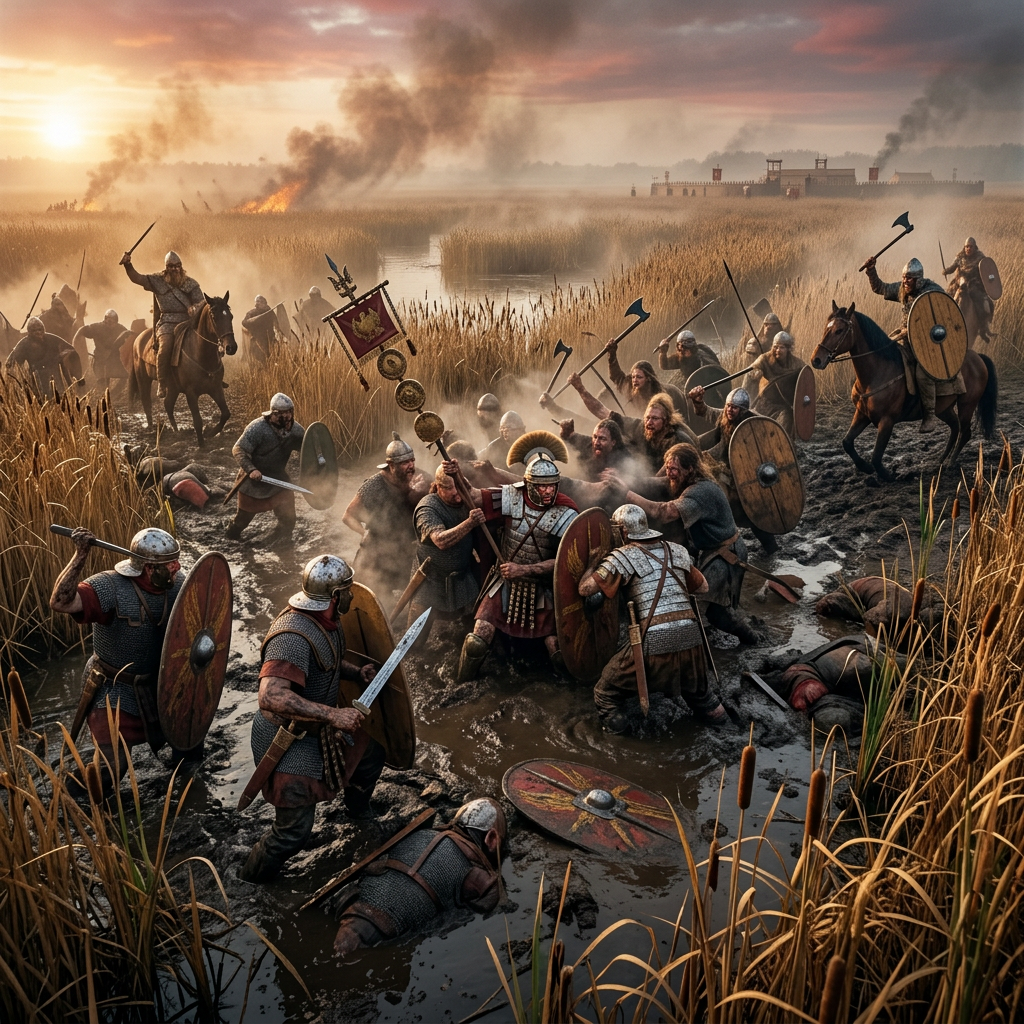
The Battle of Abritus (AD 251): Disaster in the Marshes and the Unraveling of Roman Power In the summer of AD 251, in the marshy lowlands of the province of Moesia Inferior, a Roman emperor and his heir disappeared in the confusion of battle. The defeat of Emperor Decius and his son Herennius Etruscus at the hands of a Gothic army near Abritus was not merely a bloody episode on a distant frontier.
Contemporary and later observers treated it as a revealing moment in the progressive unravelling of imperial authority: it exposed the fragility of Roman military power, undermined long-standing assumptions about Roman invincibility, and crystallized many of the wider dynamics that modern scholarship groups under the label “Crisis of the Third Century.”
1. Context: Empire under Strain
The Crisis of the Third Century
The Battle of Abritus occurred during what historians commonly term the Crisis of the Third Century (c. AD 235–284), a period characterized by accelerated turnover of emperors, recurrent civil wars, multiple frontier invasions, epidemic disease, and monetary dislocation. The relatively stable imperial order associated with the adoptive emperors of the second century gave way to a system in which political legitimacy depended heavily on the support of the army, especially the frontier troops. As is clear from narrative and epigraphic evidence, military units along the Rhine and Danube increasingly made and unmade emperors, while external enemies observed and exploited the resulting volatility.
Within this wider picture, the Danubian frontier—stretching along the middle and lower Danube—was strategically decisive. It controlled access to the Balkan hinterland and, ultimately, to the core territories of the eastern empire. The provinces of Moesia and Thrace, located between the Danube and the Aegean, thus became recurrent theatres of conflict, as new tribal confederations, among them the Goths, probed Roman defenses and, at times, penetrated deeply into provincial interiors.
The Gothic Confederations
By the mid-third century, the term “Goths” in Roman sources referred not to a single unified polity but to a constellation of groups north of the lower Danube, broadly in the regions of modern Ukraine, Romania, and Moldova. Archaeological and textual evidence suggests a mix of settled and semi-mobile communities organized under regional leaders. Drawn by the wealth of the Roman provinces and occasionally courted as allies or clients by competing Roman factions, these groups crossed the frontier to raid, besieging cities and carrying off plunder and captives.
Gothic incursions along the lower Danube coincided with other large-scale pressures. In the East, the Sasanian monarchy mounted aggressive campaigns against Roman strongholds, while along the Rhine various Germanic and other groups tested the frontier. The empire’s resources and political cohesion were insufficient to meet all threats simultaneously. It was in this congested strategic environment that Decius came to power and confronted the Gothic king Cniva.
Emperor Decius, Herennius Etruscus, and Roman Ideology
Gaius Messius Quintus Decius, more commonly known simply as Decius, was a senator and experienced military commander from the Danubian region. In AD 249, amid discontent with the emperor Philip the Arab, he was proclaimed emperor by his troops and defeated Philip in battle. To secure dynastic continuity, he raised his elder son Herennius Etruscus first to the rank of Caesar and subsequently to co-emperor (Augustus), signalling the intention to establish a new ruling house firmly rooted in the Danubian military aristocracy.
Decius carefully styled himself as a restorer of traditional Roman religious and civic values. His famous edict requiring sacrifices to the gods—attested in papyri and inscriptions from various provinces—was framed as a test of loyalty and piety, aligning imperial authority with the ancestral mos maiorum and the ideal of civic virtue often expressed in Roman moralizing literature and in collections of Latin proverbs. Yet this ideological program unfolded under acute pressure. The Gothic incursions along the Danube rapidly became the defining challenge of his short reign, culminating in the campaign that ended at Abritus.

2. Forces and Strategic Setting
Campaigns Leading up to the Battle
Our evidence for the campaigns that preceded Abritus is fragmentary, but a broad outline can be reconstructed by combining late narrative sources with archaeological indications. Around AD 249–250, a Gothic force under the leadership of a king named Cniva crossed the Danube, probably along its lower stretches. Moving south into Moesia and Thrace, they attacked key strongholds and communication nodes.
Decius marched north with a field army to contain the incursion. Initial encounters appear to have gone badly for the Romans. A Roman force was defeated near Beroe (modern Stara Zagora in Bulgaria), obliging Decius to regroup and reconsider his operational plan. Cniva then pushed into Thrace and besieged important urban centers, above all Philippopolis (modern Plovdiv). After a protracted siege, the city fell; as later authors remark, large numbers of prisoners and substantial supplies were taken, significantly enhancing the bargaining power and logistical base of the Gothic host.
With Philippopolis lost and his prestige at stake, Decius could not simply permit the Gothic army to retire unmolested across the Danube with its booty and captives. He therefore attempted to intercept Cniva’s withdrawal route back toward the frontier. The stage was set for a decisive engagement somewhere in the low-lying terrain of Moesia Inferior, in the vicinity of the town known to Roman administrators as Abritus.
The Geography of Moesia and Thrace
Moesia and Thrace formed a strategic corridor between the Danube frontier and the interior of the Balkans. The region combined rugged mountain ranges and forested hills with broad river valleys and marshy lowlands. Control of roads, river crossings, and mountain passes was essential for the movement of armies and for the maintenance of supply lines. As attested by the distribution of forts and road stations, Roman military planners sought to integrate these varied landscapes into a coherent defensive system.
The area around Abritus—commonly identified with a fortified site near modern Razgrad in northeastern Bulgaria—lay in gently undulating terrain intersected by streams and wetlands. Although not dramatic, the presence of marshes and waterlogged ground could impede movement, disrupt formations, and create conditions favorable to ambush. For a Roman field army trained to fight in ordered lines on comparatively firm ground, such an environment posed significant risks if not carefully reconnoitred and controlled.
Cniva, Gothic Forces, and Roman Troops
The Gothic leader Cniva emerges from the literary record as a determined and adaptable commander. He succeeded in leading his followers deep into imperial territory, sustaining cohesion over an extended campaign, and twice defeating Roman field forces. Although the Gothic contingents lacked the standardized equipment and heavy infantry traditions associated with the Roman legions, they were highly mobile, accustomed to raiding, and adept at operating in broken or difficult terrain.
On the Roman side, Decius’s army likely comprised elements of Danubian legions, auxiliary cohorts, and locally raised levies. Modern scholarship generally agrees that, by the mid-third century, such forces remained formidable but were affected by problems of recruitment, training, and supply. The need to respond to multiple crises simultaneously meant that units were sometimes understrength or rapidly redeployed from other sectors, complicating coordination and undermining cohesion when operating in challenging landscapes like those around Abritus.

3. The Course of the Battle
An Elusive Battlefield
Despite the battle’s importance, its precise location remains debated. Ancient writers agree only that the fighting occurred “near Abritus” in Moesia Inferior, a description too vague to fix the site. Modern archaeological work has identified the Roman town of Abritus with a fortified complex near present-day Razgrad, and several scholars place the battlefield in the surrounding lowlands, but no consensus has emerged.
Nevertheless, the general character of the terrain can be inferred. The sources emphasize the presence of marshes, streams, and uneven ground. They also stress that the Romans were lured or drawn into unfavorable conditions—most plausibly wetlands or boggy areas where heavy armor and equipment became liabilities, formations disintegrated, and visibility was reduced. Rather than a set-piece clash on an open plain, Decius’s army appears to have become embroiled in a battle dictated by the landscape and by the enemy’s choice of ground.
Pursuit and Encirclement
Several late accounts suggest that Cniva employed a form of tactical feigned retreat or withdrawal. According to this tradition, the Goths pulled back into marshy terrain, perhaps giving the impression of flight, while arranging part of their forces in concealed or protected positions. The Romans, eager to secure a decisive victory and to recover the plundered wealth and captives of the Balkan cities, pressed the pursuit with insufficient caution.
Once segments of the Roman army were committed to the difficult ground, the Goths launched a counterattack. More lightly equipped fighters were able to move through the marshes with greater agility, while archers and javelin-throwers harassed dense clusters of Roman infantry who could neither advance nor withdraw effectively. In place of the regular, mutually supporting lines envisaged in Roman tactical doctrine, the imperial troops fought in fragmented groups, exposed to local encirclement and unable to exploit their usual advantages in discipline and close-order combat.
Roman Tactical Constraints
Roman armies in the mid-third century continued to rely primarily on heavy infantry and formal battle formations, even as their institutional framework was under strain. At Abritus, Decius’s force probably included a core of seasoned legionaries alongside hastily assembled auxiliaries and local levies. Maintaining order during an advance through unstable, waterlogged ground would have tested even an experienced command structure.
In such conditions, shields and armor became encumbrances rather than assets. Soldiers risked losing their footing, becoming isolated from their standards and officers, or being drawn into deeper patches of marsh. Commanders faced severe difficulties in observing and directing the battle across obstructed, uneven terrain. The shock effect of a Roman charge—dependent on a continuous shield line and coordinated movement—could not be properly delivered. Instead, units were fed into the fighting piecemeal and were vulnerable to sudden Gothic counterblows, while the psychological impact of an unfamiliar and treacherous landscape eroded morale.
The Death of Decius and Herennius Etruscus
Within this chaotic context, both the emperor and his son lost their lives. The sources differ in detail, but they concur that Herennius Etruscus fell early in the engagement. Later tradition preserves an anecdote in which Decius reportedly reacts with stoic indifference, declaring that the loss of one soldier is insignificant to the state. While this saying is doubtless shaped by moralizing topoi about imperial self-sacrifice and virtus, it reveals how Roman authors retrospectively framed the event in terms of exemplary behavior.
Decius himself died shortly afterward, either cut down in close combat or, as one version has it, swallowed by the marshes when his horse stumbled. The claim that his body was never recovered underlines the perceived ignominy of an emperor vanishing in a swamp rather than falling conspicuously on an open battlefield. Whatever the precise circumstances, the simultaneous deaths of emperor and heir fatally disrupted the chain of command. The remaining Roman troops, leaderless and trapped in hostile terrain, broke into rout and suffered heavy losses.

4. Tactics, Adaptation, and Military Culture
The outcome at Abritus illustrates broader tactical and cultural tensions within mid-third-century Roman warfare. On one side stood a military system still oriented toward heavy infantry, close-order formations, and battles fought on ground chosen to suit Roman strengths. On the other side were opponents who relied on mobility, flexible groupings, and intimate familiarity with broken or marginal terrain. The marshes near Abritus magnified these differences, turning Roman virtues—discipline, heavy armor, rigid formations—into vulnerabilities when misapplied.
Modern analyses often emphasize that Roman forces were capable of adaptation; the later third century witnessed significant reforms in cavalry, fortification patterns, and frontier deployments. Yet Abritus reveals the costs of lagging tactical adjustment in the face of changing adversaries and environments. The battle thus serves as a case study in how military institutions, shaped by long-standing traditions and doctrines, can struggle to accommodate new conditions until prompted by severe defeats.
5. Consequences and Significance
Blow to Roman Prestige and Policy
The immediate consequence of Abritus was a profound blow to Roman prestige. The death of an emperor in battle against external enemies was not unparalleled, but the circumstances of Decius’s end—defeated in the region he knew best, in confused fighting against “barbarians” in marshy ground—became emblematic of the erosion of Roman dominance along the Danube. Contemporary and later authors treat the episode as a turning point in perceptions of Roman vulnerability.
For the Goths and other groups beyond the frontier, Abritus demonstrated that a determined confederation could not only raid Roman provinces but also annihilate a field army and kill an emperor. This precedent resonated in subsequent decades, as frontier peoples recognized that the empire could be coerced as well as plundered. For provincial populations, particularly in the Balkans, the defeat reinforced anxieties about the state’s capacity to provide security.
Military and Political Repercussions
In the wake of Decius’s death, Trebonianus Gallus, a senior officer, was proclaimed emperor by the surviving troops. Confronted with a damaged army and continuing threats, Gallus is said to have reached an accommodation with Cniva, permitting the Goths to withdraw with their gains and perhaps agreeing to regular payments to deter further incursions. Even allowing for hostile bias in later accounts, the image of “buying off” the enemy contributed to a sense of imperial weakness.
In the longer term, Abritus formed part of a broader pattern of militarization and regionalization of power. Emperors depended increasingly on the loyalty of frontier armies and on strongmen from the Danubian and Balkan regions, who in turn expected substantial rewards and influence. The distinction between defending the empire and aspiring to the purple blurred, as ambitious commanders recognized both the fragility of central authority and the opportunities opened by frontier crises.
Abritus within the Third-Century Crisis
Abritus did not initiate the Crisis of the Third Century, but it encapsulated many of its core features: unstable leadership, coordinated external pressures, exposed frontiers, and the possibility of sudden, catastrophic defeats when imperial forces were overstretched. In the following decades, new emperors rose and fell, other foreign groups crossed the borders, and breakaway regimes emerged in Gaul and the East, fragmenting political authority even further.
Eventually, under emperors such as Gallienus, Claudius II Gothicus, Aurelian, and later Diocletian, the empire undertook substantial military and administrative reforms. Frontier defenses were restructured, cavalry received greater prominence, and imperial governance was reorganized. Yet the post-crisis empire that took shape in the late third and early fourth centuries differed markedly from the confident, centralized polity of the second century. The balance of power along the frontiers had shifted, and new forms of interaction—ranging from federate agreements to the establishment of successor kingdoms—were beginning to define Rome’s relationship with its neighbors.

6. Sources and Historiographical Debates
Fragmentary and Late Evidence
Despite its dramatic character, the Battle of Abritus is poorly documented. No contemporary historian has left a full narrative of the campaign, and much of our information derives from later authors drawing on lost sources, official epitomes, or oral traditions. As a result, reconstructions of the battle necessarily rest on fragmentary and sometimes contradictory testimony, supplemented by material evidence from forts, urban centers, and rural sites in Moesia and Thrace.
Jordanes, Zosimus, and Imperial Summaries
A central, though late, witness is Jordanes, a sixth-century writer of Gothic background who composed a history of the Goths. He mentions Abritus and highlights the Gothic triumph, but his work is colored by the desire to present a coherent and valorizing narrative of Gothic origins and achievements. Another important account is that of Zosimus, an early sixth-century Byzantine historian whose critical stance toward the Christian empire and reliance on now-lost sources complicate the interpretation of his narrative.
Shorter notices appear in the works of fourth-century compilers such as Aurelius Victor and the authors of imperial biographies, who typically record basic information—names, dates, outcomes—without tactical analysis. These summaries confirm that Decius and Herennius Etruscus died in battle against the Goths near Abritus and that the Roman army suffered a major defeat, but they leave open crucial questions about numbers, precise movements, and decision-making on both sides.
Modern Interpretations and Open Questions
The limitations of the evidence have generated a range of modern interpretations. Scholars disagree about the exact route of Cniva’s campaign, the size and internal composition of both Gothic and Roman forces, and the precise location of the battlefield. Some readings of the sources emphasize possible treachery or incompetence within the Roman command, while others stress environmental factors and the Goths’ skillful exploitation of terrain.
Most recent studies adopt a cautious approach, treating Abritus as a major Roman defeat in difficult marshland, probably involving some form of feigned retreat or ambush, but resisting attempts to reconstruct a detailed, hour-by-hour narrative. In this respect, the battle provides a useful case for thinking about the limits of our knowledge of Roman warfare and about the ways in which late and ideologically inflected sources shape modern understandings of third-century events.

Conclusion: Marshes, Emperors, and the Fragility of Empire
The Battle of Abritus offers a concentrated illustration of the fragility of imperial power in the mid-third century. In principle, Rome commanded vast human and material resources, fielded professional armies, and drew on an elaborate military and ideological tradition. In practice, an emperor and his designated successor could still be drawn into treacherous terrain, outmaneuvered by a resourceful adversary, and lost together with their army in a few hours of confused fighting.
Abritus also marks a moment in the evolving relationship between Rome and the peoples beyond its borders. The Goths appear not as isolated raiders but as organized and adaptive opponents, capable of strategic planning and of exploiting Roman weaknesses. Their victory near Abritus foreshadowed later developments in which federate forces and successor kingdoms would increasingly shape the political map of the former imperial territories.
For modern observers, the battle underscores how quickly great powers can falter when structural strains—political, economic, and military—converge on a single moment of crisis. In the marshes near Abritus, the Roman Empire did not collapse, but the cracks in its armor became starkly visible. Over the following centuries, those fractures widened, contributing to the transformation of the Mediterranean world and the emergence of a late antique and medieval order in which Rome was no longer the uncontested arbiter of its frontiers.

Leave a Reply