
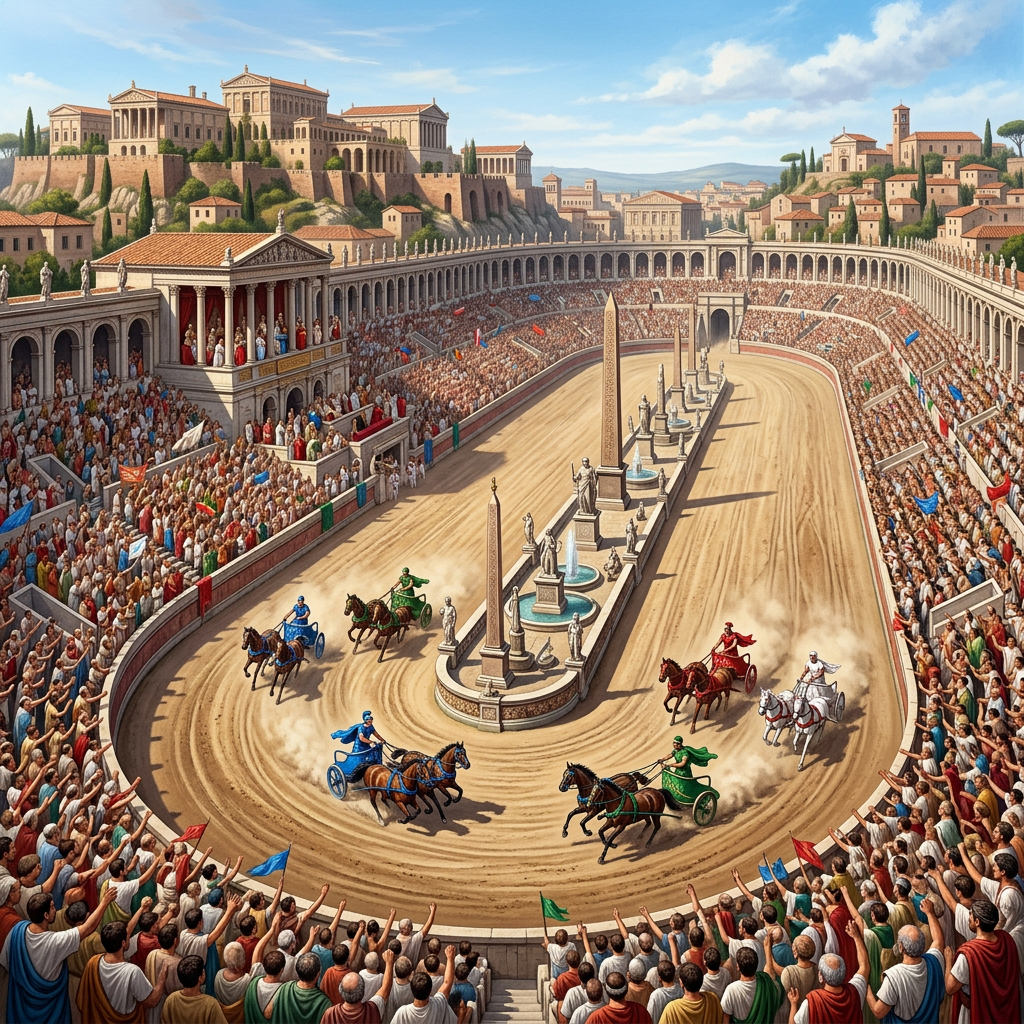
The Circus Maximus was the largest and one of the most important entertainment venues in ancient Rome. Located in the valley between the Palatine and Aventine hills, it hosted chariot races, religious festivals, political displays, and public celebrations for nearly a thousand years.
More than just a racetrack, the Circus Maximus was a stage on which Roman power, religion, and popular culture all came together.
Origins and Early History
The origins of the Circus Maximus reach back to Rome’s earliest days. Tradition holds that Romulus himself organized games in this valley to attract the Sabines, an event tied to the legendary “Rape of the Sabine Women.” While this is myth rather than verified history, it reflects how Romans liked to imagine the Circus as almost as old as the city itself.
By the 6th century BCE, during the time of the Etruscan kings, the site had begun to take on a more defined shape as a venue for public games (ludi). Initially, the circus was little more than a long, open space with wooden seating and temporary structures.
Over time, it grew more elaborate, especially as Rome expanded and leaders sought grander stages for public entertainment.
Architecture and Layout
At its peak, the Circus Maximus was an enormous and highly sophisticated structure.
Size and Capacity
The track was approximately 600 meters long and 140–150 meters wide, making it one of the largest sports venues in the ancient world. Ancient sources claim it could hold up to 250,000 spectators, and while modern estimates vary, it is clear that it could accommodate an immense crowd—perhaps a quarter of Rome’s population at certain periods.
The Track and the Spina
The racing track (arena) was an elongated oval with turning posts (metae) at each end. Down the center ran the spina, a long barrier around which the chariots raced. The spina was decorated with statues, shrines, and obelisks, including an Egyptian obelisk of Pharaoh Ramesses II later brought to Rome by Augustus. These monuments turned the center of the track into a religious and symbolic focal point, not just a practical divider.
Starting Gates and Seating
At one end of the track stood the carceres, the starting gates where chariots lined up before each race. The gates were carefully designed so that when they opened, each team had a roughly equal distance to the first turn, making the start as fair as possible.
The seating (cavea) rose in tiers around the track. The lowest and most prestigious seats were reserved for senators, equestrians, and honored guests. The emperor had his own special viewing box (pulvinar), often associated with a shrine to the gods, emphasizing the link between imperial authority and divine favor.

Chariot Racing: The Heart of the Circus
Chariot racing was the main event at the Circus Maximus and one of the Romans’ favorite forms of entertainment.
Factions and Fans
Races were organized by factions, color‑coded teams that competed against each other: the Reds, Whites, Blues, and Greens were the most famous. These factions had professional charioteers, horses, trainers, and dedicated supporters. Fans followed their colors with intense loyalty, much like modern sports teams.
The Race Itself
Most races involved four‑horse chariots (quadrigae), though two‑horse chariots (bigae) were also used. A typical race consisted of seven laps around the track, marked by counters—often in the form of dolphins or eggs—on the spina to track progress.
Chariot racing was fast, dangerous, and thrilling. The sharp turns around the metae were especially hazardous. Crashes (naufragia) were common and, for spectators, part of the spectacle. Successful charioteers could become hugely famous and wealthy, sometimes more so than many senators.
Religion, Politics, and Power
The Circus Maximus was not just about sport; it was deeply intertwined with Roman religion and politics.
Religious Festivals
Many of the games held at the Circus were part of religious festivals, such as the Ludi Romani, dedicated to Jupiter. The presence of shrines and temples near and within the circus highlighted its sacred dimension. Processions, sacrifices, and rituals often preceded the races, reminding spectators that the spectacle honored the gods as well as entertained the people.
Public Image and Imperial Authority
For Rome’s leaders, sponsoring games at the Circus was a way to display generosity, win favor, and demonstrate power. Emperors and powerful families funded lavish spectacles, including races, theatrical performances, and even staged hunts.
The emperor’s visible presence in the pulvinar, seated above the crowd as races unfolded, was a constant reminder of his central role in Roman public life. In this sense, the Circus Maximus functioned as a vast political theater, reinforcing social hierarchy and imperial authority.

Decline and Transformation
With the spread of Christianity and the gradual shift in cultural values during the late Roman Empire, public enthusiasm for certain traditional pagan festivals waned.
Economic and political instability also made staging large games more difficult.
By the 5th and 6th centuries CE, the frequency and scale of events at the Circus Maximus had diminished significantly. Eventually, the structure fell into disuse.
Over the Middle Ages, its stones were quarried for other construction projects, and the site became farmland and open ground.

The Circus Maximus Today
Today, visitors to Rome can still stand on the site of the Circus Maximus, though most of the ancient superstructure is gone.
The long, oval shape of the valley remains clearly visible, giving a sense of the enormous scale of the original arena.
Archaeological excavations have revealed sections of the seating, foundations, and parts of the track, helping historians understand how the circus was built and used.
The area now serves as a public park and event space, sometimes hosting concerts and gatherings—echoes of its ancient role as a place for mass spectacle.
For modern visitors, the Circus Maximus offers a unique chance to imagine the roar of the crowd, the thunder of hooves, and the dazzling pageantry that once filled this vast space.
Even in its ruined state, it remains a powerful symbol of Rome’s love of spectacle and its ability to build on a monumental scale.
Leave a Reply