
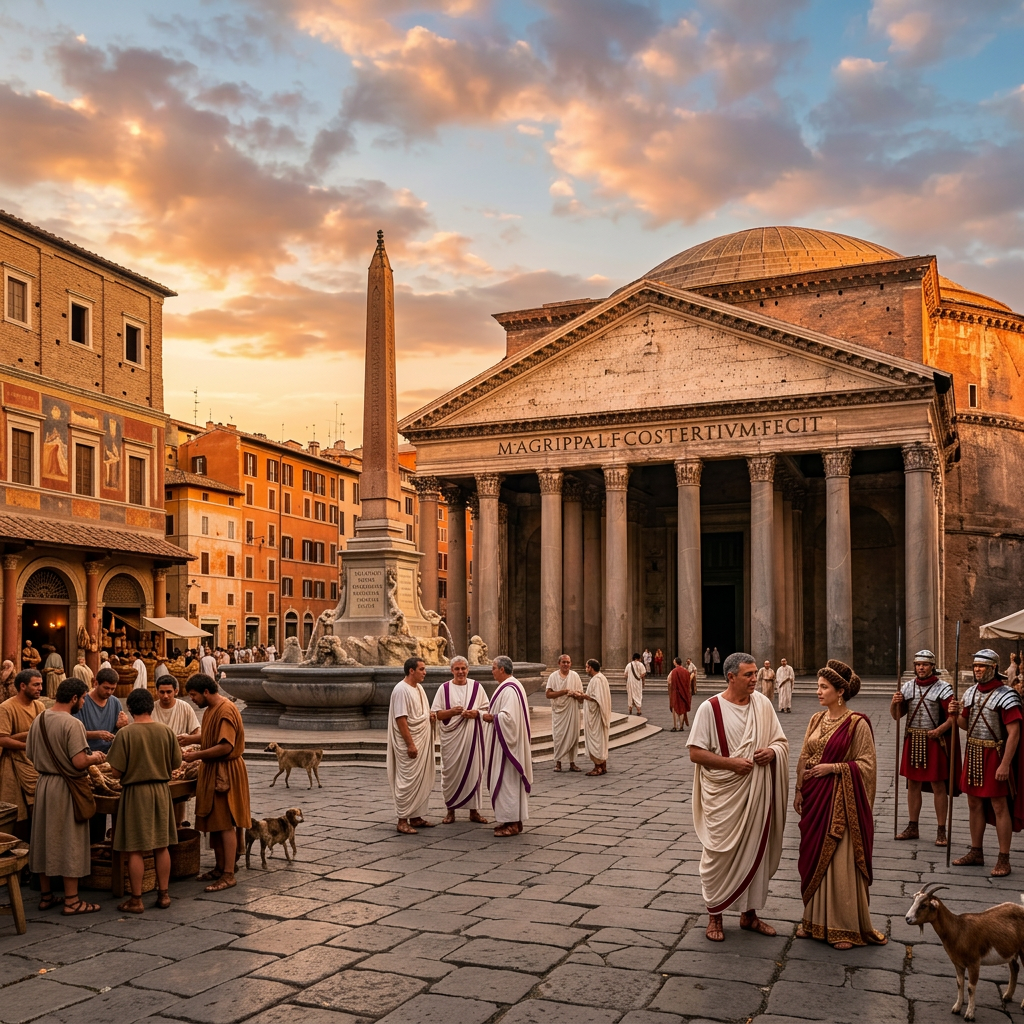
Few buildings in the world bridge the ancient and modern as seamlessly as the Pantheon in Rome. Standing in the bustling Piazza della Rotonda, this extraordinary structure has watched empires rise and fall, religions transform, and cities evolve—yet it remains remarkably intact.
More than just an architectural marvel, the Pantheon is a living link between pagan Rome, Christian Europe, and today’s global visitors.
Origins: From Agrippa to Hadrian
The word “Pantheon” comes from the Greek pan (all) and theoi (gods), reflecting its original function as a temple dedicated to all the gods of ancient Rome. The first Pantheon was commissioned by Marcus Agrippa, a close ally and son-in-law of Emperor Augustus, around 27–25 BCE.
That early building did not survive. It was damaged by fire and likely reconstructed more than once. The structure we see today dates largely from the reign of Emperor Hadrian, who rebuilt the Pantheon between approximately 118 and 125 CE. Interestingly, Hadrian chose to keep Agrippa’s name on the façade. The famous inscription still reads:
M·AGRIPPA·L·F·COS·TERTIVM·FECIT
“Marcus Agrippa, son of Lucius, consul for the third time, built this.”
This deliberate reference to Agrippa tied Hadrian’s Rome to the prestigious Augustan past, even as he created a radically innovative building.
A Revolutionary Architectural Design
The Pantheon’s design is deceptively simple: a portico of traditional columns leading into a vast, domed rotunda. Yet behind that simplicity lies technical genius.
The Portico
From the square, visitors first encounter the imposing portico: sixteen monumental Corinthian columns of Egyptian granite, each weighing many tons. This classical front would have felt familiar to ancient Romans, echoing the style of traditional temples.

The Rotunda and Dome
Passing through the bronze doors (themselves ancient, though likely not original to Hadrian’s time), one enters the rotunda—a perfectly proportioned interior that still inspires awe.
- A perfect sphere: The height from the floor to the oculus (the circular opening at the top of the dome) is equal to the interior diameter of the dome—about 43.3 meters. In theory, a perfect sphere could fit inside the building.
- The largest unreinforced concrete dome: For nearly two thousand years, the Pantheon held the record for the largest unreinforced concrete dome in the world. It remains a staggering achievement of ancient engineering.
Roman builders used ingenious methods to achieve this feat:
- They cast the dome in layers, using heavier materials like travertine at the bottom and lighter ones, including pumice, toward the top.
- The interior coffering (the recessed panels in the ceiling) is both decorative and structural, reducing the weight of the dome without sacrificing strength.
- The walls of the rotunda are extraordinarily thick—up to 6 meters—acting as a massive support system for the dome.
The Oculus: Eye to the Heavens
At the dome’s apex is the oculus, a circular opening almost 9 meters wide. It serves several purposes at once:
- Light source: The oculus is the main source of natural light for the interior. As the sun moves across the sky, a beam of light travels around the dome, creating a dynamic, almost theatrical play of illumination.
- Symbolic meaning: In antiquity, the oculus may have symbolized the eye of the gods or the connection between the earthly realm and the heavens. Today, it invites visitors to look upward and reflect on the passage of time.
- Practical ventilation: The opening also allows air and moisture to escape, helping to regulate the interior climate.
When it rains, water does fall inside, but the slightly convex marble floor and discreet drainage holes manage it efficiently.

Sacred Space Reborn: From Temple to Church
The Pantheon’s exceptional preservation is closely tied to its conversion from a pagan temple into a Christian church. In 609 CE, the Byzantine emperor Phocas gifted the building to Pope Boniface IV, who consecrated it as the Church of Santa Maria ad Martyres (Saint Mary and the Martyrs).
This change of purpose was critical:
- Many other ancient temples were quarried for building materials during the Middle Ages.
- The Pantheon, protected as a functioning church, retained its structure and much of its decoration.
Over time, Christian altars, chapels, and artworks were added, layering new meanings onto the ancient fabric. The building became not only a relic of Rome’s imperial past but also a living place of worship.
Renaissance and Beyond: A Temple of Art and Memory
During the Renaissance, the Pantheon attracted the admiration of artists, architects, and humanists who saw in it the grandeur of classical antiquity.
It influenced generations of designers across Europe and beyond, inspiring iconic buildings from St. Peter’s Basilica in Rome to the U.S. Capitol in Washington, D.C.
The Pantheon also became a burial place for eminent figures, turning it into a kind of national shrine:
- Raphael (Raffaello Sanzio): The celebrated Renaissance painter chose the Pantheon as his final resting place, a testament to his reverence for classical art and architecture.
- Italian kings: Victor Emmanuel II and Umberto I, along with Queen Margherita of Savoy, are also buried here, further cementing the Pantheon’s role in Italy’s modern national identity.
Light, Space, and Experience
What makes the Pantheon so unforgettable is not just its history or engineering, but the experience of standing inside it. Visitors often remark on:
- The harmony of proportions: The combination of circle and square, vertical and horizontal, creates a sense of balance and calm.
- The choreography of light: The moving sunbeam from the oculus animates the space, marking time and season.
- The interplay of materials: Marble floors, columns, and wall revetments, along with the massive brick and concrete structure, showcase Roman mastery of both engineering and aesthetics.
Even when crowded, the building retains an atmosphere of solemnity and wonder.

A Lasting Legacy
Nearly two millennia after its construction, the Pantheon still performs its central functions: it shelters worshippers and visitors, inspires contemplation, and demonstrates what human ingenuity can achieve. It remains:
- A masterpiece of Roman engineering.
- A rare example of an ancient building continuously in use.
- A symbol of continuity through dramatic cultural and religious change.
From its origins as a “temple of all gods” to its life as a Christian church and modern monument, the Pantheon reminds us that great architecture can transcend time, belief, and empire.
It stands at the heart of Rome not as a ruin, but as a living space—one that continues to welcome, astonish, and inspire all who pass beneath its timeless dome.
Leave a Reply