
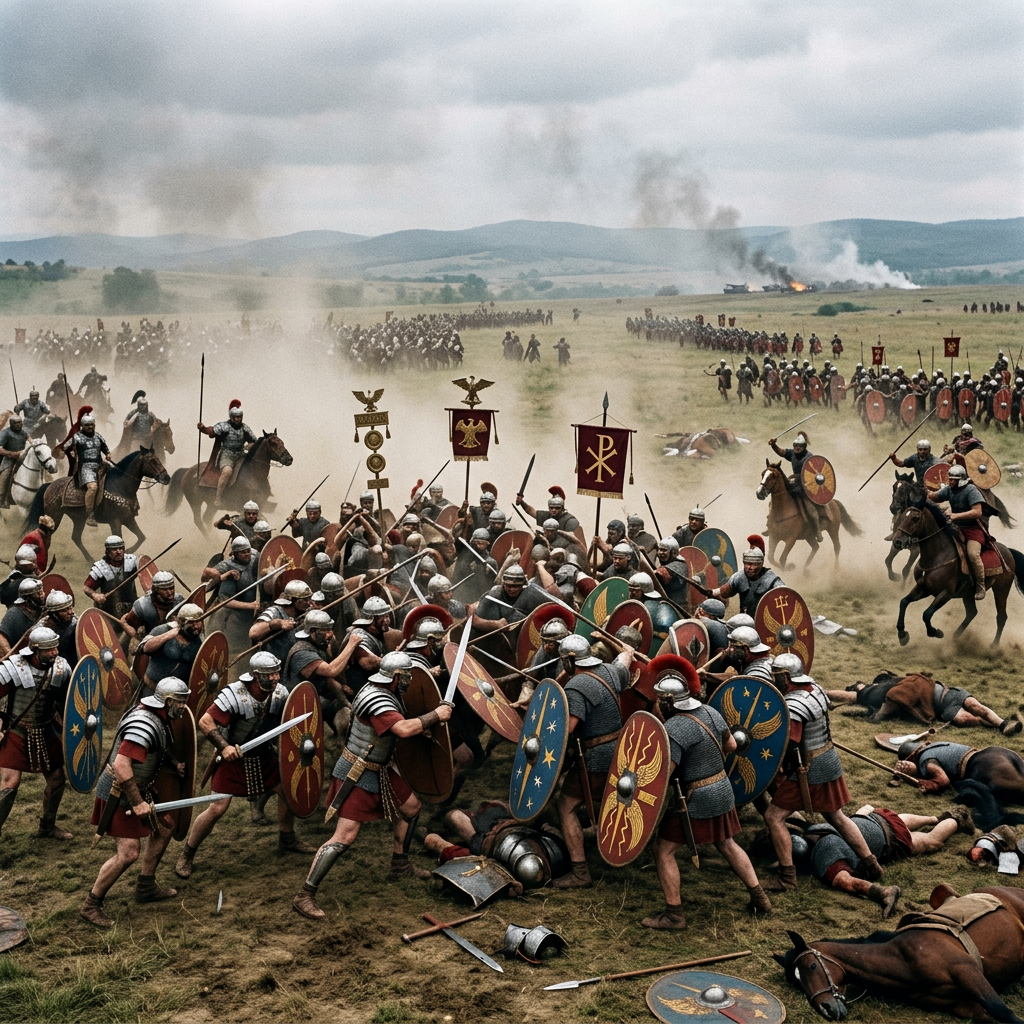
The Battle of Adrianople, fought in 324 CE between the forces of Constantine I and Licinius, was one of the decisive clashes in the final civil war of the Tetrarchic era.
Although it is often overshadowed by the later and more infamous Battle of Adrianople in 378, the 324 battle near the Thracian city of Hadrianopolis (modern Edirne) was crucial in paving the way for Constantine’s sole rule over the Roman Empire and the transformation of its religious and political landscape.
Historical Background
By the early 4th century CE, the Roman Empire had been governed for several decades under variations of the Tetrarchy, a system of rule by two senior emperors (Augusti) and two junior emperors (Caesares).
Designed by Diocletian to bring stability after the Crisis of the Third Century, this system ultimately proved fragile once personalities and ambitions clashed.
Constantine and Licinius emerged as the dominant Augusti after a series of conflicts and shifting alliances:
- Constantine I controlled the western parts of the empire and had already secured his reputation through victories such as the Battle of the Milvian Bridge (312), after which he associated his rule with the Christian God.
- Licinius held power in the eastern provinces and initially cooperated with Constantine, even co‑issuing the Edict of Milan in 313, which granted religious toleration to Christians.
Despite this alliance, tensions mounted. Territorial disputes, rival courts, and ideological differences—Constantine increasingly favoring Christianity, Licinius leaning toward traditional paganism and at times persecuting Christians—pushed the emperors toward open conflict.
By 324, their uneasy peace had broken down, leading to a final civil war for control of the entire Roman Empire.
The Road to Adrianople
The campaign of 324 unfolded primarily in the Balkans and Asia Minor. Constantine launched an offensive into Licinius’s territory, crossing the Danube and advancing through Thrace. Adrianople (Hadrianopolis), a strategically located city in Thrace, sat near key routes linking the Balkans, Asia Minor, and the Aegean.
Both emperors gathered substantial forces:
- Constantine’s Army was seasoned, bolstered by victories in previous civil wars and frontier campaigns. His troops were loyal and increasingly infused with Christian symbols and morale.
- Licinius’s Army drew on the resources of the wealthy eastern provinces, including strong contingents from Asia Minor and the Balkans.
The two forces converged near Adrianople along the Hebrus River (modern Maritsa), setting the stage for a major engagement.

Forces and Commanders
- Constantine I personally commanded his forces and brought with him his eldest son, Crispus, an able commander in his own right. Constantine’s leadership style combined personal bravery with careful tactical planning.
- Licinius, likewise, took the field with a large army and relied on experienced officers, though his forces lacked some of the cohesion and morale found in Constantine’s ranks. Among his supporters was Martinian, later elevated as co‑emperor to help defend the eastern front.
Both sides fielded typical late Roman armies: heavy infantry (the backbone of both forces), cavalry, archers, and specialized auxiliary units. The numbers reported by later sources may be exaggerated, but the battle undeniably represented a major concentration of military power in the eastern Balkans.
The Battle Itself
The battle took place near the Hebrus River, not far from Adrianople. Licinius initially tried to use the river as a natural barrier. His forces occupied strong defensive positions on the opposite bank, confident that Constantine would struggle to force a crossing against an entrenched enemy.
According to later accounts, Constantine employed a combination of engineering and deception to overcome this disadvantage:
- Feigned Maneuvers: Constantine is said to have distracted Licinius by suggesting an attack at one point on the river, drawing attention and forces there.
- Clever River Crossing: Simultaneously, Constantine’s troops constructed or used boats and rafts at another section of the river, enabling a surprise crossing. In some accounts, a contingent of elite troops made it across first, securing a bridgehead.
- Coordinated Assault: Once a substantial portion of Constantine’s army had crossed, he launched a full-scale attack on Licinius’s position.
The clash quickly turned into a decisive engagement:
- Constantine’s infantry pushed hard against Licinius’s line, while his cavalry exploited any weaknesses created by the crossing.
- Licinius’s troops, initially confident behind the river barrier, found themselves under intense pressure once Constantine established a strong foothold on their side.
- Reports speak of heavy casualties on Licinius’s side, with many of his soldiers killed or scattered as the defensive line broke.
The result was a clear victory for Constantine. Licinius’s army suffered severe losses, and the psychological blow was immense. Realizing his position in Thrace was no longer tenable, Licinius retreated eastward.

Aftermath and the Road to Chrysopolis
Following the defeat at Adrianople, Licinius withdrew to Byzantium (the future Constantinople), hoping the city’s formidable position on the Bosporus and its surrounding waterways would help him regroup and block Constantine’s advance.
The campaign, however, was far from over:
- Constantine besieged Byzantium and continued to press his advantage.
- At sea, Crispus led Constantine’s fleet and defeated Licinius’s naval forces in the Hellespont, undermining the eastern emperor’s ability to support Byzantium and shift troops across the straits.
- Eventually, the conflict culminated in the Battle of Chrysopolis later in 324, where Constantine won another decisive victory.
After Chrysopolis, Licinius surrendered. Though Constantine initially spared his life, Licinius was later executed, likely in 325, on charges of plotting rebellion. With his last serious rival eliminated, Constantine became the sole emperor of the Roman world.
Significance of the Battle of Adrianople (324)
The Battle of Adrianople was not merely one engagement among many; it played a critical role in reshaping the political and religious future of the empire.
- Step Toward Unified Rule
Adrianople severely weakened Licinius’s position, making his eventual defeat almost inevitable. Without this victory, Constantine might have faced a longer, riskier conflict in the East. - Shift in the Balance of Power
By breaking Licinius’s main field army in Thrace, Constantine gained the strategic initiative. The road to Byzantium and the eastern provinces lay open, giving him access to the wealth and resources of the East. - Religious and Ideological Implications
Constantine increasingly framed his military successes, including Adrianople, as victories granted by the Christian God. With Licinius’s defeat and eventual death, Constantine’s pro‑Christian policies could be implemented more freely throughout the empire. This paved the way for:- Greater imperial favor toward the Church.
- The convening of the Council of Nicaea in 325, which sought to address theological disputes and strengthen Christian unity.
- A gradual but profound shift in the religious orientation of Roman imperial policy.
- Foundation for Constantinople
The broader 324 campaign, including the victory at Adrianople, enabled Constantine to refound Byzantium as Constantinople. The new capital, inaugurated in 330, symbolized the new order: a unified empire ruled by a Christian emperor, centrally located between Europe and Asia.

Legacy
The Battle of Adrianople (324) is often overshadowed by the later and much better-known battle of the same name in 378, where the Eastern Roman army suffered a devastating defeat against the Goths. Yet the earlier Adrianople was, in its own way, equally transformative.
- It helped end the era of multiple emperors struggling for power and ushered in a period of unified rule under Constantine.
- It laid groundwork for the Christianization of imperial ideology and, over time, of much of the empire itself.
- It set in motion developments that would shape the late Roman and Byzantine worlds, from the founding of Constantinople to the central role of Christian councils and imperial patronage of the Church.
In sum, the Battle of Adrianople in 324 was not just a clash between two Roman armies; it was a turning point in the long process by which the classical pagan Roman Empire evolved into a Christian, late antique state centered on Constantinople and ruled by a single, powerful emperor.
Leave a Reply