
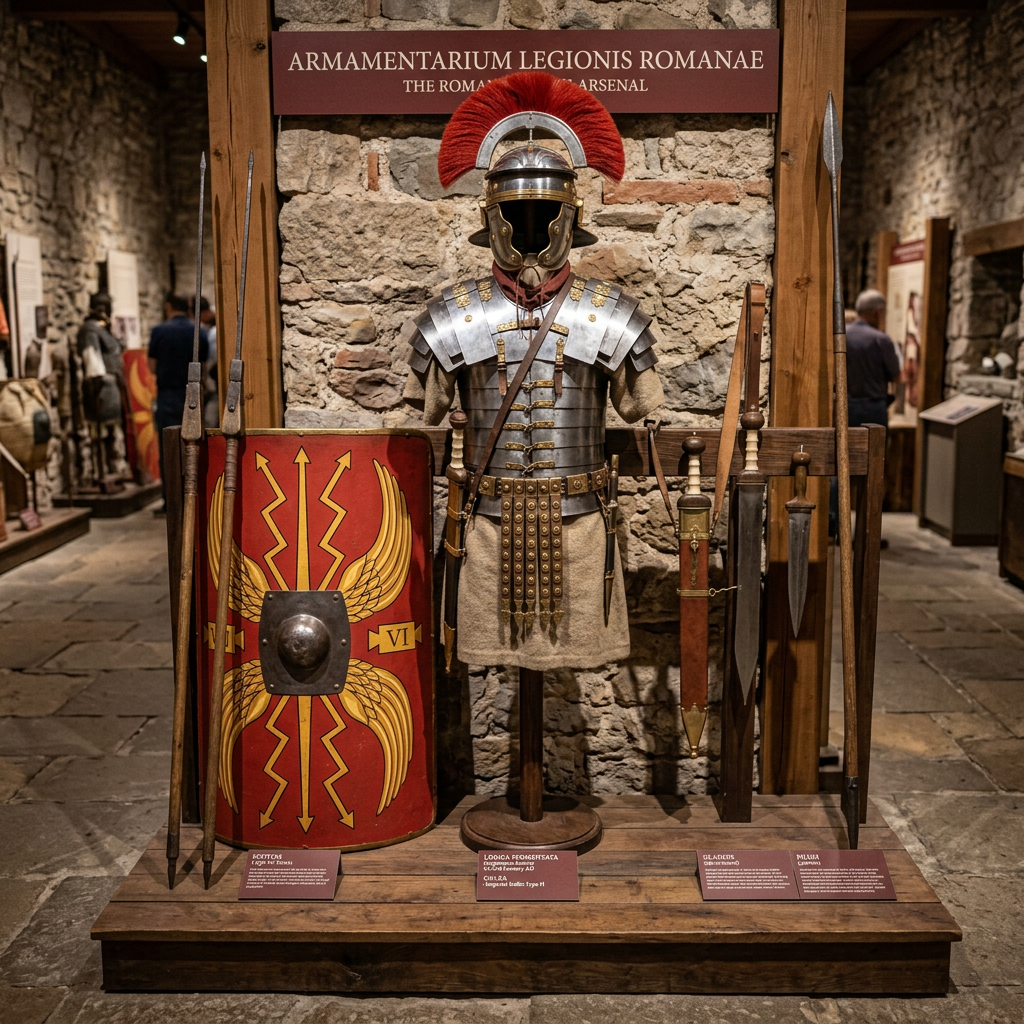
The Roman legionary was one of the most effective and disciplined soldiers of the ancient world. His success on the battlefield depended not only on training and tactics, but also on a carefully developed set of weapons and armor.
Over the centuries, Roman equipment evolved in response to new enemies, terrains, and military needs, but its core purpose remained the same: to protect the soldier while allowing him to fight effectively as part of a tightly coordinated unit.
The Roman Legionary: An Overview
A typical legionary was a citizen soldier who served in the heavy infantry of the Roman army. By the height of the Empire (1st–2nd centuries CE), he was a professional, full‑time soldier equipped at state expense. His gear had to be:
- Durable, to withstand long campaigns;
- Standardized enough to maintain order and cohesion;
- Flexible, so he could march long distances and fight in close formation.
This balance shaped the design of both weapons and armor.
Offensive Weapons
The Gladius: The Roman Short Sword
The gladius was the primary weapon of the Roman legionary. Unlike the long slashing swords of some other cultures, the gladius was a relatively short, double‑edged sword, typically about 60–70 cm in total length.
Key characteristics:
- Design: Straight, double‑edged blade with a sharp point.
- Use: Optimized for thrusting, though it could also cut.
- Tactical role: In the tight formations of the Roman line, soldiers fought behind their large shields, stepping forward to deliver short, controlled thrusts into exposed parts of the enemy.
The emphasis on thrusting was deliberate. A thrusting motion is quicker and often more lethal than a wide swing, especially in crowded battle conditions where there is little room to maneuver.
Combined with the protection of the shield, the gladius turned the legionary into a highly effective close‑combat fighter.

The Pilum: The Heavy Javelin
The pilum was a heavy throwing spear designed to disrupt enemy formations just before hand‑to‑hand combat began.
Typical features:
- Construction: A long wooden shaft with a narrow iron shank and a small pyramidal head.
- Weight and range: Heavier than a typical spear; thrown at relatively short range before the clash of infantry lines.
- Ingenious design: Many pila were designed so that, on impact, the iron shank would bend. This served two purposes:
- It made the enemy’s shield awkward and heavy, often forcing them to discard it.
- It prevented the pilum from being picked up and thrown back at the Romans.
Legionaries usually carried one or two pila. A well‑timed volley could seriously weaken an enemy line even before the swords were drawn.
The Pugio: The Dagger
The pugio was a sidearm, a small dagger carried on the belt.
- Role: Last‑resort weapon in close quarters or when the main sword was lost.
- Symbolic value: It also had a status and practical value outside battle, used as a tool and sometimes as a mark of rank or identity.
Although not a primary battlefield weapon, the pugio completed the legionary’s offensive toolkit.

Defensive Equipment
The Scutum: The Roman Shield
The scutum was one of the most distinctive pieces of Roman equipment and central to their tactics.
Characteristics:
- Shape: Large, rectangular or oval, slightly curved to wrap around the body.
- Construction: Layered wood, covered in leather or canvas, with a metal boss in the center.
- Function:
- Protected most of the soldier’s body from neck to knee.
- Provided a solid surface for forming shields walls and the famous testudo (tortoise) formation, where soldiers overlapped their shields on all sides and overhead.
The scutum allowed legionaries to fight in close ranks, presenting a unified wall of shields that was hard to penetrate, while still leaving room to thrust with the gladius from behind cover.
Body Armor: Lorica Segmentata, Hamata, and Squamata
Roman legionaries used several types of body armor over time, often coexisting in the army.
Lorica Segmentata
The lorica segmentata is perhaps the most iconic Roman armor: overlapping metal strips (segments) fastened together with straps and buckles.
- Protection: Good coverage for chest, back, and shoulders.
- Advantages:
- Strong against cuts and thrusts.
- Relatively light compared to solid plate.
- Disadvantages:
- More complex to produce and maintain.
- Required regular repair of fittings and straps.
It was widely used in the early Imperial period, especially by legionaries.
Lorica Hamata (Mail Armor)
The lorica hamata was chainmail armor made of interlinked iron rings.
- Flexibility: Very flexible, conforming to the body and allowing freedom of movement.
- Durability: Extremely durable if maintained properly.
- Usage: Common among both legionaries and auxiliary troops, and remained in use for centuries.
Mail provided excellent protection against cuts and decent defense against thrusts, especially when worn over a padded undergarment.
Lorica Squamata (Scale Armor)
The lorica squamata was made of small metal scales sewn to a backing.
- Appearance: Overlapping scales resembling fish or reptile scales.
- Protection: A good balance between coverage and flexibility, particularly against slashing blows.
- Users: Often associated with officers or specialized units, though it was not exclusive to them.

Helmets, Greaves, and Other Protection
Helmets (Galea)
Roman helmets, or galeae, were crucial for head protection and evolved over time.
Common features:
- Metal bowl to protect the head.
- Neck guard at the back.
- Cheek pieces for side protection.
- Sometimes a cross‑bar or reinforcing ridge on top.
Helmets often included fittings for plumes or crests, which could indicate rank or help identify units on the battlefield.
Greaves and Additional Protection
Not all legionaries wore greaves (shin guards), but they were used in certain periods and units, especially by officers or in specific theaters of war.
- Greaves: Protected the lower legs from blows and missiles.
- Belts and baltea: The decorated military belt was both functional (to hang weapons) and symbolic, reinforcing the soldier’s status.
- Cloaks and padding: While not armor in the strict sense, cloaks, tunics, and padded garments helped with comfort, insulation, and sometimes minor protection.
Function in Battle: Equipment and Tactics Working Together
The true strength of Roman weapons and armor lay in how they supported Roman tactics:
- Formation fighting: The scutum and gladius were designed for close‑order, disciplined combat rather than individual duels.
- Pre‑battle disruption: The pilum weakened enemy shields and formations at the critical moment before contact.
- Protection without sacrificing mobility: Armor like lorica segmentata or hamata protected vital areas while allowing the legionary to march long distances and fight repeated engagements.
- Standardization: While not identical everywhere, Roman equipment was standardized enough that commanders could rely on predictable capabilities from their troops.
This combination allowed Roman legions to fight effectively against a wide variety of enemies—from heavily armored warriors to lightly equipped skirmishers—across Europe, North Africa, and the Near East.

Conclusion
Roman legionary weapons and armor were the result of centuries of adaptation and practical experience.
The short thrusting gladius, the disruptive pilum, the protective scutum, and carefully designed armor all worked together with disciplined training and organized tactics.
The success of the Roman army cannot be explained by equipment alone, but without this sophisticated and well‑thought‑out gear, the legions would never have dominated the ancient Mediterranean world as they did.
Fortisetliber Conclusion
Roman legionaries embodied a balance of discipline, protection, and controlled force. At Fortisetliber, we explore how that same balance of strength and structure shapes lasting power—in war, in politics, and in the lives we build today.
Leave a Reply