
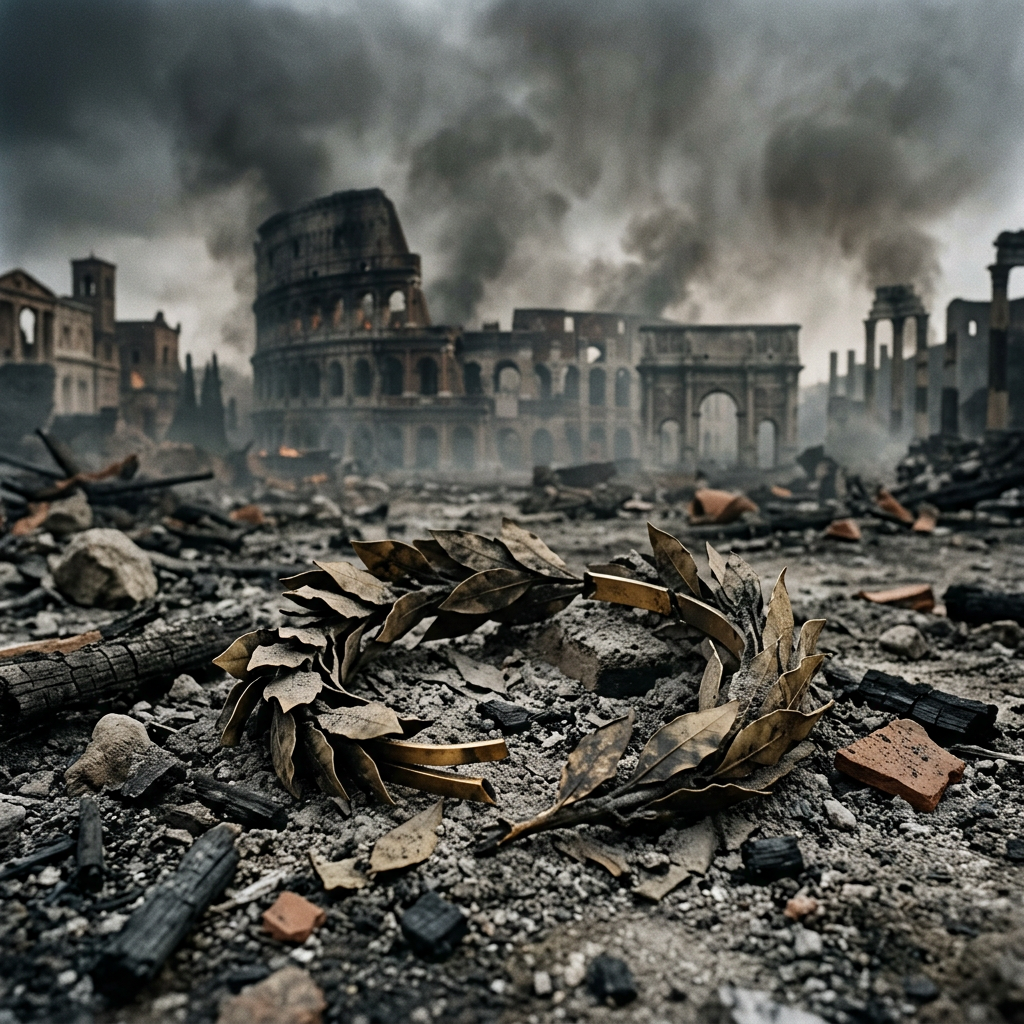
Few Roman emperors provoke as much fascination and controversy as Nero. Ruling from 54 to 68 CE, he has come down through history as a tyrant, arsonist, and persecutor—an archetype of the “mad emperor.” Yet behind the lurid stories lies a more complex figure, shaped by ruthless family politics, fragile legitimacy, and the immense pressures of ruling an empire.
This article explores Nero’s rise to power, key events of his reign, his downfall, and how his posthumous reputation was constructed and exaggerated over time.
Early Life and Path to the Throne
Nero was born Lucius Domitius Ahenobarbus on 15 December 37 CE, into a prominent but turbulent aristocratic family. His mother, Agrippina the Younger, was a formidable and highly ambitious woman, closely tied to the Julio-Claudian dynasty as the sister of Emperor Caligula and the niece of Emperor Claudius.
Adoption and Political Engineering
Nero’s path to the throne was not inevitable; it was engineered. In 49 CE, Agrippina married her uncle, Emperor Claudius—a controversial union even by Roman standards. Through careful manipulation at court, she secured Nero’s adoption by Claudius in 50 CE. Upon adoption, he took the name Nero Claudius Caesar Drusus Germanicus.
Claudius already had a biological son, Britannicus, but Agrippina successfully pushed Nero forward as heir. By 53 CE, Nero was married to Claudius’s daughter, Octavia, solidifying his position. When Claudius died in 54 CE—very likely poisoned, possibly at Agrippina’s instigation—Nero, then only sixteen, became emperor.
The “Good Years”: Nero’s Early Reign
Nero’s early reign was not characterized by madness or chaos. In fact, contemporaries recorded a period of relative moderation and competent governance, guided by a circle of powerful advisers.
Influential Advisers
Key figures in this phase included:
- Seneca the Younger, Nero’s Stoic tutor and speechwriter, who promoted clemency and moderation.
- Burrus, commander of the Praetorian Guard, who provided stability and military support.
- Agrippina, who initially exerted strong influence over her son and the imperial court.
During these early years, Nero was presented as a youthful, cultured ruler. Taxes were eased, legal reforms were pursued, and public spectacles flourished. For a time, the empire seemed stable.
However, Nero’s temperament and priorities increasingly clashed with those of his advisers and his domineering mother.

Breaking Free: The Turn Toward Autocracy
As Nero matured, he grew resentful of Agrippina’s control and the constraints imposed by his advisers. He preferred artistic pursuits—music, poetry, and theater—over the traditional military and administrative focus expected of a Roman emperor.
Conflict with Agrippina
The relationship between Nero and Agrippina deteriorated rapidly. She opposed Nero’s romantic attachments, resented his growing independence, and at times threatened to support Britannicus as a rival claimant.
In 55 CE, Britannicus died suddenly at a banquet, likely poisoned. This removed a competing heir and consolidated Nero’s position, but deepened suspicions about his and Agrippina’s ruthlessness.
By 59 CE, Nero arranged his mother’s assassination. After a failed attempt to drown her at sea, she was ultimately killed in her villa at Baiae. Nero justified this act with accusations of conspiracy, but the matricide shocked Roman society and marked a decisive break with any pretense of traditional pietas (filial piety).
The Great Fire of Rome and the Golden House
The defining event of Nero’s reign in popular memory is the Great Fire of Rome in 64 CE. The fire raged for days, destroying large sections of the city.
Did Nero Start the Fire?
Ancient sources disagree on Nero’s role. Some later writers, like Tacitus, record rumors that Nero “fiddled” or sang while Rome burned, or even ordered the fire to clear land for his grand building projects. However:
- Tacitus, our most reliable source, explicitly states that the real cause was unknown.
- Nero was not in Rome when the fire began; he reportedly rushed back to coordinate relief efforts.
- He opened his own gardens to refugees and arranged food supplies at reduced prices.
Despite these actions, suspicion persisted that he had used the disaster to reshape the city.
The Domus Aurea: Nero’s Golden House
In the aftermath, Nero launched an ambitious urban rebuilding program, introducing broader streets and stricter building codes to reduce fire risk. At the same time, he constructed his lavish Domus Aurea (Golden House), an enormous palace complex that symbolized imperial excess:
- Artificial lakes and vast pleasure gardens
- Opulent halls glittering with gold and precious stones
- A colossal statue of Nero in the guise of the sun god
To many Romans, this confirmed the suspicion that Nero had welcomed, if not orchestrated, the destruction of old Rome to make way for his dream residence.

Persecution of Christians
Another enduring part of Nero’s legacy is his association with the persecution of Christians. After the fire, facing public anger and rumors of his guilt, Nero sought a scapegoat.
Targeting an Unpopular Minority
Christians were a small, misunderstood, and often mistrusted group in first-century Rome. Their refusal to participate in traditional religious rites and imperial cult practices made them easy targets.
According to Tacitus:
- Nero blamed Christians for the fire.
- Many were arrested, tortured, and executed in brutal public spectacles—burned alive, torn apart by animals, or crucified.
This episode made Nero a lasting villain in Christian memory and later church tradition, often portrayed as a kind of archetypal antichrist figure.
Cultural Obsessions and Un-Roman Behavior
Nero saw himself as an artist and performer. This, more than anything, undermined his standing among the Roman elite.
An Emperor on Stage
Nero loved:
- Singing and playing the lyre
- Writing poetry and performing on stage
- Competing in Greek-style athletic and artistic festivals
For the Roman aristocracy, it was scandalous for an emperor to appear publicly as an entertainer—roles associated with slaves, foreigners, and social inferiors. Nero’s artistic exhibitions abroad, including his tour of Greece, were seen as a humiliation to Roman dignity.

Revolts, Conspiracies, and the Fall of Nero
By the late 60s CE, Nero’s support was unraveling.
The Pisonian Conspiracy
In 65 CE, a major conspiracy to assassinate Nero—known as the Pisonian Conspiracy—was uncovered. The plot involved senators, officers, and even his former tutor Seneca (whose exact involvement is debated). Nero responded with executions and forced suicides, further alienating the senatorial class.
Provincial Revolts
Dissatisfaction spread to the provinces:
- In 68 CE, Gaius Julius Vindex, a governor in Gaul, rebelled against Nero’s rule.
- Soon after, Servius Sulpicius Galba, governor of Hispania Tarraconensis, declared himself emperor with senatorial backing.
Crucially, Nero lost the loyalty of the Praetorian Guard, who were bribed to support Galba.
Nero’s Death
Abandoned by his guards and condemned as a public enemy by the Senate, Nero fled Rome. On 9 June 68 CE, facing capture and execution, he committed suicide with the assistance of a freedman. His reputed last words—“Qualis artifex pereo” (“What an artist dies in me”)—summarize the strange mixture of vanity and self-pity that shaped his image.
His death ended the Julio-Claudian dynasty and plunged Rome into a brief civil war known as the Year of the Four Emperors (69 CE).
Nero’s Reputation: History, Propaganda, and Myth
Was Nero truly “mad,” or was his image shaped by hostile sources and later traditions?
Biased Sources
Most of our information comes from elite Roman and later Christian writers:
- Tacitus, Suetonius, and Cassius Dio wrote decades after Nero’s death.
- They relied on senatorial traditions deeply hostile to emperors who undermined aristocratic power.
- Christian authors amplified Nero’s crimes due to his persecution of early believers.
These sources emphasize scandal, cruelty, and sensational stories. While many of their accounts are plausible, they are also colored by political and moral agendas.
Popular Memory and “Nero Redivivus”
Interestingly, not all Romans hated Nero. In some parts of the empire, especially in the Greek-speaking East, he remained popular for his patronage of the arts and reduction of burdensome taxes.
After his death, rumors persisted that Nero was still alive and would return. Several impostors appeared, claiming to be the emperor—phenomena known as the Nero Redivivus (“Nero reborn”) legends. This suggests that, for some, Nero’s memory was not entirely negative.

Conclusion: Between Monster and Man
Nero’s reign combined genuine administrative reforms with spectacular personal excess. He was neither a purely fictional monster nor a misunderstood saint. He was a young ruler elevated by ruthless family politics, intoxicated by power, and obsessed with art and performance in a society that expected military prowess and restraint from its leaders.
The image of Nero as the archetypal “mad emperor” owes much to:
- His break with Roman social and moral norms,
- His persecution of Christians,
- The hostility of senatorial and Christian writers,
- And the enduring power of stories like the Great Fire and the Golden House.
Understanding Nero means recognizing both the realities of his rule and the layers of propaganda and myth that have shaped his legacy for nearly two thousand years.
Fortisetliber’s View
At Fortis et Liber, we see Nero less as a one‑dimensional madman and more as a symptom of a system that concentrated immense power in fragile hands. His crimes and excesses were real, but so too were the prejudices of those who wrote his story. If we are to judge Nero fairly, we must read our sources with the same skepticism we reserve for modern narratives of power, propaganda, and moral outrage.
Leave a Reply