
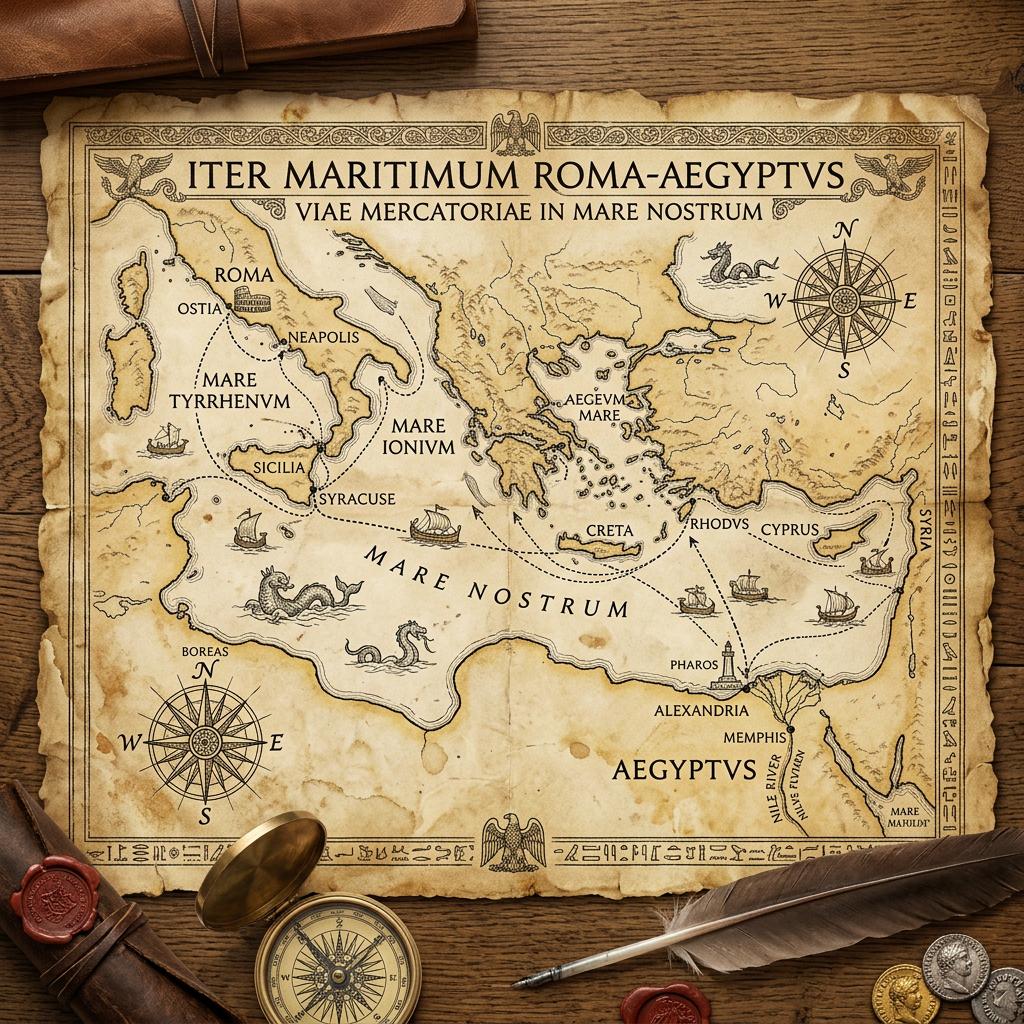
From the late Republic into the high Empire, the relationship between Rome and Egypt was shaped as much by commerce as by conquest. After Augustus’ annexation of Egypt in 30 BCE, the Nile Valley became one of the most strategically important provinces in the Roman world. At the heart of this importance lay trade: a complex web of grain shipments, luxury goods, taxes, and long‑distance connections that linked the Mediterranean to the Red Sea and beyond.
From Ptolemaic Kingdom to Roman Province
Before Roman rule, Egypt had already been a major economic power under the Ptolemaic dynasty. Alexandria, founded by Alexander the Great and developed by his successors, was:
- A major port for Mediterranean trade
- A clearinghouse for grain from the Nile Valley
- A cosmopolitan city that attracted Greeks, Egyptians, Jews, and merchants from across the east
When Octavian (later Augustus) defeated Antony and Cleopatra in 31–30 BCE, Egypt passed from Ptolemaic hands into Roman control. Augustus treated Egypt as his personal domain, separate in some ways from the usual senatorial provinces. This was not only political caution; it was also an acknowledgment of Egypt’s unique economic value, especially its grain.
Grain: Feeding the Capital
The single most crucial aspect of trade between Rome and Egypt was the grain supply.
Egypt as Rome’s breadbasket
The Nile’s annual floods made Egyptian agriculture exceptionally productive. Under Roman administration, much of this surplus was directed toward:
- Feeding the population of Rome, which depended on imported grain
- Supporting the Roman army in the eastern provinces
- Stabilizing prices and preventing famine and social unrest in the capital
The annona (the grain supply system) was a central concern of Roman emperors. Egypt’s contribution to the annona meant that:
- Grain convoys from Alexandria to Rome became a regular and carefully managed operation
- The emperors had to ensure the protection of shipping routes and ports
- Any disruption in Egyptian grain exports could quickly become a political crisis in Rome

The route from Nile to Tiber
Grain from the Nile Valley was brought downriver to Alexandria, stored in large granaries, and then loaded onto ships bound for Italian ports—primarily Puteoli in the Republic and later Ostia and Portus near Rome. From there, it traveled up the Tiber to reach the city.
This regular movement of grain was a form of trade but also, in many cases, a form of taxation in kind: a significant portion of Egypt’s output went directly to the imperial state as tax.
Beyond Grain: Luxury Goods and Everyday Trade
While grain dominated the strategic picture, trade between Rome and Egypt was not limited to staple foods. Egypt was also a source and transit point for a range of other commodities.
Egyptian products
Egypt itself produced:
- Papyrus: Essential for administration, literature, and record‑keeping across the empire
- Linen and textiles: Fine Egyptian linen was valued across the Mediterranean
- Glassware and faience: Craft production that circulated through Mediterranean markets
- Stone and minerals: Including granite and porphyry used in Roman architecture and sculpture
These goods reached Roman markets through Alexandria and other Egyptian ports, carried by merchants who served both state and private demand.
Gateway to the East
Perhaps even more significant was Egypt’s role as a corridor for long‑distance trade. Using the Nile and overland routes to the Red Sea ports (such as Myos Hormos and Berenike), Roman and provincial merchants connected with:
- Arabian traders
- Merchants from the Horn of Africa
- Indian merchants from ports along the Malabar Coast
- Indirectly, traders linked to even more distant regions in Central and East Asia
From the Indian Ocean and Red Sea regions, the following flowed through Egypt into the Roman world:
- Spices (especially pepper)
- Aromatics and incense
- Ivory, exotic animals, and hides
- Precious stones and pearls
- Eastern textiles and luxury goods
While much of this trade was high‑value and low‑volume compared to bulk grain shipments, its profits were enormous and attracted both private entrepreneurs and imperial attention.

Administration, Taxes, and Control
The economic weight of Egypt demanded a distinctive administrative approach.
The prefect of Egypt
Unlike many other provinces, Egypt was governed not by a senator but by an equestrian prefect appointed directly by the emperor. This arrangement served multiple purposes:
- It prevented ambitious senators from gaining a power base in such a vital province
- It placed direct control of Egypt’s resources in imperial hands
- It enabled more centralized management of tax revenues and trade regulation
The administration oversaw:
- Collection of taxes in grain, money, and labor
- Regulation of internal trade within Egypt
- Maintenance of canals, dikes, and infrastructure crucial to agriculture and transport
Fiscal and commercial impact
Taxes collected in Egypt—especially in grain—were crucial to imperial finances and provisioning. A portion of the trade revenues from customs and port duties also went into imperial coffers.
At the same time, Alexandria’s merchant communities, financiers, and shipowners developed their own commercial networks. Greeks, Egyptians, Jews, and later Romans living in Egypt participated in a mixed economy where state demands and private profit were closely intertwined.
Cultural Exchange Through Commerce
Trade between Rome and Egypt was not simply an economic phenomenon. The constant movement of people and goods produced cultural exchange in multiple directions.
Egyptian influence in Rome
Through trade and contact, Egyptian elements spread into Roman culture:
- Egyptian deities such as Isis and Serapis gained followers in Italy and across the empire
- Egyptian motifs appeared in Roman art, architecture, and decorative objects
- Obelisks and other Egyptian monuments were transported to Rome and set up as symbols of power and exoticism
Roman influence in Egypt
Conversely, Roman rule and commerce left their mark on Egypt:
- Latin appeared in inscriptions alongside Greek and Egyptian scripts, especially in official contexts
- Roman architectural styles and urban planning influenced cities, especially Alexandria
- The demands of the Roman market reshaped aspects of Egyptian agriculture and production
Trade thus served as a conduit for ideas, religious practices, artistic forms, and social customs, creating a hybrid world where “Roman” and “Egyptian” identities mingled.

Challenges and Vulnerabilities
Despite its wealth, the trading relationship between Rome and Egypt was not without risks.
Dependence and instability
Rome’s reliance on Egyptian grain meant that:
- Natural disasters in Egypt (poor Nile floods, crop failures) had immediate consequences for the wider empire
- Political unrest in Egypt or disruption at sea (piracy, war, bad weather) could threaten Rome’s food security
- Emperors had to monitor Egypt closely and intervene when necessary to maintain stability
Shifts over time
Over the centuries, shifts in imperial policy, military priorities, and external pressures (such as invasions and competition for trade routes) affected the volume and nature of trade. Yet, throughout the Principate, Egypt remained a pillar of Rome’s economic structure.
Conclusion: An Economic Lifeline of Empire
Trade between Rome and Egypt was more than a simple exchange of goods. It was:
- A strategic lifeline, feeding the capital and supporting imperial power
- A commercial hub, channeling luxury goods from the Red Sea and Indian Ocean into Mediterranean markets
- A cultural bridge, carrying religious ideas, artistic styles, and social practices in both directions
By controlling Egypt’s fertile lands and crucial trade routes, Rome secured not only its daily bread but also a central position in the wider networks of the ancient world. The story of Rome and Egypt is therefore a story of how empire, economy, and culture became inseparably entwined through trade.
Fortisetliber’s View
At Fortis et Liber, we tend to look at Rome not only through battles and emperors, but through the quieter forces that kept the empire alive. Few relationships make that clearer than Rome’s dependence on Egypt.
From the moment Augustus took control of the Nile Valley, Egypt became something more than a distant province. It was a lifeline. Roman power in the Mediterranean rested, quite literally, on the annual floods of a foreign river. Grain from Egyptian fields fed the capital, paid soldiers, and calmed the restless poor. An empire that liked to imagine itself self‑sufficient discovered that its stability could be shaken by low water levels thousands of kilometers away.
This dependence is uncomfortable to look at, and that is precisely why it is revealing. Rome projected an image of absolute control, yet it had to arrange convoys, protect sea lanes, and trust that no ambitious governor or enemy fleet would choke off the flow from Alexandria. Egypt offered Rome wealth, but it also exposed a vulnerability: a single point of failure in an otherwise sprawling system.
Trade between Rome and Egypt extended beyond grain—papyrus, luxury goods, and Red Sea commerce with Arabia and India all enriched the empire. But the deeper lesson lies in the structure of the relationship. Economic power, logistical planning, and political control were inseparable. Whoever could command Egypt’s harvest and routes held leverage over the world’s greatest city.
Looking at Rome and Egypt in this way, we see less of an invincible superpower and more of a complex, interdependent organism. The empire did not simply “own” Egypt; it relied on it. And in that reliance, we can glimpse a universal truth: even the strongest states are bound by the fragile networks that sustain them.
Leave a Reply