
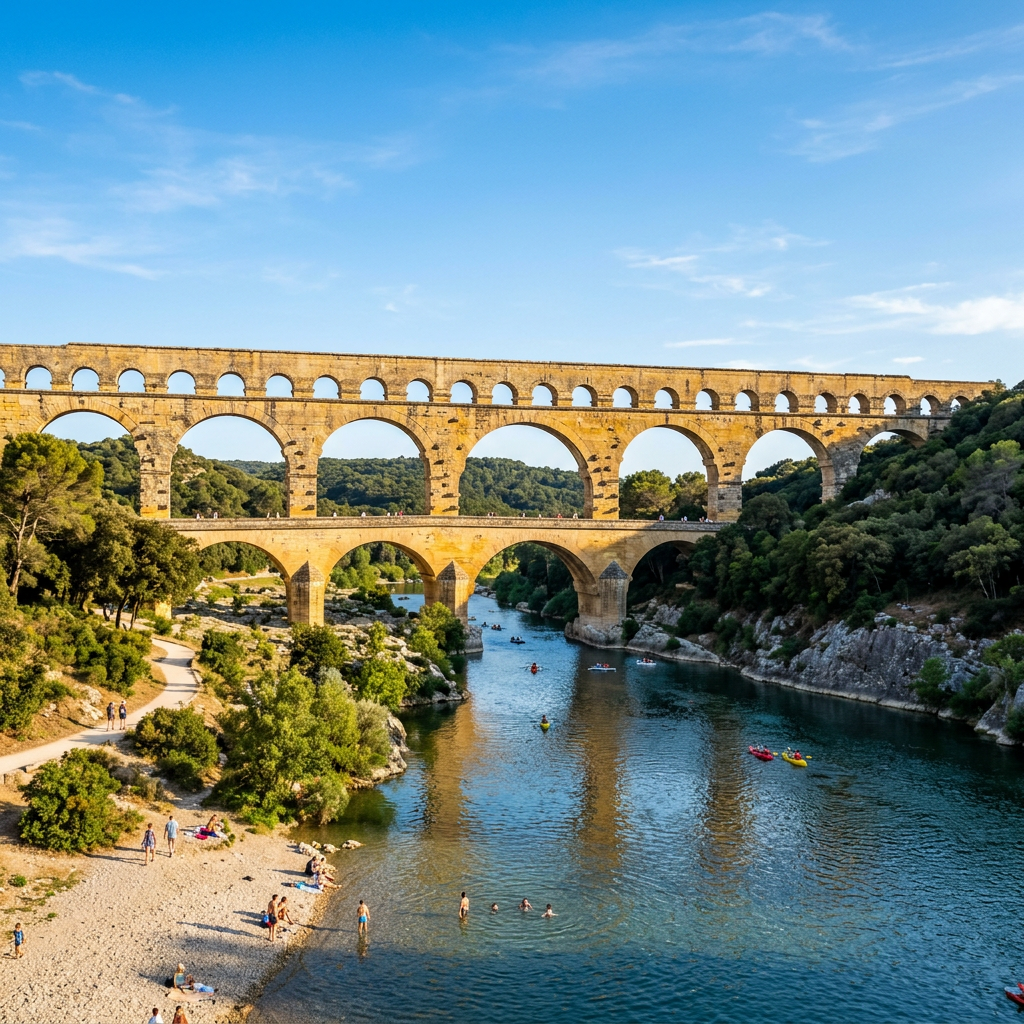
Rising gracefully above the Gardon River in southern France, the Pont du Gard is one of the most impressive and best‑preserved Roman aqueduct bridges in the world. More than 2,000 years after it was built, it still inspires awe—both as a technical achievement and as a work of architectural beauty.
A Bridge Built to Carry Water
The Pont du Gard was constructed in the 1st century AD, during the height of the Roman Empire. Its primary purpose was not to carry people or goods, but water.
The bridge is part of a larger aqueduct system that once transported fresh water from springs near Uzès to the Roman city of Nemausus, modern‑day Nîmes. This aqueduct stretched for about 50 kilometers, but the Pont du Gard was its most spectacular section, built to cross the deep valley of the Gardon River.
Despite its grandeur, the slope of the water channel is extremely gentle—only a few centimeters per kilometer—demonstrating the Romans’ deep understanding of hydraulics and gravity-fed systems.
An Extraordinary Feat of Architecture
The Pont du Gard stands around 48–50 meters high and is composed of three levels of arches:
- Lower level: Large arches spanning the river, forming the base and acting as a bridge.
- Middle level: A series of smaller arches that help distribute weight and reduce the amount of stone needed.
- Upper level: The highest tier, carrying the covered water channel (specus) that once transported the water.
Built without mortar, the blocks of local limestone—some weighing several tons—were precisely cut and fitted together. Iron clamps and careful balancing of forces helped keep the structure stable. The harmony of proportions, the alignment of arches, and the golden color of the stone all contribute to its striking visual impact.
From Aqueduct to Historic Monument
The aqueduct ceased functioning sometime between the 4th and 6th centuries as the Roman Empire declined and maintenance stopped. Over time, sections of the channel became blocked or collapsed.
However, the Pont du Gard itself survived, largely because it adapted to new uses:
- In the Middle Ages, it served as a toll bridge, with travelers paying to cross the river.
- In the 18th and 19th centuries, interest in antiquity grew, and the structure attracted artists, scholars, and early tourists.
- Restoration campaigns were undertaken to stabilize the bridge and preserve it as a historic monument.
In 1985, the Pont du Gard was designated a UNESCO World Heritage Site, recognized both for its outstanding universal value and as a symbol of Roman engineering genius.

Visiting the Pont du Gard Today
Today, the Pont du Gard is one of the most visited heritage sites in France. It lies between Nîmes and Avignon, near the village of Vers‑Pont‑du‑Gard, and is easily accessible by car, tour bus, or regional transport.
A visit typically includes:
- Viewing the bridge from multiple angles: Walking along paths on both riverbanks offers stunning perspectives, especially at sunrise or sunset.
- Museums and exhibitions: The on‑site museum explains how the aqueduct was constructed, how Romans managed water, and how the site has been preserved over centuries.
- Walking and hiking: Trails lead through the surrounding Mediterranean landscape of garrigue, with its pine trees, shrubs, and rocky outcrops.
- Swimming and picnicking: In warmer months, visitors often swim in the Gardon River below the bridge or relax on the banks.
The site balances tourism with conservation, and access is managed to protect the monument from damage.
Symbol of Roman Legacy
The Pont du Gard is more than an ancient utility structure. It is a symbol of how the Romans combined practicality with aesthetics: delivering water efficiently while building something that still captivates the human imagination.
To stand beneath its arches is to experience a tangible link with the ancient world, and to be reminded of the skill, ambition, and vision that have shaped European landscapes for millennia.

Fortisetliber’s View
For us, the Pont du Gard is a lesson in disciplined ambition. Built to do something as ordinary as carrying water, it achieves an almost serene grandeur through proportion, restraint, and exacting geometry. Its arches show how true strength lies not in excess, but in measured design—an enduring reminder that what is carefully conceived can outlive its purpose and still speak to us across centuries.
Leave a Reply