
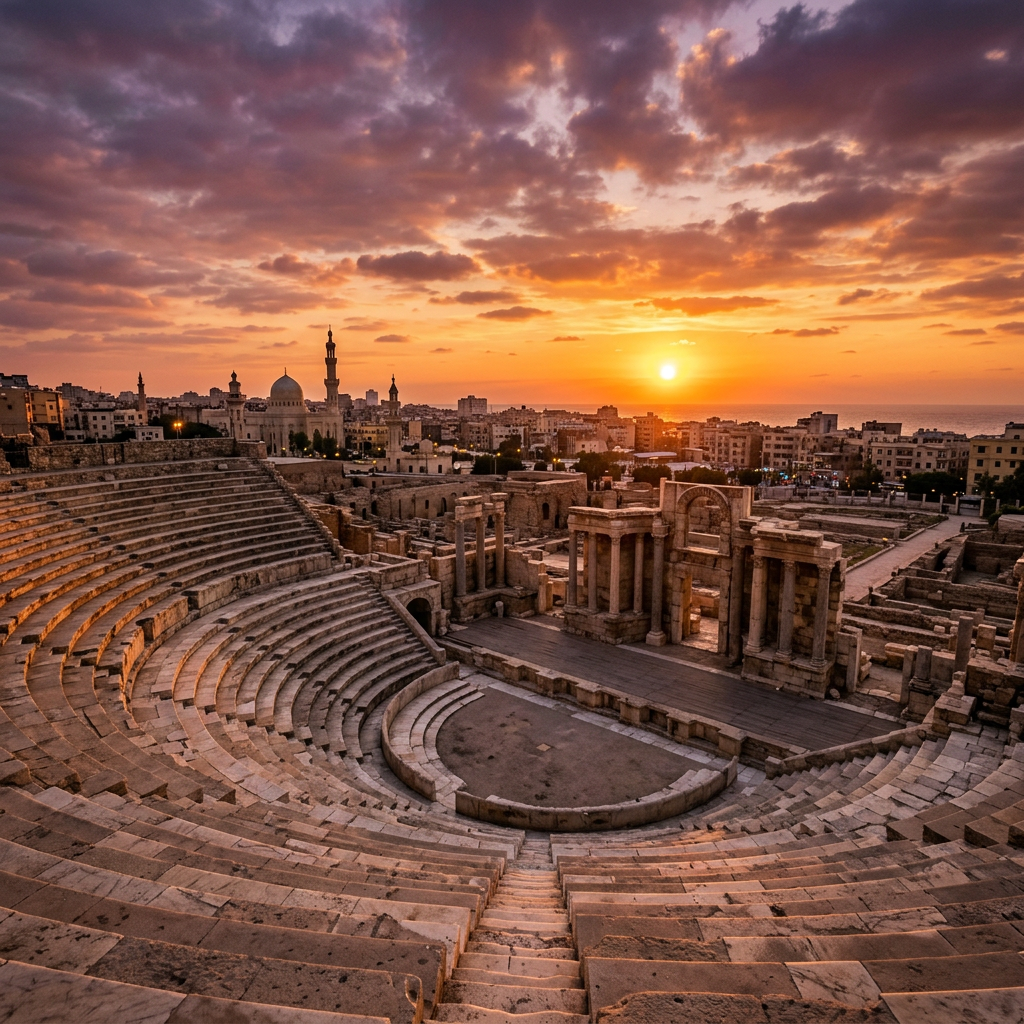
Hidden in the heart of modern Alexandria lies one of Egypt’s most intriguing archaeological surprises: the Kom El Dikka Theater. This compact Roman odeon, with its elegant marble seats and intimate semicircular design, offers a rare glimpse into the cultural life of Alexandria nearly two thousand years ago.
A Theater in the Middle of the City
Kom El Dikka literally means “Mound of Rubble,” a name locals once used for what looked like an ordinary hill of debris in central Alexandria. For centuries, no one suspected that beneath this mound were the remains of an entire urban quarter—complete with villas, bath complexes, lecture halls, and, most famously, a small Roman theater.
Today, the site sits just a short walk from Alexandria’s busy streets, contrasting the noise of the modern city with the quiet, curved rows of stone where audiences once gathered to listen, learn, and be entertained.
Historical Background
The Kom El Dikka Theater dates back to the Roman period, most likely between the 2nd and 4th centuries AD. Unlike the huge amphitheaters of Rome, this is a smaller, more intimate structure—often described as an odeon, a covered theater used for musical performances, poetry readings, and public lectures.
Alexandria in this period was a cosmopolitan city: Greek, Egyptian, Roman, Jewish, and later Christian communities all intersected here. The presence of this theater (alongside lecture halls and a grand bath complex at Kom El Dikka) reflects a city that valued learning, performance, and public life. It would have hosted:
- Musical performances and recitals
- Rhetorical displays and public speeches
- Philosophical readings and debates
- Possibly smaller theatrical pieces
Rather than mass spectacle, Kom El Dikka’s theater was about cultivated, intellectual, and artistic gatherings—very much in line with Alexandria’s reputation as a center of scholarship.
Discovery and Excavation
The true story of Kom El Dikka began in the mid‑20th century, when construction works in the area uncovered ancient remains. Systematic excavations, led largely by a Polish archaeological mission working with the Egyptian authorities, revealed that the “mound of rubble” concealed an exceptionally well‑preserved slice of Roman and Byzantine Alexandria.
The theater itself emerged as one of the most remarkable discoveries. Beneath layers of rubble and later structures, archaeologists found:
- A semicircular seating area (cavea)
- Thirteen tiers of marble seats
- A central performance space (orchestra)
- Columns that once supported a roof or covered structure
Over time, the site revealed even more: residential buildings, a large bath complex, streets, cisterns, and lecture halls. Together, they form one of the best-preserved late antique quarters in Alexandria.

Architecture and Design
While modest in size, the Kom El Dikka Theater is rich in detail and design.
Seating (Cavea)
The theater’s seating is arranged in a semicircle around the central performance area. Thirteen rows of white marble benches could accommodate a few hundred spectators. The seats are carefully cut and arranged, and in some places you can still see:
- Seat numbers or markings
- Divisions indicating different seating sections
These details suggest a well‑organized audience layout, possibly reflecting social status or function.
Orchestra and Stage Area
The central area, known as the orchestra, was where performers stood and played. It is paved and slightly lower than the seating, creating a natural focus for sound and sight. While the original stage superstructure has not survived in full, its layout indicates a venue designed for spoken word and music, not for large-scale dramatic productions.
Columns and Roofing
Around the top of the seating are columns that once supported a roof or a partially covered structure. This is typical of odeons, which were often covered to improve acoustics and protect audiences from the weather. Even in its ruined state, you can still imagine the effect: a sheltered, resonant space ideal for voice and instruments.
A Hub of Learning and Culture
Kom El Dikka was more than just a theater; the surrounding area functioned almost like an ancient campus or cultural district. Archaeologists have uncovered a series of lecture halls nearby—some with tiered seating and central podiums—suggesting that this part of Alexandria was a center for teaching and intellectual life.
Taken together, these buildings hint at:
- Educational activities: lectures in philosophy, rhetoric, and perhaps law
- Artistic events: music, recitations, and small performances in the theater
- Social gatherings: citizens and local elites meeting, discussing, and debating
In this sense, Kom El Dikka is a physical reminder that Alexandria’s reputation as a city of learning did not end with the famous Library. Even in the Roman and Byzantine periods, education and culture remained central to the city’s identity.

Kom El Dikka Through the Ages
Like many ancient structures, the Kom El Dikka Theater went through several phases of use, modification, and decline. Evidence suggests that:
- The theater may have remained in use into the Late Roman and early Byzantine periods.
- Changing religious and cultural attitudes likely shifted the kinds of performances allowed.
- Over time, parts of the theater were repurposed, built over, or stripped for building materials.
By the medieval and Ottoman periods, the once‑proud structure had disappeared beneath new layers of the city—its stones reused, its form forgotten. Only in the 20th century did it re‑emerge as one of Alexandria’s most important archaeological finds.
Visiting Kom El Dikka Today
For modern visitors, Kom El Dikka offers a rare chance to step into the world of Roman Alexandria. Walking among the marble steps, it’s easy to imagine voice and music filling the space, or groups of students and scholars gathering nearby.
A visit typically includes:
- The Theater Itself – with its semicircular rows of marble seats and central orchestra.
- The Bath Complex – evidence of the city’s sophisticated approach to public hygiene and social life.
- Residential Quarters and Streets – giving a sense of the scale and layout of the neighborhood.
- Lecture Halls (Auditoria) – underlining the educational and intellectual character of the area.
Unlike more crowded ancient sites, Kom El Dikka often feels quieter and more intimate. This adds to its atmosphere, allowing visitors to absorb the details of the architecture and imagine the layered history beneath their feet.
Why Kom El Dikka Matters
Kom El Dikka Theater is significant not because of its size, but because of what it represents:
- A window into everyday life in Roman and Byzantine Alexandria
- Physical proof of the city’s cultural and intellectual traditions after the age of the Great Library
- A rare, well‑preserved urban quarter, illustrating how people lived, learned, bathed, and were entertained
In a city whose ancient past is often hidden below modern buildings, Kom El Dikka stands as a visible bridge between eras. Its theater, modest yet elegant, reminds us that Alexandria was not only a place of power and trade, but also a city where words, ideas, and performances mattered deeply.

Fortisetliber’s View
Kom El Dikka Theater is not a monument of grand gestures. It does not dominate the skyline, nor does it speak in the language of empires and triumphal arches. Instead, it whispers of a different kind of strength: the quiet persistence of culture, study, and conversation.
In a city so often reduced to legends of a vanished library, Kom El Dikka reminds us that learning and art did not end with a single building. They migrated into smaller halls, modest theaters, and everyday spaces where people still gathered to listen, argue, and reflect. Freedom of thought is rarely a spectacle; more often, it lives in intimate rooms and semicircles of stone like this one.
To stand in Kom El Dikka today is to feel how fragile and yet how resilient a city’s memory can be. Buried, reused, forgotten—and then revealed again—it shows that what is truly vital in a civilization does not vanish easily. It may go underground for a time, but it waits to be uncovered by those willing to look beneath the surface.
In that sense, Kom El Dikka is more than an archaeological site. It is a reminder that the life of the mind survives rubble, regimes, and neglect. What endures is not the noise of power, but the enduring conversation between the living and the dead—a conversation that cities like Alexandria, and places like this theater, continue to host across the centuries.
Leave a Reply