
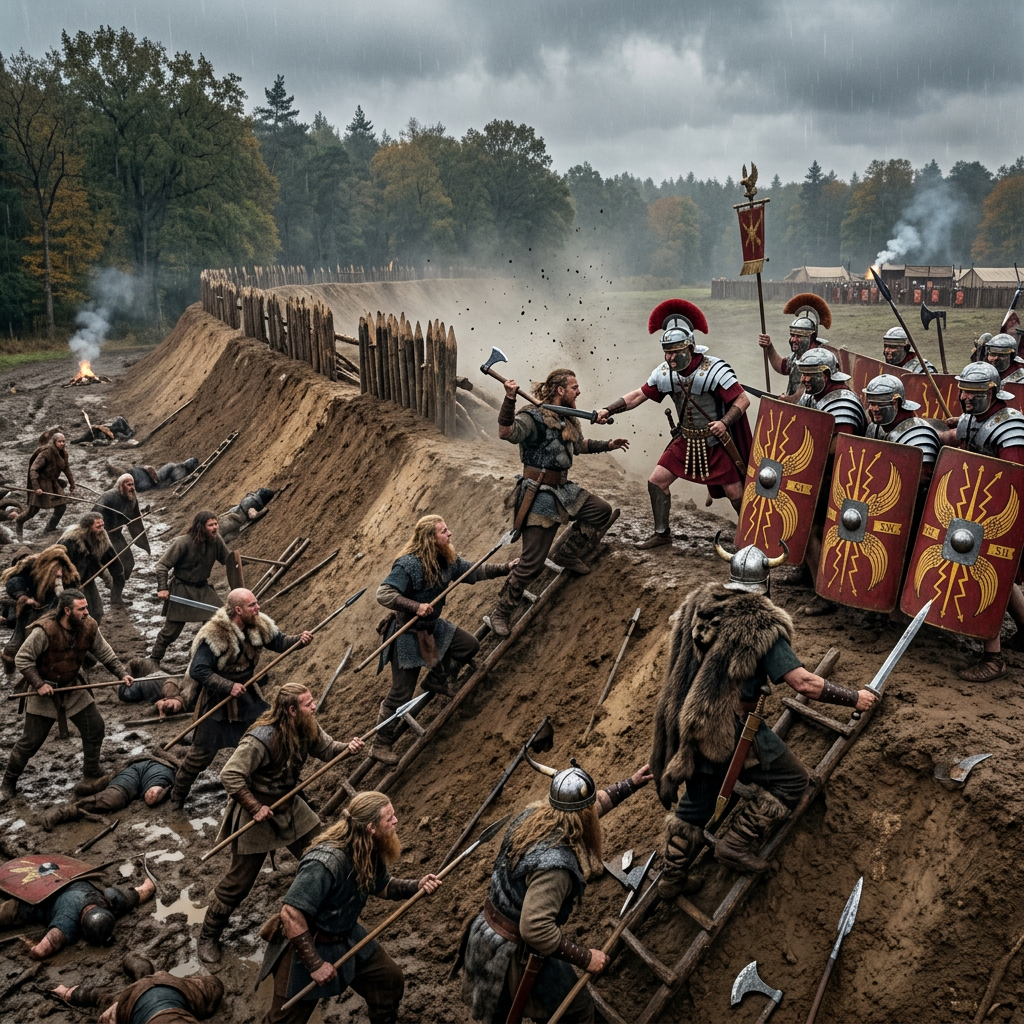
The Battle of the Angrivarian Wall, fought in AD 16, was one of the climactic encounters of Rome’s efforts to reclaim its prestige after the catastrophic defeat at the Teutoburg Forest. Commanded by Germanicus Julius Caesar, the Roman army met the forces of Arminius and his Germanic allies in a fierce, hard‑fought battle somewhere in northwestern Germania.
Although the precise location of the “Angrivarian Wall” remains uncertain, the engagement marks an important moment in the struggle between Rome and the Germanic tribes—a struggle that ultimately reshaped the imperial frontier on the Rhine.
Background: From Teutoburg to Retaliation
The Disaster at Teutoburg Forest
In AD 9, three Roman legions (XVII, XVIII, and XIX) under Publius Quinctilius Varus were ambushed and destroyed in the Teutoburg Forest by an alliance of Germanic tribes led by Arminius of the Cherusci. This defeat was a major shock to Rome:
- Three legions were annihilated.
- Their eagle standards were lost.
- Roman expansion east of the Rhine was abruptly halted.
The Teutoburg disaster became a symbol of Roman vulnerability and a personal humiliation for Emperor Augustus, who, according to Suetonius, was said to wander his palace crying, “Quinctilius Varus, give me back my legions!”
Tiberius and the German Campaigns
When Tiberius succeeded Augustus in AD 14, he inherited both the trauma of Teutoburg and the political pressure to respond. The task of avenging the defeat and reasserting Roman power in Germania fell to Germanicus, Tiberius’ adopted son and a popular general.
Between AD 14 and 16, Germanicus led multiple campaigns beyond the Rhine:
- He recovered some of the lost legionary eagles.
- He inflicted defeats on Germanic tribes loyal to Arminius.
- He sought a decisive battle that would restore Roman honor and prove that Teutoburg was an aberration, not a permanent limit.
It was in this context that the Battle of the Angrivarian Wall took place.

The Angrivarian Wall: A Mysterious Battlefield
The “Angrivarian Wall” (Latin: agger Angrivarianae) is mentioned by the historian Tacitus in his Annals (Book 2). The name likely refers to a defensive earthwork associated with the Angrivarii, a Germanic people living in the region north of the Weser River.
Modern scholars generally agree on a few points:
- It was some kind of earthwork or rampart, perhaps an artificial dike or a fortified natural ridge.
- It lay near Angrivarian territory, close to the lands of the Cherusci (Arminius’ people).
- Its precise location remains unknown, though it is usually placed somewhere in present‑day northwestern Germany.
Rather than a single, clearly identifiable fortification, the “Angrivarian Wall” may have been a series of connected embankments or a long‑standing tribal boundary structure that the Germans used as a defensive position.
Forces and Commanders
The Roman Army under Germanicus
Germanicus commanded a large and experienced force, drawn from several legions and auxiliary units. While exact numbers are debated, the Roman army in Germania during his campaigns may have amounted to:
- Eight legions in the overall Rhine command, though not all may have been present in the final battle.
- Auxiliary cohorts of infantry and cavalry recruited from allied or subject peoples.
- Specialist troops, including archers and slingers.
Roman strengths at Angrivarian Wall included:
- Heavy infantry trained for close‑order combat.
- Disciplined formations and standardized equipment.
- Professional officers and a clear chain of command.
The Germanic Coalition under Arminius
Arminius, once trained and honored as a Roman auxiliary officer, had used his knowledge of Roman tactics to devastating effect at Teutoburg. By AD 16, he was again leading a coalition of tribes, including:
- The Cherusci (his own people).
- Allies drawn from neighboring tribes resentful of Roman interference.
Germanic advantages lay in:
- Knowledge of the terrain.
- Flexible, lightly armored warriors capable of swift movement.
- Strong motivation, fighting to defend their homelands and autonomy.
Unlike the Romans, the Germanic warriors lacked standardized equipment and organization, but they were formidable opponents in forests, marshes, and rough ground.

The Road to Battle
In AD 16, Germanicus continued his campaign deep into Germania. Earlier that year he had already fought a major engagement at the Weser River and conducted punitive operations against tribes aligned with Arminius.
Tacitus describes Roman efforts to:
- Devastate enemy lands and seize captives.
- Recover lost prestige and scare potential allies away from Arminius.
- Force Arminius to commit to a pitched battle, where Roman discipline and armor could make the difference.
The Angrivarian Wall offered Arminius an opportunity to stand and fight in a chosen defensive position, rather than rely solely on ambushes and guerrilla tactics.
The Battle Unfolds
The Germanic Defensive Position
Arminius and his allies chose to anchor their line on the Angrivarian Wall, using the earthwork as a defensive barrier. The nature of the position, as inferred from Tacitus, suggests:
- Raised ground or an embankment facing the Roman advance.
- Forest or rough terrain on the flanks, limiting Roman maneuvering.
- Concealed or prepared positions from which Germanic warriors could launch surprise attacks.
The goal was to force the Romans to assault a strong front while exposing them to flank attacks from hidden forces.
The Roman Advance and Initial Fighting
Germanicus, wary from past experience, approached with caution but remained determined to bring on a direct confrontation. The Romans:
- Deployed in ordered ranks, with legions in the center and auxiliaries on the wings.
- Advanced against the wall, meeting fierce resistance from Germanic warriors hurling javelins and engaging in close combat along the rampart.
- Faced sudden attacks on their flanks, as hidden Germanic contingents tried to envelop portions of the Roman line.
The initial clash was intense, with repeated assaults and counter‑assaults around the defensive earthworks.
Turning the Tide
Several factors helped the Romans turn the battle in their favor:
- Discipline in formation: Roman units could wheel, reinforce weak sectors, and hold ground even under surprise attacks.
- Short‑range combat skills: Once Roman legionaries closed with their heavy shields (scuta) and short swords (gladii), they excelled in tight formations.
- Command coordination: Germanicus and his officers could issue clear orders, coordinate reserves, and exploit openings.
Over time, Roman pressure began to tell. The Germanic forces were gradually pushed back from the earthwork, and some parts of their line broke under sustained attack.
By day’s end, the Romans had seized the position and forced Arminius’ coalition into retreat.

Outcome and Immediate Consequences
A Tactical Roman Victory
Most ancient and modern assessments agree that the Battle of the Angrivarian Wall was a tactical victory for Rome:
- The Roman army held the field.
- Germanic forces suffered significant casualties and were driven from their defensive line.
- The battle, together with other successes in AD 16, helped Germanicus reclaim some of the honor lost at Teutoburg.
Tacitus emphasizes the ferocity of the fighting and the valor on both sides, but he presents the engagement as a Roman success in conventional battlefield terms.
Strategic Limitations
Despite this victory, the strategic situation did not fundamentally change:
- The terrain of Germania remained difficult, favoring irregular warfare over Roman set‑piece battles.
- The Germanic tribes were not permanently subdued; they could disperse, regroup, and resist again.
- The cost of continued campaigns—in lives, money, and political risk—was very high for Rome.
After AD 16, Tiberius recalled Germanicus from Germania, effectively ending the grand attempt to turn large parts of Germania into a Roman province. From then on, the Rhine became the more stable frontier.
Historical Significance
Restoring Roman Morale and Prestige
For Roman public opinion, the campaigns of Germanicus, including the Battle of the Angrivarian Wall, had important symbolic value:
- They showed that Rome could defeat Germanic coalitions in open battle.
- They recovered lost standards and prisoners, softening the memory of Teutoburg.
- They enhanced Germanicus’ reputation as a heroic and capable general.
However, political considerations at Rome, including Tiberius’ unease with Germanicus’ popularity, likely contributed to the decision to halt further conquests.
Fixing the Rhine Frontier
In strategic terms, the aftermath of the battle helped fix a new reality:
- Rome would fortify and defend the Rhine rather than try to annex deep German territories.
- The dream of a Roman Germania Magna east of the river effectively died, even if small forward bases and client rulers remained.
Thus, the Battle of the Angrivarian Wall stands at the end of a chapter—a final, forceful push before a long‑term defensive posture.
The Problem of the Sources
Our understanding of the battle is heavily dependent on Tacitus, who wrote roughly a century later. This creates several challenges:
- Bias and literary shaping: Tacitus had his own political and moral agenda, often contrasting good generals (like Germanicus) with cautious or suspicious emperors (like Tiberius).
- Limited detail: Tactical descriptions are often compressed, lacking precise numbers or clear geography.
- Missing perspectives: We know almost nothing from the Germanic side directly; their voices are filtered through Roman authors.
As a result, while the broad outlines of the battle and its outcome are reasonably clear, many specifics—from troop numbers to the exact location—remain matters of scholarly debate.

Legacy of the Angrivarian Wall
The Battle of the Angrivarian Wall is less famous than the disaster at Teutoburg Forest, yet it played a crucial role in the story of Rome and Germania:
- It illustrates Rome’s ability to recover militarily and morally after even severe defeats.
- It highlights the limits of imperial expansion, where geography, local resistance, and political calculation intersect.
- It serves as a reminder that victory on the battlefield does not always translate into lasting conquest.
In the end, Germanicus’ success at the Angrivarian Wall could not overcome the structural and political realities shaping imperial policy. The frontier remained on the Rhine, and the lands beyond continued to develop along their own trajectories, partly in tension and partly in contact with the Roman world.
Fortisetliber’s View
The Battle of the Angrivarian Wall is often told as a Roman success: Germanicus advances carefully, the legions assault a fortified position, the Germanic line breaks, and honor is restored after Teutoburg. On the surface, it is a textbook example of imperial strength doing what it does best.
Yet from a Fortis et Liber perspective, the deeper lesson lies in what Rome could not do. It could win battles, recover eagles, and devastate enemy lands—but it could not permanently reshape the lives of peoples who did not wish to become Roman. The Germanic warriors who fought behind the Angrivarian Wall stood not for a unified “nation,” but for local freedoms, kin bonds, and ways of life that no single defeat could erase.
In the end, Rome accepted the Rhine as its frontier. The empire had proved its power, but it had also discovered its limits. The Angrivarian Wall reminds us that victory is not the same as mastery, and that even the strongest state must reckon with landscapes and loyalties that resist being turned into provinces. Here, “strong” met “free”—and the frontier remained.
Leave a Reply