
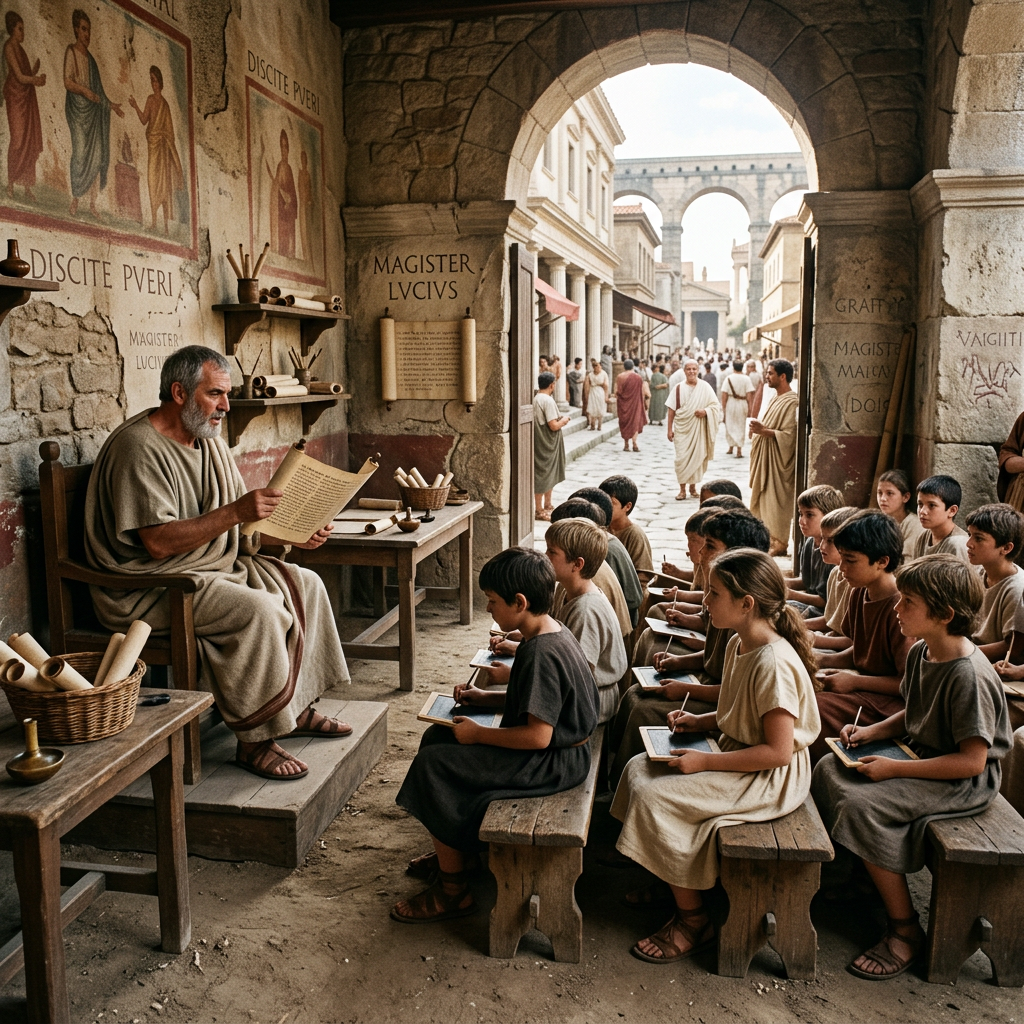
Education in ancient Rome was never a single, unified system run by the state. Instead, it was a patchwork of family instruction, private tutors, and small, often informal schools. It reflected Roman values—discipline, respect for tradition, and the art of persuasive speech—and it varied greatly depending on class, gender, and period. By looking at how Romans taught their children, we gain insight into what they believed mattered most in life.
Early Childhood: Learning at Home
For most Roman children, education began in the home. The family, especially the parents, played a central role in early learning.
- The mother typically oversaw the child’s first years, teaching basic language, manners, and religious practices.
- The father, as paterfamilias, was the legal and moral head of the household. He was expected to serve as a model of Roman virtues: courage, piety, self-control, and loyalty to the state.
- Many wealthier households employed a Greek or educated slave, often called a paedagogus. This person accompanied the child in public, supervised behavior, and sometimes taught basic reading and writing.
In these early years, Roman children learned far more than academic skills. They absorbed the values that would define them as Romans: respect for elders, obedience to authority, devotion to the household gods, and pride in the city of Rome.
Primary School: The Ludus Litterarius
Around the age of seven, many children—especially boys from free families—began attending a primary school known as the ludus litterarius.
Teachers and Setting
The teacher, called a litterator or magister ludi, was often a freedman or lower-status citizen with enough education to teach basic literacy. Schools were not grand institutions but modest rooms, shaded porticoes, or rented spaces in busy parts of town. There was no official state funding or standardized curriculum; schools were private ventures, and students’ families paid fees.
Subjects and Methods
At the primary level, the focus was on:
- Reading and writing Latin, and sometimes Greek
- Basic arithmetic, including counting, simple calculations, and commercial math
- Copying texts onto wax tablets and, for more advanced pupils, onto papyrus
Teaching relied heavily on repetition and memorization. Pupils recited the alphabet, copied letters and words, and repeatedly read short texts aloud. Precision and endurance were more prized than creativity.
Discipline
Discipline in Roman schools was often strict, even harsh. Corporal punishment was common, and teachers did not hesitate to use rods or whips to enforce attention and obedience. Romans believed that firmness in childhood produced disciplined adults capable of serving the family and the state.

Secondary School: The Grammaticus and Classical Culture
For children of wealthier families, the next step was study with a grammaticus, usually beginning around age twelve. This level of education was less about basic skills and more about cultural polish.
The Role of the Grammaticus
The grammaticus taught:
- Advanced reading and writing
- Grammar and style, in both Latin and Greek
- Classical literature, especially poetry
Students read authors such as Homer, Virgil, and other revered poets and historians. The texts were not simply read; they were analyzed line by line. Teachers explained vocabulary, grammar, mythological references, and moral lessons embedded in the stories.
Moral and Cultural Formation
Literature served as a vehicle for moral education. Heroes and villains in the texts became examples to follow or avoid. Through these stories, students learned about:
- Courage and cowardice
- Loyalty and betrayal
- Piety toward the gods
- Proper conduct in war, politics, and family life
In this way, the classroom reinforced the values that Rome’s elite wanted to see in future citizens and leaders. Mastery of literature marked one as cultivated and distinguished from the uneducated masses.
Higher Education: Rhetoric and Public Life
The highest level of Roman education was rhetorical training, aimed primarily at young men who aspired to careers in law, politics, or administration. This stage typically began in the mid- to late-teen years.
The Rhetor and His Students
The teacher, the rhetor, was often a highly respected figure, sometimes even more prestigious than the grammaticus. Here, the goal was not just to understand texts, but to master the art of persuasive speech.
Curriculum of Rhetoric
Students practiced:
- Composing and delivering speeches on a wide range of topics
- Arguing both sides of a case, whether legal, political, or ethical
- Imitating famous orators such as Cicero or Demosthenes
- Declamations, fictional or historical scenarios in which students gave formal speeches as if in court or the senate
The focus was on structure, logical argument, emotional appeal, and stylistic ornament. A successful Roman statesman needed to sway juries, assemblies, and fellow senators. Rhetoric was the primary tool for exercising power in a society that valued public oratory.

Social Class, Gender, and Access to Education
Roman education was not universal, and access to formal schooling depended heavily on social class and gender.
Class Differences
- Elite families could afford all three stages: primary, grammar, and rhetoric. Many also hired private tutors, sometimes famous intellectuals, to teach their children at home.
- Middle and lower classes might manage basic literacy training for their children, especially boys, but often could not afford prolonged schooling. Instead, children entered apprenticeships or family trades early.
- Slaves and freedpeople varied widely in education. Some were illiterate, while others, especially household slaves in wealthy homes, could be highly educated and even serve as teachers.
Education, therefore, functioned as a marker of status. Mastery of literature and rhetoric distinguished the ruling class and reinforced their hold on political and cultural power.
Education for Girls
Girls’ education was less formalized but not absent.
- In many families, girls learned to read and write, especially in the elite classes.
- They were often taught at home rather than in schools and were expected to gain skills in household management, weaving, and domestic economy.
- A small number of women from affluent families became highly educated, reading literature and philosophy. However, training in rhetoric and public speaking—the pathway to political life—was largely reserved for men.
Roman society expected women’s primary sphere to remain the household, even when individual women possessed considerable learning or influence.
Teaching Materials and Daily School Life
Daily life in a Roman school combined simple tools with disciplined routines.
Writing Materials
Students typically used:
- Wax tablets: wooden frames filled with wax, into which students scratched letters with a pointed stylus. The flat end of the stylus could smooth the wax for reuse.
- Papyrus scrolls: more expensive and used for copying finished texts or reading literary works.
- Ink and reed pens for more permanent writing.
Books as we know them did not yet exist; instead, texts were stored on rolled scrolls, which were unrolled horizontally to read.
School Routine
The school day likely began early and could be long, with short breaks. Lessons consisted of:
- Repetition of previously learned material
- Copying and dictation
- Reading aloud and recitation
- Question-and-answer sessions with the teacher
The atmosphere could be noisy and intense, with multiple students reciting at once and the teacher trying to maintain order.
The Values Behind Roman Education
Roman education cannot be understood apart from the values it was designed to instill.
- Respect for tradition
By studying earlier authors and historical figures, students were taught to revere the past and see themselves as heirs to a long line of Roman greatness. - Obedience and discipline
Strict discipline in the classroom mirrored the discipline expected in the army and in civic life. - Public service and leadership
Especially at the rhetorical level, education trained students to speak in public, lead debates, and make decisions affecting the community. - Social hierarchy
The structure of education helped preserve social hierarchies. Advanced education was a privilege of the elite, reinforcing their control over politics and culture.

Comparing Roman and Modern Education
Although there are some familiar elements—teachers, classrooms, reading, and writing—Roman education differs from modern systems in several key ways:
- No centralized, compulsory schooling: Education was largely private, and attendance was not required by law.
- Strong focus on rhetoric: Persuasive speech and courtroom-style argument held a central place, far more than in most modern curricula.
- Limited access: Education, especially beyond the basics, was primarily for freeborn boys of the upper classes.
- Moral and civic emphasis: While modern education also includes civic education, Roman schooling aimed very directly at shaping citizens ready for public life, particularly in law and politics.
Conclusion
Education in ancient Rome was more than a way to teach reading and writing; it was a system for producing a particular kind of person: disciplined, respectful of tradition, and skilled in the art of persuasion. Beginning in the family and continuing through the ludus litterarius, the school of the grammaticus, and the rhetorical classroom of the rhetor, Roman education reflected the priorities of a society that valued order, hierarchy, and eloquent leadership.
Though limited to a relatively small segment of the population, this educational system helped sustain the Roman elite and, through them, the institutions of the Republic and the Empire. To study how Romans learned is to see, in miniature, how they understood power, virtue, and the responsibilities of citizenship.
Fortisetliber’s View
Roman education reminds us that learning is never only about skills. From the home to the school of rhetoric, the Romans aimed to form a particular kind of person: disciplined, rooted in tradition, and able to speak with clarity in public. Their system was unequal and limited, but it grasped something we risk forgetting—that education shapes character as much as competence.
At Fortis et Liber, we see in Rome a challenge to our age of haste and distraction. The slow reading of great texts, the hard work of memorization, the training of the voice and the mind: these were not ornaments, but preparation for a life lived responsibly before others. The real question, then, is not only what we teach, but whom we are trying to form.
Leave a Reply