
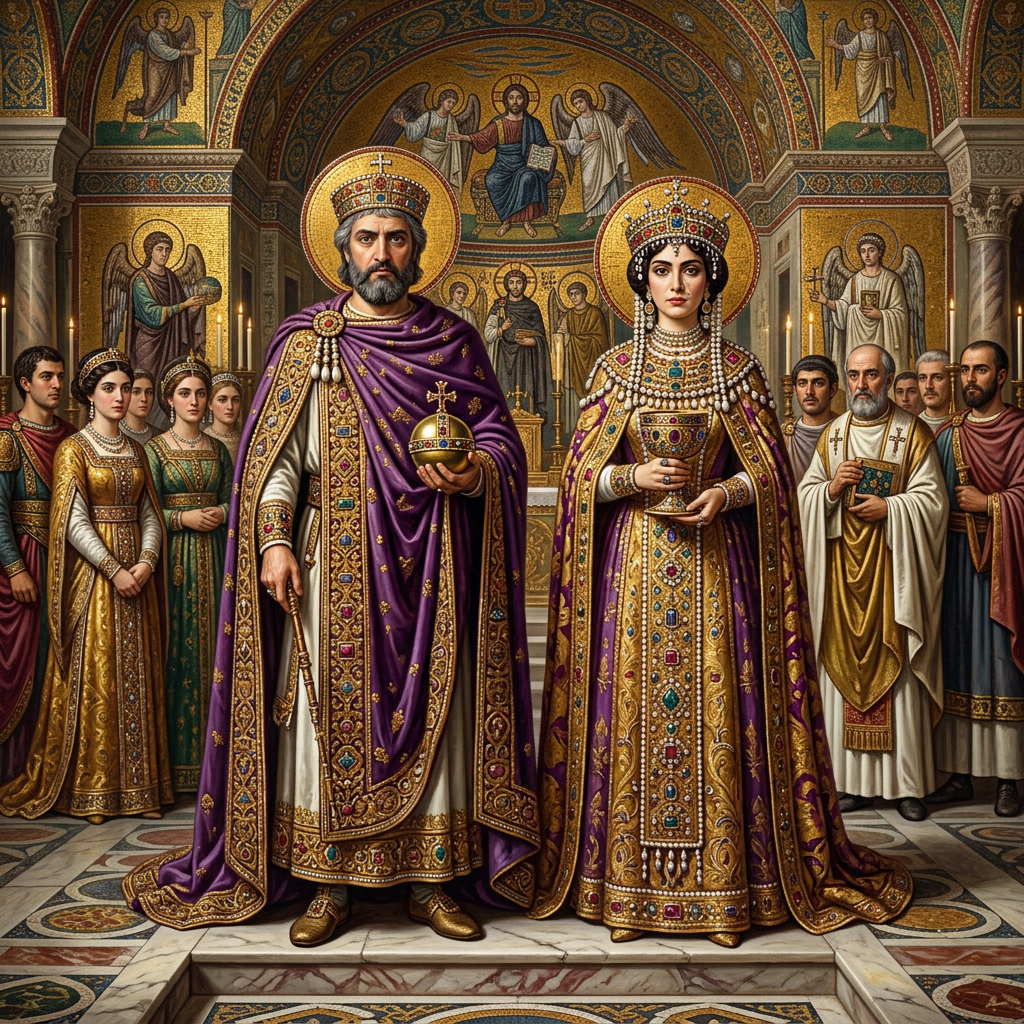
The reign of Emperor Justinian I (527–565 CE) and his wife, Empress Theodora, stands out as one of the most remarkable periods in Byzantine history. Together they reshaped the Eastern Roman (Byzantine) Empire through ambitious legal reforms, building projects, and religious policies. Their story combines political ambition, social mobility, and a powerful—if sometimes controversial—partnership at the heart of imperial rule.
Origins: A Soldier and an Actress
Justinian was born around 482 in Tauresium, in the Balkans, to a family of modest means. His uncle, Justin, rose through the military ranks in Constantinople and eventually became emperor in 518. Justinian’s career unfolded in his uncle’s shadow: he received an excellent education, gained influence at court, and was prepared for succession.
Theodora’s background could hardly have been more different. According to the historian Procopius, she was the daughter of a bear-keeper in the Hippodrome and worked as an actress and courtesan—professions that carried social stigma in Byzantine society. Procopius, who disliked her, paints a scandalous picture, but even allowing for exaggeration, it is clear she came from outside the traditional aristocratic elite.
At some point in the 520s, Justinian met Theodora, and she quickly became his companion and then his wife. Because of her background, a special law had to be passed to allow a man of senatorial rank to marry a former actress. The marriage itself was a statement: Justinian chose personal loyalty and ability over convention and class prejudice.
A Shared Rule: Theodora as Co-Ruler
When Justinian became emperor in 527, Theodora did not retreat into the background. She was crowned Augusta and appeared alongside her husband in official ceremonies, mosaics, and public life. Contemporary sources, even hostile ones, acknowledge her sharp intelligence and strong will.
Theodora participated actively in decision-making, receiving foreign envoys, advising on policy, and intervening in legal and religious disputes. She maintained her own circle of supporters and protégés at court, sometimes at odds with Justinian’s advisors. Their relationship was not one of a distant emperor and a passive consort; it was a close political partnership.
The Nika Revolt: A Defining Moment
The most famous example of Theodora’s influence came during the Nika revolt of 532. What began as a dispute at the races in the Hippodrome escalated into a full-scale uprising against Justinian. Rioters burned much of Constantinople, and many senators supported replacing the emperor.
At a critical moment, Justinian and his advisors considered fleeing the city to save their lives. According to Procopius, it was Theodora who stood firm and refused to run. In a speech that became legendary, she is said to have declared that “royalty is a fine burial shroud” and that she would rather die an empress than live in exile.
Her resolve stiffened Justinian’s courage. Instead of fleeing, he ordered loyal generals, including Belisarius, to crush the revolt. The repression was brutal—tens of thousands were killed in the Hippodrome—but the dynasty survived. Theodora’s counsel in that moment arguably saved Justinian’s reign.
Rebuilding Constantinople: The Hagia Sophia and More
After the destruction of the Nika revolt, Justinian and Theodora embarked on an ambitious rebuilding program to restore and glorify the capital. The most famous result was the new Hagia Sophia, completed in 537. With its massive dome and dazzling mosaics, it was intended as a visible sign of divine favor and imperial power.
Other churches, public buildings, and fortifications were also constructed or restored across the empire. Together, these building projects were part of a broader vision: to present the Byzantine Empire as the legitimate continuation of the Roman world, renewed and strengthened under their rule.

Law and Order: Justinian’s Legal Reforms
Justinian is perhaps best known for his comprehensive reform of Roman law. Before his reign, centuries of legislation and legal commentary had accumulated into a confusing and sometimes contradictory mass. Justinian ordered this material to be collected, organized, and clarified.
The result was the Corpus Juris Civilis (“Body of Civil Law”), which included the Code (Codex), the Digest (Digesta), the Institutes, and later the Novellae (new laws). This legal project not only reshaped Byzantine law but also influenced the development of legal systems in medieval and modern Europe. Although Theodora is not credited as a jurist, evidence suggests she intervened in specific areas, especially where women’s rights and social welfare were concerned.
Social and Religious Policies
Theodora used her position to advocate for those on the margins of society. Laws from Justinian’s reign show concern for protecting women from exploitation, improving the status of former prostitutes, and granting certain rights in marriage and property. Some of these measures may reflect Theodora’s own experiences and sympathies.
Religiously, the couple did not always see eye to eye. Justinian pursued a policy of Christian unity under Chalcedonian orthodoxy, while Theodora was sympathetic to the Monophysites—a group considered heretical by the imperial church. She protected Monophysite leaders and provided them with refuge in the capital. Their differing positions sometimes produced tension, but also illustrate the complexity of religious politics in the empire and the extent of Theodora’s independent influence.
War and Ambition: Restoring the Roman World
Under Justinian, the empire launched military campaigns to reconquer former Western Roman territories. Generals like Belisarius and Narses won major victories in North Africa against the Vandals and in Italy against the Ostrogoths. For a time, imperial authority was restored over large parts of the western Mediterranean.
These campaigns were costly and difficult to maintain. While they briefly expanded Byzantine power, they also stretched resources and left newly conquered territories vulnerable to later invasions. Still, in the context of Justinian and Theodora’s reign, they formed part of a grand vision: a reunified Roman Empire under strong, divinely-sanctioned rule.
Theodora’s Death and Justinian’s Later Years
Theodora died in 548, likely from cancer, after more than twenty years as empress. Her death was a personal and political blow to Justinian. He continued to rule until 565, but the dynamic partnership that had defined the earlier part of his reign was gone.
Yet Theodora’s impact did not vanish with her. Her protégés remained influential, her legal interventions continued to shape policy, and her image—literally, in mosaics like those at Ravenna—endured as a symbol of imperial power and female authority.
Legacy: An Imperial Partnership
The legacy of Justinian and Theodora is complex. To some, they were harsh rulers whose ambitions burdened the empire with heavy taxes, wars, and religious conflict. To others, they were visionaries who codified law, beautified Constantinople, defended imperial authority, and offered a path of social mobility and reform.
What is beyond dispute is that they ruled together. Their reign demonstrates how an imperial marriage could become a genuine political partnership—one that changed the course of Byzantine history. Justinian may have worn the crown, but Theodora’s voice, courage, and willpower were inseparable from the achievements and controversies of his long rule.
Fortisetliber’s View
Justinian and Theodora show how power is rarely the work of one will alone. Justinian brought legal vision and imperial ambition; Theodora supplied the resolve that kept that ambition from collapsing in moments of fear and crisis.
From a Fortisetliber perspective, Theodora’s story is central: a woman from the social margins who rose to co-rule an empire and used that position to protect the vulnerable and reshape the law. Their reign is a reminder that institutions change when someone is willing to bear the cost of acting on conviction, even within a harsh and imperfect age.
Leave a Reply