
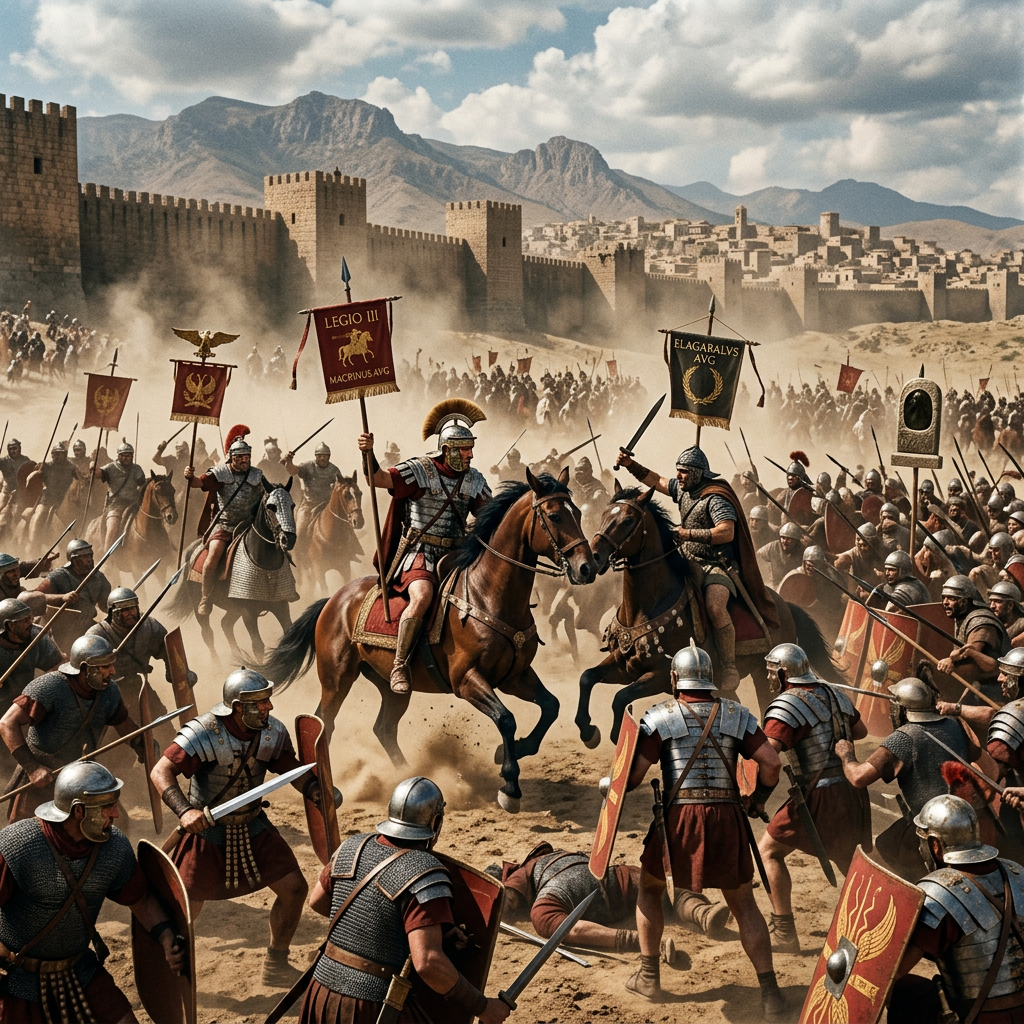
The Battle of Antioch, fought in June 218 CE near the great city of Antioch in Syria, was a decisive clash that reshaped the politics of the Roman Empire. It pitted the ruling emperor Macrinus against the teenage usurper Elagabalus (born Varius Avitus Bassianus), who claimed descent from the Severan dynasty. The outcome not only toppled a reigning emperor, but also restored the Severan house and highlighted the growing power of the eastern legions and imperial women in Roman politics.
Background: From Caracalla to Macrinus
The events leading to the battle began with the assassination of Emperor Caracalla in 217 CE. Caracalla, a member of the Severan dynasty, had ruled in a turbulent and often brutal fashion, but he still commanded loyalty among many soldiers, especially in the eastern provinces.
- Caracalla’s assassination (217 CE):
While traveling between Edessa and Carrhae in Mesopotamia, Caracalla was murdered by a soldier, likely acting on the orders of Marcus Opellius Macrinus, the Praetorian Prefect. - Macrinus becomes emperor:
In the aftermath, Macrinus, a career official and the first emperor to rise from the equestrian order rather than the senatorial class, was proclaimed emperor by the army. He took the name Caesar Marcus Opellius Severus Macrinus Augustus to stress continuity with the Severans, even though he was not related by blood. - A fragile rule:
Macrinus faced immediate challenges:- He inherited an expensive and ongoing conflict with the Parthian Empire.
- He tried to reduce military expenditure by cutting certain benefits to the soldiers.
- These cost-saving measures angered many in the army, whose loyalty was already uncertain.
This fragile situation created an opening for a rival, especially one who could claim a link to the popular Severan line.
The Rise of Elagabalus and Julia Maesa’s Plot
At the center of the opposition to Macrinus stood Julia Maesa, the sister of Julia Domna (Caracalla’s mother) and thus aunt to the late emperor. Exiled from the imperial court after Caracalla’s death, Maesa returned to her home city of Emesa (modern Homs in Syria), a prominent religious center.
- Julia Maesa’s strategy:
Maesa had vast wealth and strong connections in the eastern provinces. She used both to build support for her grandson, Varius Avitus Bassianus—better known by his later imperial name, Elagabalus. - Elagabalus as high priest:
The young Bassianus was the high priest of the local sun god Elagabal (or Heliogabalus) at Emesa. His religious role and Syrian background would later shape his controversial reign, but in 218 his religious standing helped him attract devotion and a sense of destiny. - Claiming Severan descent:
Maesa spread the claim that Elagabalus was the illegitimate son of Caracalla. Whether true or not, the story was politically powerful:- It gave soldiers a plausible Severan heir to rally around.
- It allowed Maesa to present her grandson as the rightful continuation of Caracalla’s line.
Her efforts soon bore fruit among the troops stationed in the region.

The Mutiny of the Eastern Legions
The key support for Elagabalus came from the Legio III Gallica, a legion stationed in Syria. Discontent over Macrinus’s pay reforms and nostalgia for the Severan regime fuelled their willingness to rebel.
- Proclamation of Elagabalus (218 CE):
At Raphanaea (or near it, according to some sources), elements of Legio III Gallica proclaimed the teenager emperor, hailing him as Marcus Aurelius Antoninus, invoking Caracalla’s official name. - Macrinus’s reaction:
Macrinus, based in Antioch, initially tried a mix of:- Diplomatic efforts—attempting to undermine the usurper’s legitimacy.
- Military preparations—assembling forces to confront the rebels.
However, his attempts to appease or buy off certain units were undermined by distrust and by the appeal of a “true” Severan heir.
The Armies and the Road to Antioch
As tension escalated, both sides gathered their forces in the region of Antioch, one of the major cities of the eastern Roman Empire.
- Macrinus’s forces:
- Included the Praetorians and other units loyal to the current emperor.
- Likely had numerical advantages in some arms, especially cavalry.
- Command was centralized under Macrinus, but his lack of a deep military reputation and recent unpopular decisions weakened morale.
- Elagabalus’s forces:
- Core support from Legio III Gallica and other eastern troops drawn by Julia Maesa’s money and influence.
- Motivated by loyalty to the Severan name and by anger at Macrinus’s policies.
- Commanded, in practice, by more experienced generals, while the young Elagabalus served as symbolic figurehead.
The stage was set for a decisive engagement near Antioch in June 218.
The Battle of Antioch
Ancient sources (notably Cassius Dio and Herodian) provide partial and sometimes conflicting details, but a general outline of the battle can be reconstructed.
- Initial phase – advantage for Macrinus:
At the outset, Macrinus’s army reportedly gained the upper hand. His forces, better organized and perhaps superior in cavalry, pushed back parts of the rebel line. For a moment, it seemed that Macrinus might quickly crush the insurrection. - Turning of the tide – the role of discipline and morale:
Despite this early advantage, the tide turned:- The troops of Elagabalus, especially Legio III Gallica, fought with fierce determination, believing they were restoring the rightful dynasty.
- Macrinus’s men, less committed to him personally and resentful of recent reforms, began to waver under sustained resistance and counterattacks.
- Collapse of Macrinus’s position:
As the battle dragged on, the imperial army’s cohesion weakened. Once units began to fall back or break, the retreat quickly turned into a rout. Macrinus failed to rally his troops and instead chose to flee the battlefield. - Macrinus flees and is captured:
Disguising himself as an ordinary courier, Macrinus tried to escape east and then north, hoping to reach safety. He was captured near Chalcedon (in Bithynia) and executed shortly afterward. - Fate of Diadumenianus:
Macrinus’s young son and co-emperor, Diadumenianus, attempted to flee toward Parthia but was captured and killed. With their deaths, Macrinus’s brief reign came to an abrupt end.

Aftermath: Elagabalus Becomes Emperor
With Macrinus defeated and dead, Elagabalus was recognized as emperor by the victorious troops. He entered Antioch as a teenage ruler, backed by the powerful figure of Julia Maesa.
- Formal recognition:
Elagabalus assumed the imperial name Marcus Aurelius Antoninus to reinforce the claim that he was Caracalla’s son and the legitimate Severan successor. The senate in Rome, faced with a fait accompli, eventually confirmed his position. - The power behind the throne – Julia Maesa:
Although formally emperor, Elagabalus was inexperienced and very young. Real power often lay with his grandmother Julia Maesa, who:- Managed political alliances.
- Controlled the flow of money.
- Ensured that the Severan female line remained central to imperial politics.
- A controversial reign to come:
Elagabalus’s subsequent rule (218–222 CE) would become notorious for:- Religious innovations centered on the Emesan sun god Elagabal.
- Tensions with the Roman elite and traditional religious practices.
- Political instability that eventually led to his assassination and replacement by his cousin Severus Alexander.
But all of that followed from the decisive victory at Antioch.
Significance of the Battle
The Battle of Antioch (218) was far more than a single military encounter; it revealed deeper trends in the Roman Empire’s evolving politics and military power structures.
- Restoration of the Severan house:
The battle ended Macrinus’s brief experiment as a non-Severan ruler and restored the dynasty started by Septimius Severus. This highlighted how powerful the Severan brand remained among both soldiers and civilians. - The influence of imperial women:
Julia Maesa’s role was crucial:- She orchestrated the rebellion.
- She financed and legitimized Elagabalus’s claim.
- Her success demonstrated how elite women of the Severan house could shape imperial succession behind the scenes.
- The power of the eastern legions:
The victory underscored:- The growing political weight of eastern frontier armies.
- Their willingness to make and unmake emperors, a pattern that would become increasingly common during the third-century crises.
- The fragility of emperors without dynastic roots:
Macrinus’s downfall showed how vulnerable an emperor could be:- Lacking noble or dynastic legitimacy.
- Relying primarily on bureaucratic and military office rather than a long-standing family claim.
- Attempting unpopular fiscal reforms without a strong base of support.
In this sense, the Battle of Antioch foreshadowed the instability of the mid-third century, when short-lived emperors and military uprisings would become almost routine.

Conclusion
The Battle of Antioch in 218 CE marked a turning point in Roman imperial history. It ended the short rule of Macrinus, restored the Severan dynasty through the figure of Elagabalus, and demonstrated the immense power of military and provincial elites in shaping the imperial throne. Behind the clash of armies, figures like Julia Maesa and the eastern legions underscored a broader reality: in the Roman Empire of the early third century, emperors rose and fell not only on the battlefield, but also through the loyalties, grievances, and ambitions of those who commanded armies and controlled wealth.
Fortisetliber’s View
The Battle of Antioch (218) is more than a clash between a sitting emperor and a teenage usurper; it exposes the fault lines of power when it forgets those who sustain it. Macrinus tried to secure his rule through cost-cutting and procedure, but he never won the loyalty of the soldiers whose privileges he reduced. Elagabalus, for all his inexperience, arrived with a powerful story—Severan blood—and the backing of Julia Maesa’s money and influence. Antioch reminds us that authority without trust is brittle, and that lasting power depends not only on law and force, but on the narratives and relationships people are willing to fight for.
Leave a Reply