
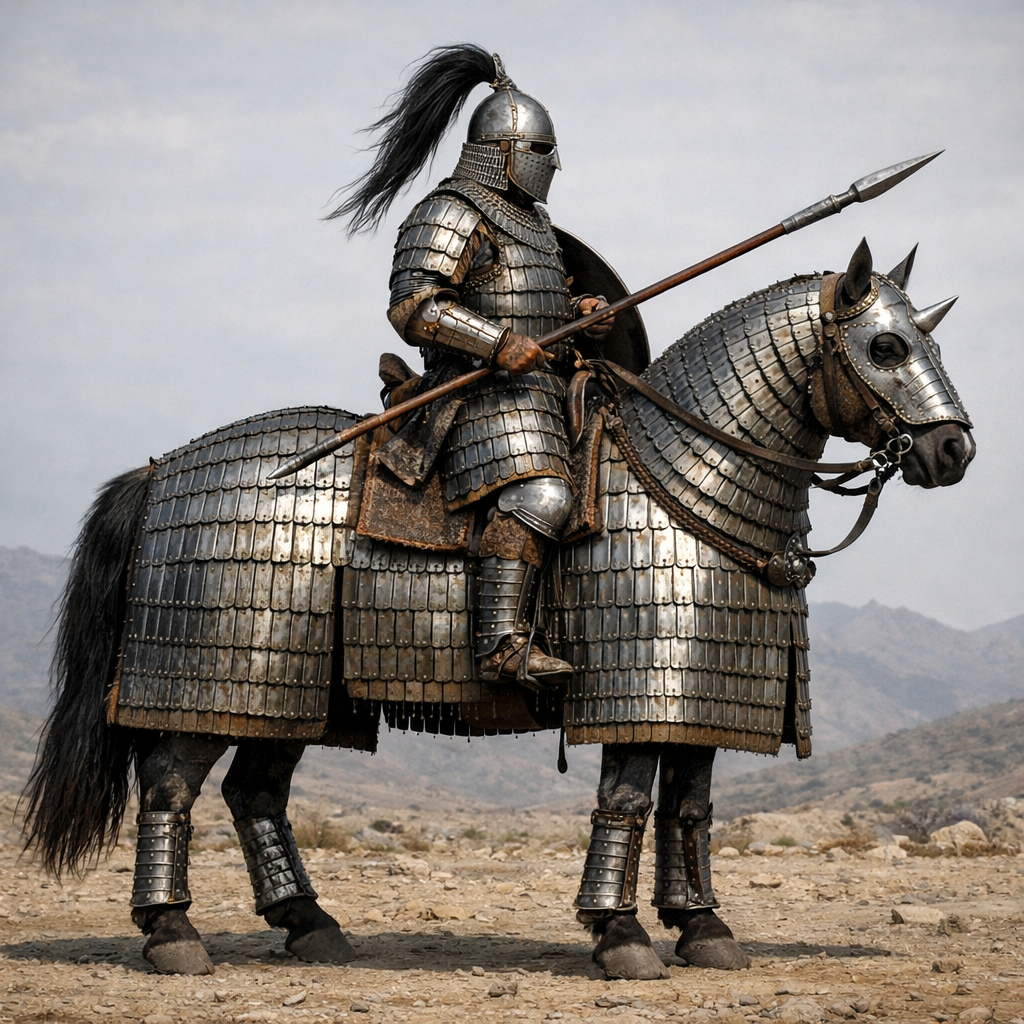
Among the most striking cavalry formations of antiquity and the early Middle Ages were the cataphracts—heavily armored horsemen who embodied the idea of shock cavalry long before medieval knights dominated European battlefields. Wrapped in metal or thick armor from head to toe, riding equally protected horses, cataphracts were designed to smash through enemy lines with sheer weight and momentum.
This article explores their origins, equipment, tactics, and legacy.
Origins of the Cataphract
The concept of the fully armored cavalryman likely emerged in the ancient Near East, particularly among the Iranian peoples of the steppe and plateau regions.
- Early Roots:
Proto-cataphract units seem to appear among ancient Persians, Parthians, and Sarmatians. These cultures valued cavalry and had access to both the metallurgy and horse-breeding practices necessary to field such troops. - Parthian and Sarmatian Influence:
The Parthians, who ruled much of Iran from the 3rd century BCE to the 3rd century CE, are especially associated with early cataphract-like forces. Their armies combined:- Light horse archers for skirmishing
- Heavily armored cavalry for decisive charges
Neighboring steppe peoples, like the Sarmatians, also fielded units that closely resemble cataphracts in equipment and role.
Over time, the idea spread westward and eastward, influencing both the Roman Empire and later the Byzantine Empire, as well as various powers in Central and Eastern Asia.
Armor and Equipment
Cataphracts were defined above all by their armor. They were not simply cavalry with helmets; they were moving fortresses of iron, bronze, or hardened leather.
Armor for the Rider
A typical cataphract might wear:
- Helmet: Often a fully enclosing helm with face protection, sometimes with mail or lamellar neck guards.
- Body Armor:
- Scale armor (small metal plates sewn to a fabric or leather backing), or
- Lamellar armor (laced plates overlapping horizontally)
This often covered the torso, shoulders, arms, and sometimes the upper legs.
- Arm and Leg Protection: Greaves, arm guards, and sometimes additional mail or plate elements protected limbs.
- Shield (optional): Some cataphracts carried small, round shields, though others relied entirely on body armor.
Armor for the Horse
A key feature distinguishing cataphracts from many other cavalry types was the armored horse:
- Headpiece: A metal chamfron or similar plate to protect the horse’s face.
- Neck and Chest Armor: Scale or lamellar coats covering vital areas.
- Flank Protection: In some depictions and archaeological finds, horses wear near full-body bards (horse armor), turning them into living battering rams.
This level of protection was expensive and logistically demanding. Horses had to be strong enough to carry not only their own armor but also that of a fully equipped rider.
Weapons
Cataphracts usually carried a combination of weapons suited for both shock and close combat:
- Contus (Lance):
A long, heavy spear sometimes wielded with two hands. This gave tremendous reach and impact during a charge, at the cost of shield use. - Sword:
A long, straight or slightly curved sword for melee once the initial charge had broken the enemy line. - Secondary Weapons:
Some cataphracts carried maces, daggers, or even bows, but their primary function was that of heavy shock cavalry, not skirmishers.

Tactics and Battlefield Role
Cataphracts were built for decisive action, not for nimble skirmishing or reconnaissance.
Shock Cavalry Doctrine
Their core tactic was simple but devastating if executed correctly:
- Formation: Cataphracts formed up in dense ranks or wedges.
- Approach: They advanced at controlled speed to maintain cohesion.
- Charge: At the right moment, they accelerated into a full charge, lances leveled.
- Impact: The combination of speed, mass, and long lances allowed them to penetrate infantry lines or break enemy cavalry formations.
Their effectiveness relied heavily on discipline, timing, and support from the rest of the army. Alone, they could be vulnerable to:
- Rough or broken terrain
- Concentrated missile fire
- Fresh reserves counter-attacking a stalled charge
Coordination With Other Troops
Successful armies integrated cataphracts into a broader combined-arms strategy:
- With Horse Archers: Light cavalry could harass and weaken enemy formations before the cataphracts charged.
- With Infantry: Infantry could pin the enemy in place, protecting cataphracts from flanks and providing a fallback line.
- With Skirmishers and Archers: These units could disrupt enemy cohesion and reduce the effectiveness of pikes and spears.
Cataphracts in Rome and Byzantium
The Romans initially faced cataphracts as enemies, particularly in clashes with Parthia and later the Sassanian Empire.
Roman Encounters
Battles like Carrhae (53 BCE) exposed Roman vulnerabilities to heavy cavalry and horse archers. Over time, Rome adapted by:
- Recruiting or copying cataphract-style units
- Increasing the role of cavalry in its armies
- Experimenting with armor and tactics specifically aimed at countering such threats
By the Late Roman period, the empire fielded its own heavily armored cavalry, sometimes actually called catafractarii or clibanarii in Latin sources.
Byzantine Evolution
The Byzantine Empire, heir to the Eastern Roman military tradition, refined the use of armored cavalry even further. Byzantine manuals describe:
- Cataphract units organized with a mix of lancers and horse archers
- Sophisticated formations designed to charge, withdraw, and reform
- An emphasis on disciplined maneuvering rather than simple frontal assaults
These Byzantine cataphracts stood alongside infantry and other cavalry types as part of a flexible, professional army capable of defending a vast and contested frontier.

Decline and Legacy
Several factors contributed to the gradual decline of traditional cataphract forces:
- Cost: Equipping and maintaining fully armored horsemen was extremely expensive.
- Changing Warfare:
- The rise of more powerful bows and eventually firearms made heavy armor less practical.
- Improved infantry tactics and polearm formations could blunt heavy cavalry charges.
- Evolution into Other Forms:
Many of the ideas behind cataphracts—armored cavalry, shock tactics, the prestige of elite mounted warriors—survived and evolved:- In Western Europe, into the medieval knight and later heavy cavalry traditions.
- In Eastern Europe and the Middle East, into various armored cavalry corps with mixed weapons and roles.
Even after classic cataphract formations disappeared, their image endured as a symbol of disciplined, devastating heavy cavalry.
Conclusion
Cataphracts were among the most impressive cavalry troops of the ancient and early medieval world. Clad in armor from head to hoof, they turned horse and rider into a single, formidable weapon designed to shatter enemy lines.
Their story is also a story of adaptation: empires encountering new threats, adopting and refining them, and eventually transforming them into new military traditions. From steppe warriors and Parthian nobles to Roman and Byzantine elites, the legacy of the cataphract can be traced in the evolution of heavy cavalry across Eurasia.
Fortisetliber’s View
At Fortis et Liber, we are drawn to figures like the cataphract not only for their martial spectacle, but for what they reveal about power, vulnerability, and the human search for security.
The cataphract is, in one sense, the triumph of control: horse and rider encased in metal, drilled into obedience, forged into a single instrument of the state’s will. Layers of armor promise invincibility. Yet this very protection comes at a cost. The more weight you add, the more you depend on perfect conditions—firm ground, disciplined coordination, an army behind you that can pay for the steel and feed the horses.
What looks like absolute strength is, in reality, a delicate bargain. An armored elite is only as free as the system that sustains it. A cataphract cannot simply ride off into the hills and live by his wits; his equipment ties him to empire, supply lines, and the strategies of others. When the battlefield changes—when arrows grow stronger, formations more flexible, economies less willing to bear the expense—the cataphract’s apparent invulnerability turns into a liability.
This tension between protection and dependence is not confined to antiquity. We, too, reach for armor: institutions, technologies, routines that promise safety and predictability. Like the cataphract, we risk mistaking heaviness for solidity, complexity for wisdom, and prestige for freedom. But the more elaborate our defenses, the more fragile we often become when the ground shifts beneath us.
To be fortis and liber—strong and free—is therefore not to accumulate ever thicker armor, but to cultivate a strength that can endure with less of it. The story of the cataphract invites us to ask whether our own protections are serving genuine freedom—or merely encasing us in systems we no longer control.
Leave a Reply