
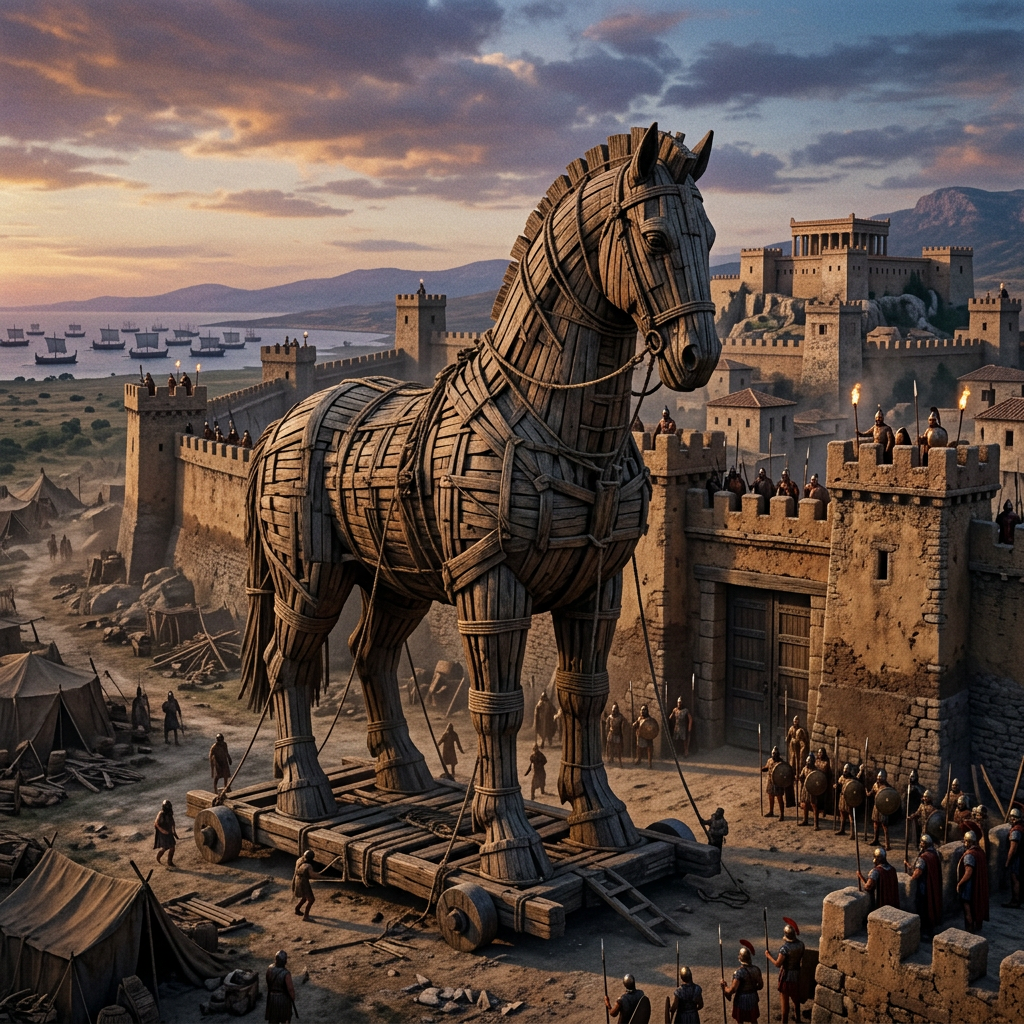
For more than two millennia, the story of the Trojan Horse has captured the imagination of readers, artists, and thinkers. Whether treated as history, legend, or metaphor, the tale of a wooden horse used to infiltrate and destroy the city of Troy remains one of the most powerful narratives about deception and the hidden cost of war.
This article explores the myth of the Trojan Horse, its literary sources, the historical debates around it, and the symbolic meanings that still resonate today.
Origins of the Trojan Horse Story
The Trojan Horse belongs to the cycle of stories surrounding the Trojan War, a legendary conflict between the Greeks (often called Achaeans) and the city of Troy in Asia Minor. While the war itself is most famously told in Homer’s Iliad, the Iliad actually ends before the fall of Troy and does not describe the wooden horse in detail.
Instead, the Trojan Horse appears more fully in later works:
- Homer’s Odyssey (Book 8 and Book 11) briefly mentions the stratagem.
- The Epic Cycle (especially the now-lost Little Iliad and Iliou Persis) reportedly gave fuller accounts known to ancient audiences.
- Virgil’s Aeneid (Book 2), written in Latin in the 1st century BCE, provides the most complete surviving narrative, told from the perspective of the Trojan hero Aeneas.
These sources weave together myth, memory, and poetic imagination into the version of the story that became canonical in Western tradition.
The Famous Stratagem: How the Horse Fooled Troy
According to the traditional account, after ten years of siege, the Greeks grew weary and desperate. Conventional warfare had failed to breach Troy’s strong walls, so cunning replaced brute force.
1. The Construction of the Horse
On the advice often attributed to Odysseus, the Greeks built a massive wooden horse. It was hollow, large enough to conceal a select group of elite warriors. The horse was presented as:
- A “gift” to the goddess Athena, supposed to ensure the Greeks a safe voyage home.
- A symbol of surrender, suggesting the Greeks had abandoned the war and sailed away.
The decision to build a horse was not arbitrary: in Greek culture, horses were prestigious animals associated with wealth, nobility, and sometimes the gods themselves. A divine “votive offering” in the shape of a horse would have appeared plausible.
2. The Deceptive Departure
After constructing the horse, the bulk of the Greek forces pretended to sail away, hiding their ships behind a nearby island. A small group remained hidden inside the wooden structure, waiting for nightfall.
When the Trojans looked out from their walls, they saw:
- An apparently deserted Greek camp.
- A huge wooden horse left behind on the beach.
This unexpected sight triggered confusion and debate within Troy.
3. Debate Inside Troy
The Trojans were divided on what to do with the mysterious horse:
- Laocoön, a Trojan priest, famously warned, “Beware of Greeks bearing gifts” (Timeo Danaos et dona ferentes, in Virgil’s version). He suspected a trick and urged the Trojans to destroy the horse or burn it on the spot.
- Cassandra, the prophetess cursed to speak true prophecies that no one would believe, also warned of disaster.
- Sinon, a captured Greek left behind on purpose, spun a convincing tale: he claimed to have been betrayed by the Greeks and suggested the horse was an offering to Athena that would make Troy invincible if brought inside the city.
Tragically for Troy, the voices of caution were ignored. In Virgil’s Aeneid, even ominous signs—like serpents killing Laocoön and his sons—are misinterpreted as punishment for doubting the “sacred” offering.
4. The Fall of Troy
In a fateful decision, the Trojans opened a breach in their own walls and dragged the horse into the city as a trophy of victory. That night:
- The Trojans celebrated, feasting and drinking after years of war.
- When the city was asleep, the Greek warriors emerged from the horse.
- They opened Troy’s gates to the Greek army, which had secretly returned under cover of darkness.
- The Greeks flooded into the city, burning and plundering, bringing about the total destruction of Troy.
The wooden horse thus became the ultimate symbol of victory through deception rather than direct confrontation.

Symbolism and Meaning
Over time, the Trojan Horse has taken on a life far beyond the original myth. It functions as a rich symbol in literature, art, politics, and everyday language.
1. Deception and False Gifts
The most immediate symbolism of the Trojan Horse is deception disguised as generosity. A gift that conceals danger warns us to be wary of:
- Offers that seem too good to be true.
- Flattery and superficial signs of friendship from former enemies.
- Apparent “solutions” that import new, hidden problems.
This theme resonates in diplomacy, business, and personal relationships: the Trojan Horse is the archetype of the enemy within, invited in through one’s own misjudgment.
2. The Limits of Strength Without Wisdom
The Greeks win not simply because they are stronger or more numerous, but because they use intelligence and strategy. Troy, though strong, falls because it fails to listen to wise counsel and underestimates the possibility of a cunning ploy.
The story suggests that:
- Strength without discernment is vulnerable.
- Wisdom goes unheard when a community is intoxicated by desire, pride, or fatigue.
- The greatest threat is often invited in by our own blindness.
3. Fate, Prophecy, and Human Error
In some versions, the fall of Troy is long foretold by prophecy, yet the Trojans still walk into disaster. This tension between fate and free will adds depth:
- Prophets like Cassandra and priests like Laocoön try to avert catastrophe but are ignored.
- Human beings receive warnings but dismiss them when they clash with what they want to believe.
The Trojan Horse, then, becomes a metaphor for the way individuals and societies ignore inconvenient truths until it is too late.
Did the Trojan Horse Really Exist?
Historians and archaeologists have long debated whether the Trojan Horse has any basis in reality or whether it is purely symbolic.
1. Historical Troy
Excavations at Hisarlik in modern-day Turkey suggest that a city that might be identified with Troy did exist and may have been destroyed around the late Bronze Age (c. 12th–13th century BCE). However:
- The exact nature of any conflict over Troy remains uncertain.
- The details in Homer and later poets likely mix memory, myth, and creative elaboration.
2. Possible Historical Kernels
Some scholars have proposed that the Trojan Horse could represent:
- A siege engine or battering ram shaped like a horse, remembered as a “wooden horse” in later storytelling.
- A ship or a group of soldiers hidden in a vessel with a horse emblem, later mythologized into the famous story.
- A metaphor for an earthquake or natural disaster (since the god Poseidon, associated with earthquakes, was also linked to horses).
None of these theories can be proven definitively, but they illustrate how a striking image—a wooden horse hiding soldiers—might be a poetic transformation of some historical tactic or event.

The Trojan Horse in Later Culture
The image of the Trojan Horse has never lost its appeal. It continues to be reused and reinterpreted in multiple ways:
- Literature and art: Poets, playwrights, and painters revisit the scene of the horse entering Troy or the city’s night of destruction.
- Politics and propaganda: Rivals accuse each other of Trojan Horse tactics—policies or allies that appear beneficial but conceal danger.
- Technology and security: In modern computing, a “Trojan horse” (or simply “trojan”) is malicious software that disguises itself as a legitimate program to gain access to a system.
In each case, the core idea remains the same: a threat that succeeds because it appears harmless or even helpful.
Lessons from the Trojan Horse
The enduring power of the Trojan Horse story lies in the lessons it offers about human behavior, trust, and vulnerability:
- Question apparent gifts from former enemies. Not all generosity is sincere; motives matter.
- Listen to uncomfortable warnings. Wise voices are often ignored when they say what people don’t want to hear.
- Beware of inviting danger inside your own walls. The most devastating blows often come from within, once defenses have been deliberately lowered.
- Value wisdom alongside strength. Cunning and intelligence can overturn even the mightiest fortifications.
Conclusion
The Trojan Horse is more than a memorable episode from ancient epic. It is a timeless symbol of deception, misplaced trust, and the fragile line between security and ruin. Whether or not a literal wooden horse ever stood outside the walls of a historical Troy, the story continues to speak to modern concerns—about politics, technology, and the ways we can be misled by appearances.
In every age, new “Trojan Horses” appear, dressed in the clothing of help, progress, or victory. The ancient myth endures as a reminder to look beneath the surface, to listen to wise counsel, and to question the gifts that arrive too easily at our gates.

Fortisetliber’s View
To us at Fortisetliber, the Trojan Horse is not just an ancient curiosity but a sharp mirror held up to every age—including our own. The Greeks do not win by sheer strength, and Troy does not fall because its walls are weak. The city is destroyed because its people choose to believe a comforting story over a disturbing warning. The decisive battlefield is not the plain before the gates, but the judgment within the minds of the Trojans themselves.
What enters Troy that night is more than a wooden structure; it is a union of two temptations: the desire to declare victory and the refusal to heed inconvenient truth. Laocoön and Cassandra stand for a kind of courage rarer than bravery in battle—the courage to say “no” when everyone wants to say “yes.” Their fate in the story is grim, yet their role is instructive. A society that punishes its truth-tellers is already dismantling its own defenses from within.
Seen this way, the Trojan Horse is a permanent warning sign at the gate of every community, institution, and soul. The most destructive forces seldom arrive under their true names. They appear instead as progress, opportunity, or reward. To live wisely is not to reject every gift, but to test the stories that accompany them. The lesson of Troy is not simply “do not trust the enemy,” but “do not surrender your discernment—even when the gift is beautiful, even when the crowd is cheering.”
Leave a Reply