
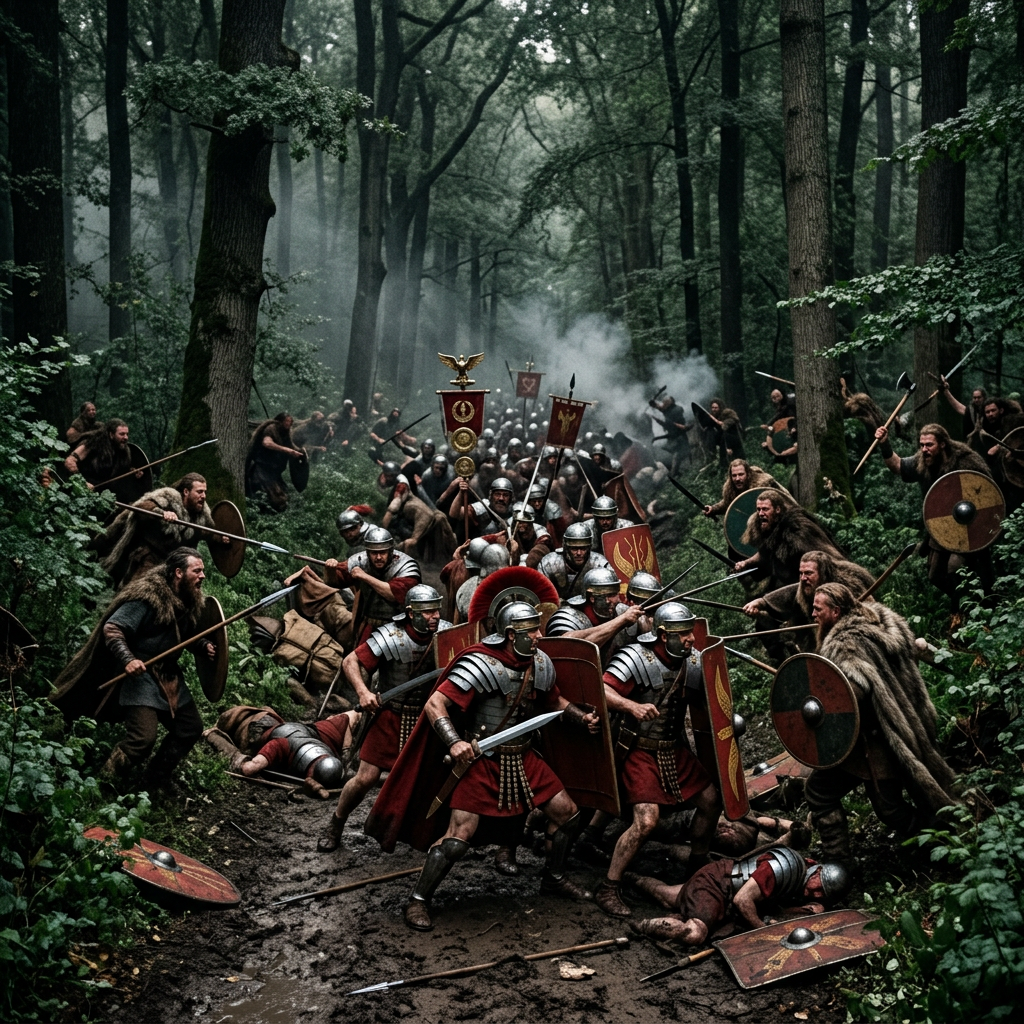
The Battle of Arbalo, fought in 11 BC, was a tense and nearly disastrous engagement during Rome’s early attempts to expand its power into the lands east of the Rhine. Commanded by Nero Claudius Drusus (often called Drusus the Elder), the Roman army narrowly escaped a carefully prepared ambush by Germanic tribes. Although less famous than later conflicts like the Battle of the Teutoburg Forest, Arbalo offers a revealing glimpse into the difficulties Rome faced in trying to conquer Germania.
Historical Background
Rome’s Expansion into Germania
By the late 1st century BC, the Roman Empire under Augustus was at its height. After consolidating control over Gaul, Roman leaders turned their attention beyond the Rhine, hoping to pacify and eventually integrate Germania into the imperial system.
Key aims of Roman policy in the region included:
- Securing the frontier along the Rhine.
- Preventing large-scale Germanic incursions into Roman territory.
- Winning over local tribes through alliances, trade, and displays of military strength.
- Extending Roman political and economic influence eastward.
Drusus, stepson of Augustus and an accomplished commander, was tasked with leading several campaigns across the Rhine beginning in 12 BC. Arbalo took place during his second major campaign, in 11 BC.
The Germanic Tribes and the Terrain
Unlike the organized and urbanized societies Rome had faced in the Mediterranean, the Germanic peoples were decentralized, with power resting in tribal chieftains and warrior elites. The Cherusci, Chatti, Sugambri, and other groups inhabited forests, marshes, and river valleys that were largely unknown to Roman surveyors and scouts.
The landscape itself was a weapon:
- Dense forests limited visibility and Roman maneuverability.
- Marshes and rivers restricted cavalry and heavy infantry.
- Narrow passes and ravines offered ideal locations for ambushes.
It was in such a constricted, hostile environment that the events at Arbalo unfolded.
The Road to Arbalo
In 11 BC, Drusus led a major expedition across the Rhine, advancing deep into Germanic territory. Ancient sources (especially Velleius Paterculus) describe a campaign of rapid marches, skirmishes, and punitive actions against hostile tribes who resisted Roman influence.
During this campaign:
- Drusus pushed farther east than most Roman forces had gone before.
- The Cherusci and allied tribes began to recognize the serious threat Rome posed.
- Hostile leaders sought opportunities to strike the Romans when they were most vulnerable—during movement rather than in open battle.
At some point on Drusus’ return march, his forces entered a narrow defile near a place later identified as Arbalo, likely somewhere in northwestern Germany, though its exact location remains uncertain.

The Ambush at Arbalo
Roman Vulnerability
The Roman army on the march was powerful but not invincible. Long columns of soldiers, baggage trains, pack animals, and artillery moved along constrained paths. In difficult terrain:
- The column could stretch over a great distance.
- Communication between the front, center, and rear became slow.
- If attacked suddenly, units could be isolated and overwhelmed before reinforcements arrived.
The Germanic warriors understood this. They allowed the Romans to penetrate deeply into a narrow pass, then launched a coordinated attack.
The Germanic Attack
According to the surviving accounts, Germanic warriors had prepared the battlefield in advance:
- They positioned themselves in the forested high ground along the pass.
- They waited until a large portion of the Roman army was inside the constricted area.
- They then surged down from the heights, hurling missiles and charging into the flanks and rear of the column.
For a moment, the Roman army faced the very real possibility of encirclement and annihilation. Confined by the terrain and under attack from several directions, Drusus’ legions were in grave danger.
Roman Discipline and Recovery
What saved the Romans at Arbalo was not terrain, surprise, or numbers—but discipline and command.
Drusus and his officers:
- Quickly rallied the troops in the threatened sectors.
- Formed defensive positions where possible, using the classic Roman tactics of cohesion and shield walls.
- Pushed to secure a defensible camp or strong position at one end of the defile.
Roman soldiers, trained to fight in close order and maintain formation even under intense pressure, gradually stabilized the situation. While individual Germanic warriors were formidable, their attacks lacked the sustained coordination and heavy infantry organization of the legions.
Despite severe fighting, the Romans:
- Prevented a total collapse of the line.
- Held their ground long enough for units from other sections of the column to reinforce them.
- Eventually drove the attackers back and broke out of the trap.

Outcome and Immediate Aftermath
The Battle of Arbalo ended as a Roman tactical escape rather than a clear-cut victory:
- The Germans failed to annihilate Drusus’ army, which survived as a coherent fighting force.
- The Romans suffered notable casualties and were shaken by how close they had come to disaster.
- Drusus managed to bring his legions back to safer ground west of the immediate danger zone.
From a Germanic perspective, Arbalo was a demonstration that Roman forces, while powerful, were not invulnerable—especially in difficult terrain where local knowledge and surprise could be used to great effect.
For Rome, the battle served as a stark warning:
- Deep operations beyond the Rhine were fraught with risk.
- Overconfidence and extended lines of communication could invite catastrophe.
- Terrain and ambush tactics could neutralize some of the legions’ advantages.
Significance of the Battle
Strategic Lessons for Rome
Although Arbalo did not stop Roman campaigns in Germania, it influenced Roman thinking:
- Caution in Deep Penetrations
Commanders became more aware of the dangers of operating far from fortified bases and supply lines, particularly in unfamiliar terrain. - Emphasis on Reconnaissance
The need for better intelligence, scouting, and cooperation with friendly or neutral tribes became clearer. - Foreshadowing Future Disasters
Arbalo, in some ways, foreshadowed the far larger catastrophe at the Teutoburg Forest in AD 9, when three Roman legions were destroyed in another woodland ambush. Both battles highlight Rome’s vulnerability in environments where its standard battlefield doctrines were difficult to apply.
Germanic Resistance and Identity
For the Germanic tribes, Arbalo contributed to:
- A growing tradition of resistance against Roman expansion.
- The development of tactics centered on ambush, surprise, and use of terrain rather than open-field combat.
- The strengthening of local leaders who could claim to have stood up to Rome.
These themes would resurface dramatically in the leadership of Arminius and the alliance of tribes that destroyed Varus’ legions some two decades later.
Drusus’ Reputation
Despite the close call at Arbalo, Drusus’ overall reputation remained strong:
- He was seen as a bold and energetic general.
- His campaigns laid much of the groundwork for Rome’s presence and influence east of the Rhine, even if full provincial annexation ultimately failed.
- His early death in 9 BC cut short a promising career; some Roman writers later speculated that Germania might have been more securely controlled had he lived longer.
The Elusive Battlefield
One lingering mystery about Arbalo is the precise location of the battle. Ancient sources do not provide exact coordinates, and archaeological evidence has yet to definitively identify the site.
Scholars have proposed that Arbalo lay:
- Somewhere in the region between the Rhine and the Weser rivers.
- Along a major route used by Roman forces during Drusus’ campaigns.
The uncertainty illustrates a broader challenge in studying Rome’s German campaigns: much of the conflict took place in forests and temporary camps that have left only faint traces in the archaeological record.

Conclusion
The Battle of Arbalo in 11 BC may not be as widely known as other Roman battles, but it was a crucial episode in the long and troubled history of Rome’s engagement with Germania. It revealed both the strengths and the weaknesses of the Roman war machine:
- Strength in the discipline, cohesion, and leadership that allowed the legions to escape a near-fatal ambush.
- Weakness in the empire’s dependence on open terrain, reliable logistics, and predictable opponents.
Arbalo stands as a reminder that even at the height of its power, Rome was not all-powerful. In the deep forests beyond the Rhine, small missteps and hostile terrain could quickly turn an imperial advance into a desperate fight for survival.
Fortisetliber’s View
The Battle of Arbalo reveals Rome at its most paradoxical: powerful enough to thrust deep into unknown lands, yet fragile when that power was stripped of preparation, intelligence, and terrain. Drusus’ army did not prevail at Arbalo because of inevitability or imperial destiny, but because disciplined men and capable officers held their nerve in circumstances that should have destroyed them.
For Fortisetliber, Arbalo is a reminder that strength without prudence is merely a prelude to disaster. The Germanic tribes showed how knowledge of land, patience, and the willingness to strike at the moment of maximum vulnerability can humble even the greatest empire. Rome escaped this trap, but the same pattern—overconfidence, extended lines, underestimated opponents—would return at Teutoburg with far bloodier consequences.
Arbalo therefore stands not as a triumphant Roman episode, but as a quiet warning. Freedom and security are preserved not simply by force of arms, but by an honest reckoning with limits: of terrain, of knowledge, and of human foresight. Where that reckoning is ignored, the forest is always waiting.
Leave a Reply