
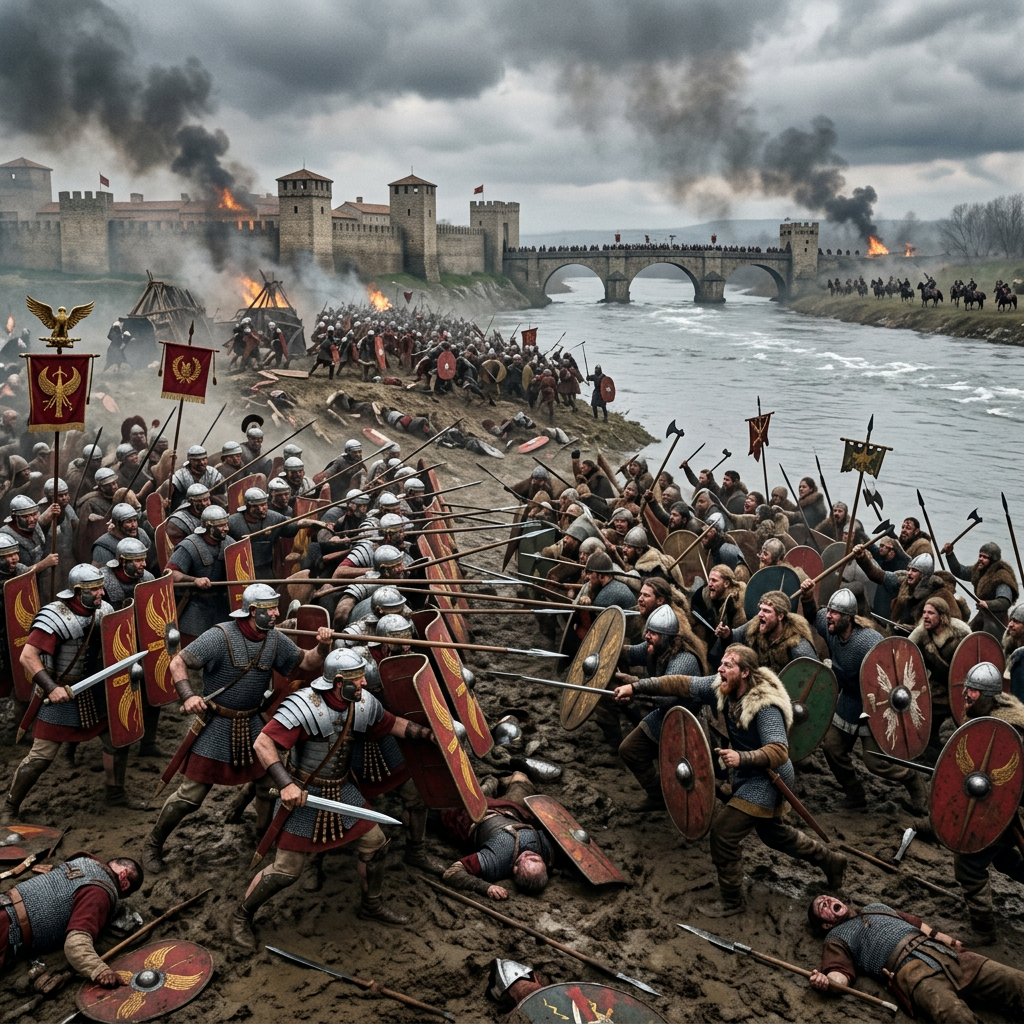
In 458 AD, near the city of Arelate (modern Arles in southern France), a Roman army under the new Western emperor Majorian confronted the Visigothic king Theodoric II. Though often overlooked, this victory briefly revived imperial authority in Gaul and reshaped relations between Romans and Goths at a critical moment of decline for the Western Roman Empire.
1. Background: Crisis in the Late Western Roman Empire
By the mid-fifth century, the Western Roman Empire was a fragile remnant of its former power. Central authority was weak, military resources were thin, and powerful generals and barbarian allies often held more real influence than emperors themselves.
Majorian rose within this world as a professional soldier and close associate of the powerful general Ricimer. Distinguished in earlier campaigns against barbarian groups, he became a leading candidate to restore imperial strength after a series of ineffectual rulers.
In 457, after the death of Emperor Avitus, Majorian was proclaimed emperor of the West with the backing of the army and Ricimer. Although formally recognized by the Eastern court later, his position was initially insecure. To survive, Majorian needed clear military successes that could demonstrate his legitimacy and restore Roman prestige.
At the same time, the Visigoths occupied a powerful position in southwestern Gaul and parts of Hispania. Originally settled as federate allies of Rome in Aquitaine earlier in the fifth century, they had expanded their authority as Roman control weakened, especially after the crisis of 451 when they had fought alongside Rome against Attila.
Under King Theodoric II, the Visigothic kingdom centered on Tolosa (Toulouse) operated with considerable independence. While still nominally tied to Rome by treaty, Theodoric pursued his own regional ambitions, pushing into new territories and taking advantage of Roman weakness.
2. The Road to War and the Strategic Importance of Arelate
The collapse of strong central control in Gaul opened space for both Roman regional commanders and the Visigoths to compete for authority. After 451, the Visigoths pressed further into Roman lands, including areas along the lower Rhône. Their presence threatened key cities and communication lines that connected Italy with the remaining Roman possessions in Gaul and Hispania.
Majorian and his circle aimed to reverse these losses. To have any chance of reconstituting Western power, the imperial government needed reliable access to Gaul, a secure route to the Iberian Peninsula, and stable relations with major barbarian groups. That meant reining in Visigothic expansion and reasserting Roman control over contested cities.
Arelate, long an important Roman center, stood at a crossroads. It lay near the mouth of the Rhône, at the point where river, sea, and land routes met. Whoever held Arelate could control traffic between Italy and Gaul, monitor movements along the Mediterranean coast, and influence trade and supply lines into the interior.
By the late 450s, Visigothic pressure in southeastern Gaul and their involvement in Roman internal struggles had made Arelate a focal point of tension. When Majorian prepared his first major campaign as emperor, he chose to move against the Visigoths in Gaul. A decisive battle near Arelate offered an opportunity not only to recover territory but also to signal that the Roman state still mattered.

3. Commanders and Forces: Romans and Visigoths
On the Roman side, Emperor Majorian did not act alone. He relied on a network of experienced generals who commanded the remaining imperial forces in Gaul and northern regions.
Majorian himself was a seasoned officer noted for his personal courage and organizational skill. He had served under the great general Aetius and had experience fighting in Gaul and along the Rhine. As emperor, he now had to combine military leadership with political calculation.
A key ally was Aegidius, the former magister militum in Gaul and a powerful Roman commander based in the north. Loyal to Majorian, Aegidius controlled troops in the region around the Loire and had his own interest in limiting Visigothic expansion. Another figure, Nepotianus, is also mentioned in the sources as taking part in the campaign, likely commanding additional Roman or allied contingents.
Opposing them was Theodoric II, king of the Visigoths. Theodoric had come to power in 453 after overthrowing his brother, reflecting the often violent internal politics of the Visigothic court. Educated and capable, he balanced cooperation with Rome when useful against an agenda of territorial enlargement.
The Visigothic forces were largely composed of heavily armed Gothic warriors, many of them elite cavalry who had proven themselves in earlier battles such as the campaign against Attila. They were supported by subject or allied groups in Gaul and Hispania. The Roman army, by contrast, was a composite force, mixing regular troops, remnants of older field armies, and various federate and mercenary contingents.
4. The Campaign and the Battle Near Arelate
The sources for this campaign are limited and often written from a Roman perspective, so many details remain uncertain. Nonetheless, a broad outline of events can be reconstructed.
Once secure enough in Italy, Majorian moved north and west, coordinating with Aegidius and Nepotianus to concentrate Roman forces in Gaul. The goal was to confront the Visigoths in a major engagement and compel them to accept new terms that favored Rome.
The Visigoths, for their part, could not easily avoid battle. Their territories in Aquitaine and their ambitions in southeastern Gaul depended on projecting strength. Allowing a Roman army to advance freely toward Arelate would have undermined their authority among both Gothic nobles and subject provincials.
Clashes likely occurred as the Romans advanced, with skirmishes and sieges in contested areas. The decisive meeting came near Arelate in 458. Here, Majorian and his commanders brought their forces to bear against Theodoric’s army in a pitched battle.
Later Roman writers such as Sidonius Apollinaris emphasize the discipline and tactical skill of Majorian’s troops. The Romans appear to have exploited their knowledge of local terrain and coordinated infantry and cavalry effectively. Despite Visigothic strength in heavy cavalry, the Roman army managed to break their formations and drive them from the field.
Theodoric II was forced to retreat and seek peace. While exact casualty figures are unknown, the outcome was clearly a Roman victory, marked not only by success in battle but also by the favorable settlement that followed.

5. Immediate Outcome and Political Consequences
The defeat near Arelate compelled the Visigoths to accept new terms from Majorian. According to later accounts, Theodoric II renewed his status as a Roman ally and returned some territories he had previously occupied, particularly in southern Gaul.
For the Visigoths, the loss checked their rapid expansion and temporarily curtailed their influence in the Rhône valley. Theodoric could not afford to alienate Rome completely, especially with rival powers such as the Suebi and Vandals also active in the western provinces. By agreeing to Majorian’s conditions, he preserved his kingdom but accepted a more limited role, at least for a time.
For Majorian, the victory at Arelate was a major political success. It demonstrated that the Western Empire could still field effective armies and win significant battles. In the eyes of Roman elites in Gaul and Italy, this helped legitimize his rule and encouraged some provincial leaders to cooperate with his broader reform and reconquest plans.
The battle also strengthened Majorian’s position relative to his powerful partner Ricimer. While Ricimer remained influential, Majorian’s personal command of a successful campaign in Gaul enhanced his independent stature and allowed him to negotiate with barbarian kings, including Theodoric, from a position of greater confidence.
6. Long-Term Significance for Roman Gaul
In the longer view, the Battle of Arelate did not permanently restore Roman power in Gaul. Within a few years, Majorian’s ambitious plans were cut short. In 461 he was deposed and killed under circumstances that strongly suggest Ricimer’s involvement. Without Majorian’s leadership, the Western Empire lacked the energy and coherence needed to sustain gains.
After Majorian’s death, Roman authority in Gaul eroded rapidly. Aegidius maintained a semi-independent Roman enclave in the north for a time, but broad imperial control collapsed. The Visigoths, freed from the constraints imposed after Arelate, resumed their expansion, eventually dominating most of southern Gaul and much of Hispania.
Even so, the battle’s significance should not be dismissed. It showed that, under determined leadership, the Western Empire could still force powerful federate kingdoms to negotiate and even cede territory. The brief revival of Roman prestige in Gaul influenced how local elites thought about loyalty, identity, and the possibility of imperial recovery.

Conclusion: Why This Lesser-Known Battle Still Matters
The Battle of Arelate is easily overshadowed by more famous clashes like the Battle of the Catalaunian Plains or the sack of Rome. Yet it captures a crucial moment when the Western Empire, though gravely weakened, could still act decisively and shape events in Gaul.
Studying Arelate highlights the complexity of the late Roman world, in which emperors, generals, and barbarian kings constantly renegotiated power. It reminds us that the fall of the Western Empire was not a single event but a long process, punctuated by efforts at recovery and episodes of real, if temporary, success. In that sense, the battle stands as a testament to both the resilience and the limits of late Roman rule in the West.
Fortisetliber’s View
The Battle of Arelate is a rare moment of attempted recovery in an age we usually describe only as decline. Majorian’s victory shows that leadership, discipline, and clear strategic aims could still briefly restore Roman authority even in the Empire’s final phase. Yet the speed with which court intrigue in Italy erased these gains is the deeper lesson: external successes cannot save a polity whose inner institutions no longer support or reward its most capable defenders.
Leave a Reply