
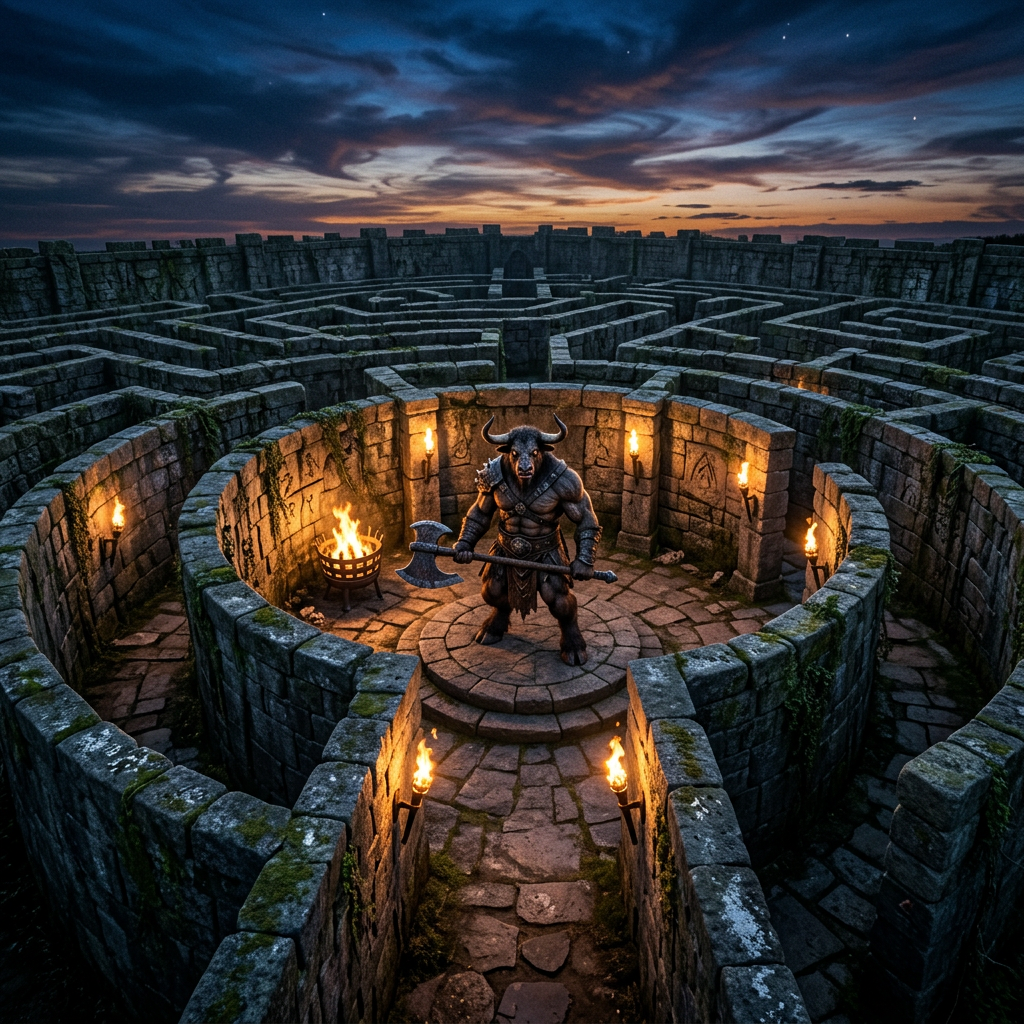
The story of Theseus and the Minotaur is one of the most enduring myths of ancient Greece. Set between the shining city of Athens and the mysterious island of Crete, it combines politics and sacrifice, courage and cunning, and the haunting image of a monster hidden in a maze. Far more than a simple monster-slaying tale, it reflects ancient anxieties about power, order, and what it means to be truly human.
The World of the Myth: Athens, Crete, and a Deadly Tribute
In most versions of the myth, Athens has fallen under the power of Crete. Years earlier, King Minos of Crete had defeated the Athenians in war. As part of the peace terms—or as an act of revenge—Minos imposed a terrible tribute: every nine years (in some tellings, every year), Athens must send seven young men and seven young women to Crete.
These youths are not prisoners of war or criminals. They are the children of Athenian families, chosen by lot. Their fate is to be thrown into the Labyrinth, a vast and bewildering maze designed by the genius craftsman Daedalus. Somewhere at the center of this maze lurks the Minotaur: half man, half bull, a ravenous creature that devours the Athenian youths.
For Athens, this tribute is more than a political humiliation. It is a ritualized bleeding of its own future, a slow sacrifice of its next generation to a foreign power and a monstrous god.
The Birth of the Minotaur: A Monster of Divine and Human Transgression
The Minotaur itself has a disturbing origin that reveals much about the world of the myth.
Minos, king of Crete, once begged Poseidon, god of the sea, for a sign of divine favor. Poseidon sent a magnificent white bull rising from the waves, with the expectation that Minos would sacrifice it back to the god. Impressed by its beauty and power, Minos refused to kill it and kept the bull for himself.
This act of ingratitude and disobedience calls down divine punishment. Poseidon causes Minos’ wife, Queen Pasiphaë, to fall in unnatural desire for the bull. With the help of Daedalus, she contrives to mate with it. From this union is born the Minotaur: a monstrous being, with the body of a man and the head of a bull, who feeds on human flesh.
Ashamed and fearful, Minos orders Daedalus to build the Labyrinth, a structure so intricate that no one who enters can find the way out. There the Minotaur is confined, hidden but not destroyed, sustained on the blood of Athenian youth.
Already the myth suggests that monsters are not simply “other”: they can be the product of human pride, divine anger, and failed responsibility. The Minotaur is a symbol of what happens when rulers misuse power and ignore divine and moral limits.

Theseus Steps Forward: A Hero Volunteers
In Athens, the tribute to Crete becomes a recurring nightmare. When the time comes again to send fourteen young Athenians, King Aegeus mourns, yet feels he has no choice.
It is at this point that Theseus, prince of Athens and son of Aegeus, intervenes. Rather than allow another group to go to certain death, he volunteers to be one of the seven young men. His decision is both political and personal: he aims to free Athens from the humiliating tribute and to prove himself as a true hero of the city.
In some accounts, Theseus promises his father that if he survives, he will change the sails of his ship from black (a sign of mourning) to white (a sign of victory) upon returning. This detail will become tragically important later.
Theseus’ heroism is not purely a matter of physical strength. His journey to Crete is also a willingness to confront the unknown: a foreign court, a hidden monster, and the confusion of the Labyrinth itself.
Ariadne and the Thread: Love, Cunning, and Escape
When Theseus arrives in Crete, his fate seems already sealed. Yet another figure quietly reshapes the story: Ariadne, daughter of King Minos.
Ariadne sees Theseus and falls in love with him—or at least is moved deeply by his courage and beauty. She resolves to help him survive the Labyrinth, on one condition: that he take her with him to Athens and make her his wife.
She obtains from Daedalus the crucial piece of practical wisdom that will make Theseus’ victory possible. Daedalus advises that, before entering the Labyrinth, Theseus should tie one end of a thread (or in some versions, a ball of wool) at the entrance and unwind it as he goes, so he can retrace his steps after killing the Minotaur.
Armed with Ariadne’s thread and his own courage, Theseus enters the maze. After wandering through its twisting corridors, he finally encounters the Minotaur. In the cramped space of the Labyrinth, brute strength and close combat decide the outcome. Theseus wrestles the monster and kills it—sometimes with his bare hands, sometimes with a sword.
The slaying of the Minotaur is only half the victory. Without Ariadne’s thread, Theseus and the other youths would simply die of hunger and confusion within the maze. By following the thread back to the entrance, Theseus leads the survivors safely out of the Labyrinth and toward freedom.
The “thread of Ariadne” becomes, in later literature and philosophy, a metaphor for any guiding principle that helps one navigate complexity and chaos.

The Return and Tragedy: Forgetting, Grief, and a New King
Theseus flees Crete with the freed Athenian youths and with Ariadne. On the way back to Athens, however, the story darkens.
On the island of Naxos (or Dia, in some versions), Theseus abandons Ariadne. Ancient sources disagree about why. In some tellings, the god Dionysus appears and claims Ariadne for himself, commanding Theseus to leave her. In others, Theseus simply deserts her, raising questions about his character and loyalty.
Whatever the reason, Ariadne is left behind, and Theseus sails on toward Athens. But he makes a fatal mistake: he forgets to change the ship’s sails from black to white, as he had promised his father.
King Aegeus, watching from a cliff near Athens, sees the black sails on the returning ship. Believing his son to be dead, he is overcome with grief and throws himself into the sea. The body of water, in turn, is said to take its name from him: the Aegean Sea.
When Theseus lands and learns what has happened, he is both victorious and bereaved. He has freed Athens from the Minotaur and the Cretan tribute, but his father is dead, and Ariadne is gone. Theseus becomes king of Athens, yet his kingship is shadowed by personal loss and moral ambiguity.
Symbolism of the Labyrinth and the Minotaur
The myth of Theseus and the Minotaur is rich in symbolism that continues to resonate:
- The Labyrinth as the Human Condition
The Labyrinth represents confusion, uncertainty, and the complexity of life. To enter it is to confront the unknown within and without. Modern readers often see it as a symbol of the mind, society, or the difficult paths of moral and spiritual growth. - The Minotaur as the “Beast Within”
Half man and half bull, the Minotaur stands for uncontrolled instinct, violence, and desire—forces that, when denied or hidden, do not disappear but grow more dangerous. Buried in the Labyrinth, this “inner beast” feeds on what is most precious: in the myth, the youth of Athens. - Ariadne’s Thread as Reason, Memory, or Love
Theseus defeats the Minotaur through strength, but he escapes the Labyrinth through intelligence and trust. Ariadne’s thread can be seen as reason (the ability to keep track of one’s path), memory (a way of not losing oneself), or love (the relationship that guides Theseus out of isolation). - Theseus as Civic Hero—and Flawed Human Being
Theseus embodies Athenian ideals of courage, initiative, and devotion to the city. Yet his abandonment of Ariadne and the forgotten sails suggest that even heroes are limited, forgetful, or morally compromised. The myth refuses a simple, idealized picture of heroism.
Political and Cultural Meanings
In the context of ancient Greece, the story also had political dimensions:
- Athenian Identity: Theseus was celebrated as a founding hero of Athens, sometimes credited with unifying Attica under Athenian rule. His victory over the Cretan monster dramatizes Athens’ rise from subjugation to power and prestige.
- Power and Tribute: The Athenian youths sent to Crete can be read as a commentary on how empires assert dominance through symbolic, ritualized demands. The myth may preserve a distant memory of Minoan influence over the mainland or more generally reflect anxieties about being subject to a foreign power.
- Human Sacrifice and Civilization: The end of the Minotaur’s reign marks a turning point: a move away from primitive, bloodthirsty rituals toward a more “civilized” and rational order. Killing the monster and escaping the Labyrinth become symbols of a society freeing itself from barbaric practices.

Why the Myth Still Matters
Today, the story of Theseus and the Minotaur continues to inspire literature, art, and philosophy. We speak of “labyrinthine” problems, of following an “Ariadne’s thread” through complex arguments, of facing our own “inner Minotaur.”
The myth endures because it offers a powerful image of the human journey:
- We are thrown into a kind of labyrinth—of choices, fears, and desires.
- We must confront whatever monstrous realities we or others have hidden away.
- We rely on threads: relationships, memory, reason, and faith, to guide us.
- Even when we succeed, our victories come mixed with loss and imperfection.
In this way, the ancient tale of Theseus and the Minotaur is not just a story about a hero in a distant past. It is an exploration of how we navigate danger and complexity, what we are willing to sacrifice, and how we struggle to become truly human in a world where monsters are never entirely far away.
Fortisetliber’s View
The myth of Theseus and the Minotaur is not only about a hero killing a monster; it is about a city that has learned to live with injustice. Athens sends its own sons and daughters into the Labyrinth as tribute to Crete. Long before Theseus lifts a sword, the real horror is the quiet agreement that this must continue—that some lives can be spent to keep the peace.
Theseus’ choice to volunteer breaks that agreement. He refuses the logic of resignation, taking on himself the risk his city has pushed onto the anonymous young. Yet courage alone would not be enough. Without Ariadne and her thread, his victory over the beast would end in another death, lost in the maze. The thread—reason, memory, or love—turns a single brave act into a path that others can follow out of the darkness.
The story, however, will not let us idealize our hero. Theseus abandons Ariadne; he forgets to change the sails and causes his father’s death. The one who frees his city remains flawed. That tension is crucial. The Labyrinth today is wherever we maintain order by hidden sacrifices—suffering we choose not to see. To live brave and free is to enter that space with open eyes, to name the beast we have been feeding, and to seek together a thread strong enough to lead us not just out of fear, but back into responsibility.
Leave a Reply