
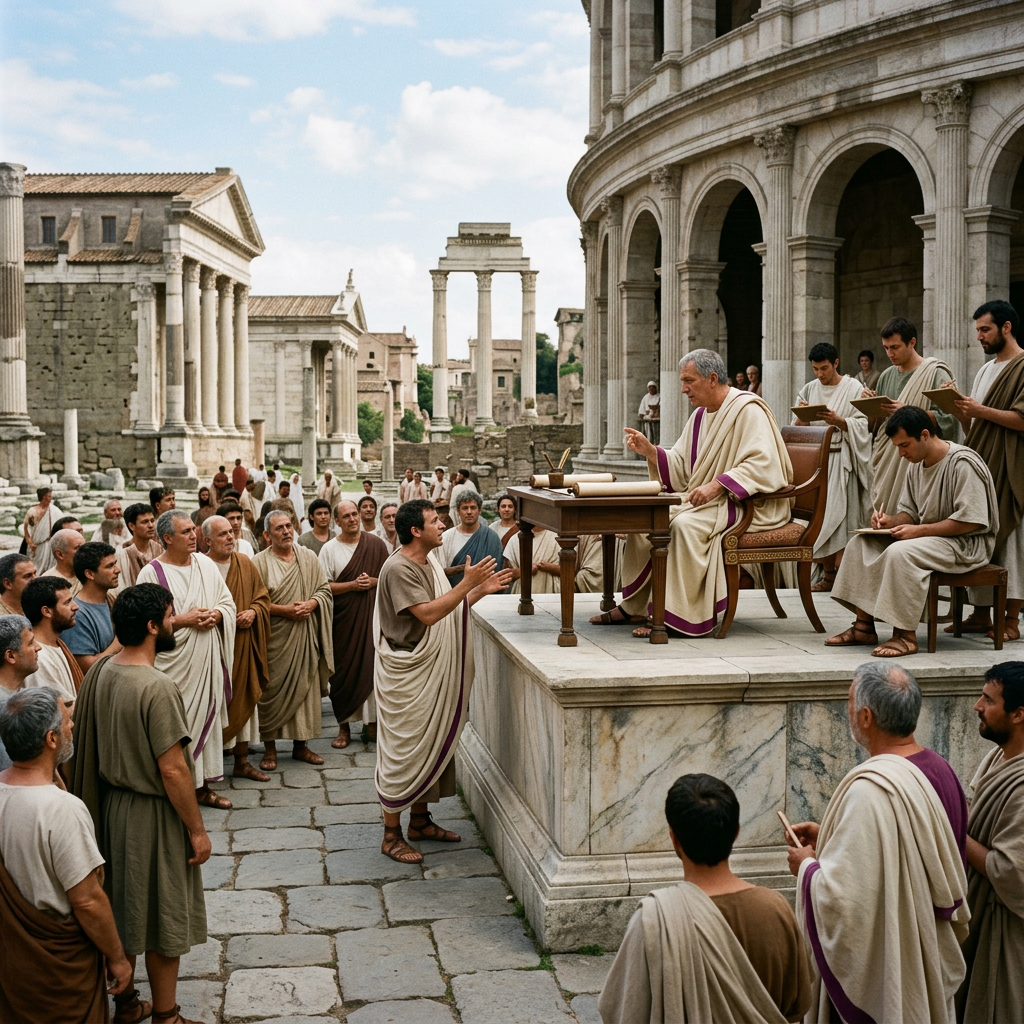
The Roman law courts were central to the political, social, and intellectual life of Rome. Far from being marginal technical institutions, they formed a crucial arena in which status, power, and rhetoric were exercised and contested. From the Republic through the Principate, the Roman legal system evolved from relatively simple proceedings grounded in customary law (mos maiorum) to a sophisticated and increasingly professionalized body of jurisprudence.
This article outlines the principal courts and magistrates, distinguishes between civil and criminal proceedings, and sketches the evolution of procedural forms from the legis actiones to the cognitio extra ordinem. It concludes by considering the role of advocates, jurors, and evidence in Roman forensic practice.
1. Judicial Organization in the Roman Republic
1.1 Magistrates and Jurisdiction
In the Republican period, judicial authority was closely connected to magistracies holding imperium or other forms of public power. The most important figures were:
- The praetor urbanus, responsible for disputes between Roman citizens (cives Romani).
- The praetor peregrinus, introduced in 242 BCE, who handled cases involving foreigners (peregrini) or mixed citizen–foreigner disputes.
- Various aediles, consuls, and quaestors, who exercised limited or specialized jurisdiction.
These magistrates did not, in the main, decide factual disputes themselves. Instead, especially in civil law (ius civile), their function was to frame the legal issue and to appoint a judge (iudex) or a panel of judges (iudices) to hear the case. This two‑stage system is fundamental to understanding Roman procedure.
1.2 The Dual‑Stage Civil Procedure
Classical jurists and later compilations, such as the Institutes of Gaius (Gai. Inst. 4), distinguish two stages in civil proceedings under the Republic and early Empire:
- In iure (before the magistrate):
- The parties appeared before the praetor.
- The praetor determined whether the claim was legally cognizable and within his imperium.
- He granted or denied an actio (a form of action) according to his edict (edictum praetoris).
- If the action was granted, a formula (in the formulary period) was crafted to define the legal issue.
- Apud iudicem (before the judge):
- A private individual, the iudex privatus, or occasionally a panel of recuperatores, heard evidence and witnesses.
- The iudex applied the formula and rendered a condemnatio (condemnation) or an absolutio (acquittal in civil sense: dismissal).
This delegated jurisdiction preserved the political authority of magistrates while embedding judicial decision‑making within the elite citizen body, reinforcing Roman ideals of civic participation.

2. Criminal Justice and the Quaestiones Perpetuae
2.1 From Popular Assemblies to Standing Courts
Early criminal trials (iudicia publica), especially those involving capital penalties, were often held before the popular assemblies (comitia). However, from the late second century BCE onward, Rome increasingly relied on standing jury courts, the quaestiones perpetuae.
Each quaestio perpetua had jurisdiction over a particular category of offense, such as:
- Repetundae – extortion by provincial governors.
- Maiestas – offenses against the majesty of the Roman people (roughly “treason”).
- Ambitus – electoral bribery and corruption.
- Peculatus – embezzlement of public funds.
- Sicarii et venefici – murderers and poisoners.
These courts were presided over by a praetor or other magistrate, but the verdict was rendered by a panel of iudices (jurors) drawn from defined social orders, originally the senatorial order, later including the equites.
2.2 Composition and Role of the Jury (Iudices)
The jurors (iudices) in the quaestiones were not professional judges; they were typically members of the elite orders serving for a set term. Their role included:
- Hearing oratorical arguments from both prosecution and defense.
- Evaluating witness testimony and documentary evidence (where available).
- Voting, often by secret ballot (tabellae), on condemnatio or absolutio.
This system made the criminal courts powerful instruments of politics and reputation. Trials of prominent figures—such as those described by Cicero in his speeches Pro Roscio Amerino, In Verrem, and others—were public spectacles in which legal argument intertwined with moral rhetoric and political maneuvering.
3. Forms of Civil Procedure: From Legis Actiones to Cognitio
3.1 The Legis Actiones
The earliest known form of Roman civil procedure, the legis actiones, is notoriously archaic and formalistic. As described in Gaius (Inst. 4.11–30), these proceedings were:
- Tied directly to statutory formulas (leges).
- Performed through ritualized verbal and physical acts, such as the legis actio sacramento, in which parties swore an oath and staked a sacramentum (a sum of money).
- Extremely sensitive to technical errors; a mispronounced word or incorrect gesture could be fatal to one’s claim.
The rigidity of the legis actiones came to be seen as an obstacle to justice in an evolving, increasingly commercial society.

3.2 The Formulary Procedure (Per Formulas)
By the late Republic and early Principate, the formulary procedure largely supplanted the legis actiones for ordinary civil disputes. In this system:
- The praetor, in the in iure stage, issued a standardized or customized formula, essentially a written instruction to the iudex.
- The formula contained components such as:
- Intentio: the plaintiff’s claim (e.g. “If it appears that the defendant ought to pay…”).
- Demonstratio: a description of the underlying facts.
- Condemnatio: authorization for the iudex to condemn or absolve, often within monetary limits.
- Exceptio: a defense plea raised by the defendant (e.g. exceptio doli, defense of fraud).
- The iudex then proceeded apud iudicem, restricted by the terms of the formula.
The formulary system allowed the praetor’s edict to become a powerful engine of legal development. Through the annual edict, the praetor could introduce new actiones utiles, exceptiones, and interdicta, thereby gradually reshaping Roman private law.
3.3 Cognitio Extra Ordinem
In the later Empire, the older two‑stage system gave way to the cognitio extra ordinem, a more unified and bureaucratic form of procedure:
- The dispute was heard in a single stage before an official (iudex or cognitor) who combined the roles of magistrate and judge.
- Appeal procedures developed, and imperial rescripts and constitutions began to overshadow the praetorian edict.
- This process is reflected in the later compilations such as the Digest (Digesta) and Codex of Justinian.
The cognitio procedure marks a shift toward centralized imperial judicial authority, aligning with broader transformations in the late Roman state.
4. Advocates, Rhetoric, and Forensic Culture
4.1 The Roman Advocate (Orator / Patronus)
Roman courts were arenas of oratory as much as of law. The role of the advocate (orator, patronus) was crucial:
- Elite Romans often saw forensic eloquence as a path to political prominence.
- Famous advocates like Marcus Tullius Cicero cultivated public reputations through published speeches (orationes).
- Advocacy was initially understood as a form of amicitia and patronage, rather than a paid profession in the modern sense, though by the Empire there were honoraria and more professionalized legal practitioners.
Cicero’s rhetorical manuals, such as De Oratore, and his forensic speeches display both technical legal argument (argumentatio iuridica) and appeals to ethos and pathos, highlighting how legal reasoning and persuasion were intertwined.
4.2 Evidence and Proof
Roman law did not develop a technical “law of evidence” in the modern sense, but certain principles can be discerned:
- Witness testimony (testes) played a central role. Character and status of witnesses affected credibility.
- Documents (tabulae, instrumenta), such as contracts and account books, were used and could be challenged for authenticity.
- Oaths (iuramentum) and torture (quaestio), especially of slaves, were sometimes employed, particularly in criminal or politically sensitive cases.
- The iudex or iudices enjoyed a relatively broad discretion to assess probatio (proof), guided by social expectations and rhetorical framing.
Because courts were public and often crowded, the proceedings had a strong theatrical element, with advocates leveraging legal and extra‑legal factors alike.

5. Roman Courts and the Development of Legal Thought
5.1 Jurists and Jurisprudence
Alongside magistrates and advocates stood the jurists (iuris prudentes), experts in ius civile and ius honorarium:
- They did not usually sit as judges, but provided responsa (opinions), cavere (drafting of legal instruments), and agere (advice on litigation).
- The classical jurists—such as Labeo, Sabinus, Ulpian, Paulus, and Papinian—shaped the conceptual structure of Roman law.
- Their writings were extensively excerpted in Justinian’s Digest (Dig. 1.1 ff.), which became a foundational text for later civil law traditions in Europe.
The interaction between practical litigation in the courts and scholarly jurisprudence created a rich body of legal doctrine that influenced medieval and modern legal thought.
5.2 Social and Political Dimensions
The Roman courts were not merely neutral venues for dispute resolution. They were embedded in:
- Class relations: access to legal remedies and the likelihood of favorable outcomes were shaped by status (status civitatis, status familiae) and wealth.
- Imperial authority: under the Principate and Dominate, the emperor’s imperium maius and rescripts increasingly dominated criminal and administrative justice.
- Urban culture: high‑profile trials were important public events, shaping reputations and political alignments.
Consequently, understanding Roman law courts offers insight not only into ancient legal doctrine, but also into the structures of Roman society and government.
Conclusion
The Roman law courts evolved from early, highly formalistic rituals to sophisticated, text‑based and bureaucratic procedures. The distinction between civil (privata) and criminal (publica) actions, the two‑stage in iure / apud iudicem system, the creation of standing jury courts (quaestiones perpetuae), and the later emergence of cognitio extra ordinem illustrate the dynamism of Roman legal institutions.
At every stage, the courts were shaped by and, in turn, helped shape Roman politics, social hierarchy, and intellectual life. Through the work of magistrates, jurors, advocates, and jurists, the Roman legal system left a legacy that would profoundly influence later continental European and, indirectly, global legal traditions.
Fortisetliber’s View
To modern readers, the Roman law courts can appear simultaneously familiar and alien. Familiar, because we recognize structures that still shape contemporary legal systems: written formulas, professional advocacy, the separation between the framing of legal issues and the evaluation of facts, and the slow sedimentation of case‑driven jurisprudence. Alien, because these mechanisms were embedded in a society in which status, citizenship, and patronage mattered far more than abstract equality before the law.
Roman litigation was never merely about the correct application of rules. A trial before a quaestio perpetua or a civil dispute apud iudicem was a theatre in which elite competition played out under the cloak of legality. The same institutions that disciplined provincial governors for repetundae also offered ambitious advocates a stage on which to advertise their loyalty to the res publica or, later, to the emperor. Law in Rome was not an external constraint upon power; it was one of power’s preferred languages.
Yet it would be reductive to see the courts only as instruments of domination. Precisely because litigation was public and rhetorically charged, it generated normative expectations: about what counted as just dealing, about acceptable uses of authority, and about the obligations owed even to weaker parties. The praetor’s edict, the practice of the jurists, and the decisions of countless iudices collectively produced a body of reasoning that later legal traditions could appropriate, reinterpret, and contest.
Studying Roman courts, then, is less about reconstructing an ancient technicality than about understanding how a powerful society translated conflict into argument and argument into judgment. In that translation—partial, biased, and contingent though it was—we can see both the possibilities and the limits of law as a civilizing force.
Leave a Reply