
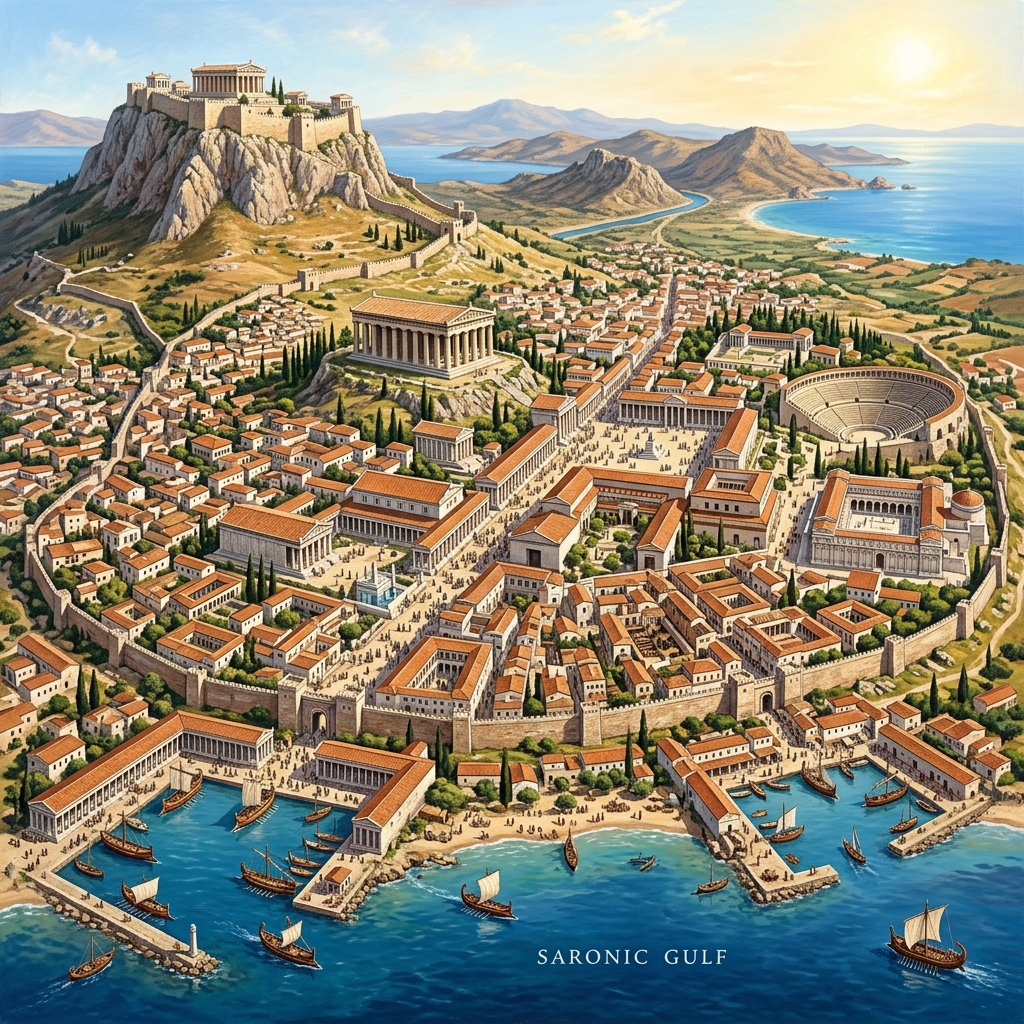
Perched on the narrow isthmus that joins mainland Greece to the Peloponnese, ancient Corinth was one of the most strategically placed and influential cities of the classical Mediterranean. For centuries it controlled vital land and sea routes, prospered from trade, and left a lasting imprint on Greek politics, culture, and religion.
A City Between Two Seas
Corinth’s power began with geography. The city sat on the Isthmus of Corinth, the slim land bridge between the Aegean and the Ionian Seas. To its east lay the Saronic Gulf, to its west the Corinthian Gulf. This position offered two major advantages:
- Control of overland traffic between northern and southern Greece. Any army or merchant caravan moving between Attica and the Peloponnese passed near Corinth.
- Access to two harbors: Lechaeum on the Corinthian Gulf for western trade, and Cenchreae on the Saronic Gulf for eastern routes toward the Aegean and beyond.
Because the seas around the Peloponnese could be treacherous, the Corinthians developed the diolkos, a paved trackway over which ships or their cargoes could be transported across the isthmus. This innovation turned Corinth into a hub of maritime commerce and contributed greatly to its wealth.
Early History and Founding Myths
Archaeological evidence suggests that the area around Corinth was inhabited from the Neolithic period, but the city rose to prominence in the early first millennium BCE. In myth, Corinth was linked with legendary figures such as:
- Sisyphus, the cunning king condemned in the underworld to roll a boulder up a hill for eternity.
- Bellerophon, the hero who tamed the winged horse Pegasus at the fountain of Peirene, a famous spring in Corinth.
These myths, while not historical, reflect the city’s early prestige and its place in the shared imaginative landscape of the Greeks.
Politically, Corinth became an important polis (city-state) by the 8th–7th centuries BCE. Under the rule of aristocratic families and, at times, tyrants, it extended its influence over surrounding territories and founded colonies across the western Mediterranean.

Commerce, Colonies, and Craftsmanship
Corinth’s economic life was rich and diverse:
- Trade: Corinthian merchants traded pottery, metalwork, textiles, and other goods across the Greek world and beyond. The city’s twin harbors bustled with ships arriving from Italy, Sicily, Asia Minor, and Egypt.
- Colonization: Corinth founded important colonies, including Corcyra (Corfu) and Syracuse in Sicily. These colonies extended Corinth’s influence and created durable commercial networks.
- Craft production: Corinthian artisans became famous for their pottery, especially in the 7th and 6th centuries BCE. Corinthian vases, often decorated with lively animal friezes and orientalizing motifs, were exported widely.
Wealth from trade and manufacturing supported a sophisticated urban life, with public buildings, temples, and fortifications that reflected the city’s prosperity.
Politics and Rivalries in Classical Greece
In the Archaic and Classical periods, Corinth played a major role in the shifting alliances and rivalries that defined Greek politics.
- Rivalry with Athens: As a maritime power with its own network of colonies, Corinth sometimes found itself at odds with Athens, especially as Athens expanded its influence in the 5th century BCE.
- The Peloponnesian League: Corinth was an early member of the alliance led by Sparta. Its grievances against Athens helped spark the Peloponnesian War (431–404 BCE), the long and destructive conflict that reshaped the Greek world.
- Internal tensions: Like many Greek city-states, Corinth was not immune to internal strife. Tensions between aristocrats, merchants, and other social groups occasionally erupted into political upheaval.
Despite these conflicts, Corinth remained a major force in Greek affairs through much of the classical period.
Religion and the Sacred Landscape
Religion permeated every aspect of Corinthian life. The city’s acropolis, Acrocorinth, rose dramatically above the plain, serving both as a fortress and a cultic center. It was associated in later periods with the worship of Aphrodite, though our sources about the nature of that cult are layered with legend and later moralizing.
One of the most striking monuments of the city is the Temple of Apollo, built in the 6th century BCE. Its sturdy Doric columns, some of which still stand today, are among the earliest large-scale stone temples in mainland Greece.
Corinth was also closely linked to the Isthmian Games, one of the four great Panhellenic athletic festivals, alongside Olympia, Delphi, and Nemea. Held at the nearby sanctuary of Poseidon on the Isthmus:
- The games featured athletic contests, horse races, and musical competitions.
- They attracted participants and spectators from all over the Greek world.
- They reinforced Corinth’s identity as a central meeting point of Greek culture.

Hellenistic Upheaval and Roman Destruction
Corinth’s fortunes shifted dramatically in the Hellenistic and Roman periods. After the conquests of Alexander the Great, the city became part of a world of larger kingdoms and leagues.
In the 2nd century BCE, Corinth joined the Achaean League, a federation of Greek states that resisted growing Roman power. The conflict culminated in the Battle of Corinth in 146 BCE. After defeating the Greeks, the Roman general Lucius Mummius:
- Sacked the city, destroying much of it.
- Sold many inhabitants into slavery.
- Left the site largely in ruins for over a century.
This episode was a turning point, symbolizing the end of Greek political independence and the firm establishment of Roman dominance in Greece.
Roman Corinth: A City Reborn
In 44 BCE, Julius Caesar refounded Corinth as a Roman colony, Colonia Laus Iulia Corinthiensis. The city was repopulated with Roman colonists, including freedmen, veterans, and others from across the empire. Over time, Roman Corinth once again became a thriving urban center:
- Architecture: The city acquired a distinctly Roman character, with a forum, baths, fountains, and other public buildings.
- Population: Greeks, Romans, freed slaves, traders, and travelers mingled, creating a cosmopolitan society.
- Economy: Corinth’s strategic position continued to support active trade between east and west.
This new, Roman Corinth is the city encountered by later writers, including early Christian authors.
Corinth and the Rise of Early Christianity
For many readers today, ancient Corinth is familiar because of its association with the Apostle Paul in the first century CE. According to the Acts of the Apostles and Paul’s own letters:
- Paul visited Corinth around the year 50 CE.
- He stayed there for an extended period, preaching and establishing a Christian community.
- The New Testament letters known as First and Second Corinthians are addressed to this early church.
These letters offer a vivid snapshot of life in a diverse and often divided urban community:
- They mention social tensions, disputes, and ethical questions facing the Corinthian Christians.
- They reflect the broader complexity of Roman Corinth, with its varied social classes, religious backgrounds, and cultural influences.
Through Paul’s correspondence, the name “Corinth” came to resonate not only in Greek history but also in Christian tradition.
The Archaeological Site Today
Modern excavations have revealed much of ancient and Roman Corinth, allowing visitors and scholars to reconstruct aspects of its long history. Key remains include:
- The Temple of Apollo, with its impressive Doric columns.
- The Roman forum, with colonnades, shops, public fountains, and administrative buildings.
- The Bema, a raised platform in the forum traditionally associated with the place where Paul was brought before the Roman proconsul Gallio.
- Residential quarters, workshops, and sanctuaries that testify to daily life and religious practice.
High above the city, the fortress of Acrocorinth still dominates the landscape, offering sweeping views of the surrounding seas and plains.

Legacy of Ancient Corinth
Ancient Corinth’s legacy is multifaceted:
- As a commercial power, it exemplified how geography can shape a city’s destiny, turning a narrow isthmus into a gateway between seas.
- As a political player, it influenced the balance of power in Greece and participated in the events that defined the classical era.
- As a religious and cultural center, it hosted Panhellenic games, supported significant sanctuaries, and later became a key site in the spread of Christianity.
- As an archaeological site, it continues to illuminate the transitions from Greek to Roman worlds and the complex life of a cosmopolitan ancient city.
From its early myths and colonial ventures to its Roman rebirth and Christian communities, Corinth stood—and still stands—as a crossroads: between land and sea, Greece and Rome, pagan cults and emerging Christian faith. Its story is a reminder of how a single city, shaped by its landscape and its people, can leave a mark across centuries.
Fortisetliber’s View
Ancient Corinth invites us to reflect on how power, prosperity, and faith intersect in any age. The city’s greatness rested on geography and trade, yet its story is punctuated by moral tension, political rivalry, and eventual ruin. The boulder of Sisyphus and the shattered walls of 146 BCE both remind us that even the most confident societies stand under judgment—historical, moral, and divine. The isthmus that enriched Corinth also exposed it: the same openness that brought wealth also brought competing loyalties, ideas, and gods.
For the Christian reader, Paul’s letters to the Corinthians add a sharper clarity. They show a community wrestling with status, sexuality, factionalism, and spiritual pride—issues that feel uncomfortably familiar. In that sense, Corinth is not just an archaeological site but a mirror. To walk its forum or read its epistles is to see how the gospel takes root in a restless, pluralistic world, neither fleeing the city nor baptizing its vices. Fortis et liber—strong and free—is not the boast of a self-satisfied polis, but the calling of those who learn, in Corinth and beyond, that true strength is found in weakness and true freedom in the service of Christ.
Leave a Reply