
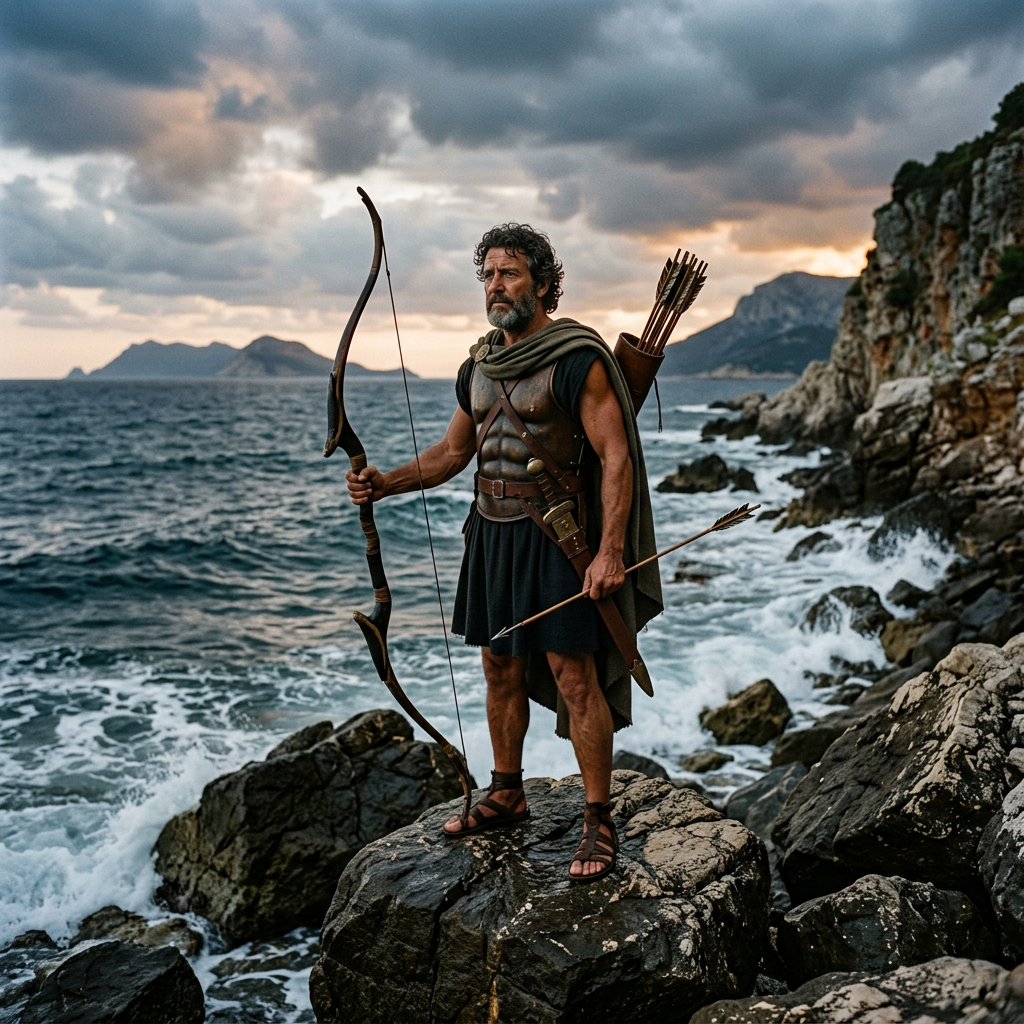
Odysseus is one of the most fascinating figures in Greek mythology—a hero celebrated not only for strength and bravery, but above all for intelligence, eloquence, and cunning. Best known as the central character of Homer’s Odyssey and a key strategist in the Iliad, Odysseus embodies the complex, often ambiguous nature of heroism in the ancient Greek world.
Origins and Early Life
Odysseus was the king of Ithaca, a small, rocky island in the Ionian Sea. His parents are usually given as Laertes and Anticlea, and he is sometimes said to be a descendant of Hermes, the trickster god. From early on, Odysseus is marked not by overwhelming physical power, but by his metis—a Greek term that combines cleverness, resourcefulness, and practical wisdom.
He marries Penelope, renowned for her fidelity and intelligence, and they have a son, Telemachus. The ideal of the household—oikos—is central to Odysseus’ identity, and his longing to return home to Ithaca becomes the driving force of The Odyssey.
Odysseus and the Trojan War
The Reluctant Warrior
When the Trojan War breaks out after the abduction (or elopement) of Helen to Troy, Odysseus initially tries to avoid joining the Greek coalition. Knowing that a prophecy has foretold a long and costly war, he pretends to be mad, yoking a donkey and an ox together and ploughing the seashore. The ruse fails when the Greek envoy Palamedes places Odysseus’ infant son Telemachus in front of the plow, forcing Odysseus to reveal his sanity to save the child.
The Strategist of the Greeks
Though he does not possess the raw strength of Achilles or Ajax, Odysseus becomes indispensable to the Greek war effort:
- He is a master orator, often calming disputes among the Greeks.
- He undertakes dangerous reconnaissance missions, including infiltrating the Trojan camp.
- He is central to the diplomacy and strategy that sustain the long siege.
The Trojan Horse
Odysseus’ most famous wartime achievement is the idea of the Trojan Horse. After years of stalemate, he devises the plan to construct a giant wooden horse, hide elite Greek warriors inside it, and present it as a “gift” to the Trojans. The Trojans bring the horse into their city, ignoring ominous warnings, including the prophet Laocoön’s famous cry, “Beware of Greeks bearing gifts.”
At night, the warriors emerge from the horse, open the gates for the Greek army, and Troy falls. This act showcases Odysseus’ ingenuity, but also highlights the darker side of his cunning—victory is won through deception as much as valor.

The Odyssey: The Long Journey Home
After the fall of Troy, Odysseus’ struggle is far from over. His journey home to Ithaca, which should have been relatively short, stretches out to ten years, filled with trials that test his body, mind, and moral character. Homer’s Odyssey is both an adventure tale and a profound exploration of identity, loyalty, and the meaning of home.
The Cicones and the Lotus-Eaters
Odysseus’ troubles begin almost immediately:
- The Cicones: Odysseus and his men raid the city of Ismarus, home of the Cicones. Greedy and disobedient, his men linger too long, allowing the Cicones to regroup and counterattack. Many Greeks are killed—a sign that leadership and discipline will be recurring challenges.
- The Lotus-Eaters: On another island, some of his men eat the lotus plant, which makes them forget their desire to return home. Odysseus must physically drag them back to the ships, emphasizing his role as a leader fighting not only external dangers but also forgetfulness, temptation, and despair.
The Cyclops Polyphemus
One of the most famous episodes is the encounter with Polyphemus, the Cyclops and son of Poseidon. Trapped in the Cyclops’ cave, Odysseus devises a plan:
- He tells Polyphemus that his name is “Nobody.”
- He gets the Cyclops drunk on strong wine.
- While Polyphemus sleeps, Odysseus and his men blind him with a sharpened stake.
- When the other Cyclopes ask who is hurting him, Polyphemus can only reply, “Nobody is attacking me,” so they do nothing.
- Odysseus and his men escape by clinging to the undersides of the Cyclops’ sheep.
However, Odysseus then makes a crucial mistake. As they sail away, he reveals his true name, boasting of his cleverness. Polyphemus calls upon his father, Poseidon, to curse Odysseus, asking that he be delayed, lose his comrades, and return home only after great suffering. This curse shapes the rest of the journey.
Aeolus, the Laestrygonians, and Circe
Odysseus continues to encounter both help and harm:
- Aeolus, Keeper of the Winds: Aeolus gives Odysseus a bag containing all the winds except the favorable west wind. When Odysseus falls asleep close to Ithaca, his curious crew open the bag, thinking it contains treasure. The released winds blow them back across the sea, highlighting the consequences of mistrust and poor discipline.
- Laestrygonians: These giant cannibals destroy most of Odysseus’ fleet, leaving only his own ship. The episode underscores how fragile survival has become.
- Circe: The enchantress Circe turns some of Odysseus’ men into pigs. With help from the god Hermes, Odysseus resists her magic and forces her to restore his men. He then stays with her for a year. Circe is both a threat and a guide, later directing him to the Underworld to seek prophetic advice.
Journey to the Underworld
Following Circe’s instructions, Odysseus travels to the realm of the dead to consult the prophet Tiresias. In the Underworld he:
- Learns of Poseidon’s wrath and the hardships still to come.
- Is warned not to harm the sacred cattle of Helios.
- Meets the shades of fallen heroes like Achilles and Ajax.
- Encounters his own mother, Anticlea, who has died of grief during his long absence.
This descent into the Underworld—katabasis—is a powerful symbolic moment, representing a confrontation with mortality, memory, and the cost of war.

The Sirens, Scylla, and Charybdis
Odysseus’ voyage continues through a series of maritime perils:
- The Sirens: These creatures lure sailors to their deaths with irresistible song. Odysseus, eager for knowledge, has his men plug their ears with wax and lash him to the mast so he can hear safely. This episode highlights his unique trait: he seeks experience and understanding, even when it is dangerous.
- Scylla and Charybdis: Forced to choose between sailing close to Scylla, a six‑headed monster, or Charybdis, a deadly whirlpool, Odysseus opts for Scylla, sacrificing a few men rather than risking total destruction. The choice raises difficult questions about leadership, sacrifice, and moral responsibility.
The Cattle of Helios and the Wrath of Zeus
Despite warnings from Tiresias and Circe, Odysseus’ crew, driven by hunger and desperation, slaughter the sacred cattle of the sun god Helios. Helios complains to Zeus, who destroys Odysseus’ last ship with a thunderbolt. All his remaining men are killed; only Odysseus survives, drifting to the island of Calypso.
Calypso and the Phaeacians
On the island of Ogygia, the nymph Calypso falls in love with Odysseus and keeps him there for years, offering immortality if he will stay with her. Odysseus longs for home and Penelope, and eventually the gods intervene. Hermes orders Calypso to let him go.
After building a raft and escaping, Odysseus is shipwrecked again but eventually reaches the land of the Phaeacians. There, he is welcomed, tells the story of his journeys, and is finally given a ship to return to Ithaca.
Return to Ithaca: The Test of Identity
When Odysseus arrives in Ithaca at last, he finds his palace overrun by suitors seeking to marry Penelope and seize his throne. With Athena’s help, he disguises himself as a beggar to test the loyalty of those around him:
- Penelope remains faithful but cautious, not trusting appearances.
- Telemachus, now grown, proves brave and loyal.
- Some servants are loyal; others have betrayed the house.
Penelope devises her own strategies to delay remarriage, such as weaving and secretly unweaving a shroud at night. Her intelligence mirrors Odysseus’ cunning, making her a fitting counterpart.
The Contest of the Bow
Penelope declares that she will marry the man who can string Odysseus’ great bow and shoot an arrow through twelve axe heads. None of the suitors can do it. Still disguised, Odysseus strings the bow with ease and completes the feat. He then reveals his identity and, with Telemachus and a few loyal allies, defeats the suitors in a brutal confrontation.
Recognition and Reconciliation
Even after this, Penelope tests Odysseus one last time by suggesting that their bed be moved. Odysseus protests, knowing the bed is built around a living olive tree and cannot be moved—a secret known only to them. Satisfied, Penelope finally accepts that this is truly her husband.
The Odyssey ends with Odysseus restored as king, but the tales hint at ongoing tensions and the difficulty of reintegrating after so many years of war and wandering.

Odysseus as a Complex Hero
Odysseus is not a straightforward hero. His defining trait is not sheer strength but intelligence:
- Cunning and Deceit: He lies, disguises himself, and manipulates others. His cleverness wins wars, but it also offends gods and costs lives.
- Endurance and Resilience: He suffers shipwrecks, temptations, and profound loss, yet continues striving for home.
- Moral Ambiguity: His decisions—such as sacrificing men to Scylla or using deception against the Trojans—invite debate about the ethics of leadership and survival.
For the ancient Greeks, Odysseus represented a very human kind of heroism: flawed, adaptable, and persistently striving in a world governed by fate, divine will, and chance.
Legacy and Cultural Impact
Odysseus’ story has echoed through centuries:
- In ancient Greece, he appears not only in Homer’s epics but also in tragedies and later mythic retellings.
- In the Roman world, he is known as Ulysses, appearing in works like Virgil’s Aeneid.
- In modern literature, James Joyce’s Ulysses famously reimagines his journey in 20th‑century Dublin.
- Countless novels, films, and adaptations draw on the themes of a long journey home, the struggle for identity, and the tension between cunning and honor.
Odysseus endures because he is not simply a warrior or a king; he is a thinker, a storyteller, and a wanderer. His journey speaks to anyone who has faced trials, made mistakes, and still longed to find their way home.
Fortisetliber’s View
At Fortis et Liber, we are drawn to figures who live at the edge of human endurance, whose stories expose both the greatness and the fragility of the human heart. Odysseus is one of these figures. He is not the flawless hero of children’s tales, but a man whose brilliance is mixed with pride, whose victories are stained by loss, and whose deepest longing is not for glory, but for home.
Odysseus’ journey is a long resistance against forgetfulness. The Lotus-Eaters tempt his men to abandon memory; Calypso offers him comfort without roots; even the gods at times seem content to let him drift. Yet he refuses to let his identity dissolve. He remembers Ithaca. He remembers Penelope. He remembers who he is. In an age where distraction and comfort constantly pull us away from what matters, this stubborn fidelity to home and vocation is a radical act.
At the same time, Odysseus forces us to confront the cost of cleverness without humility. His taunting of Polyphemus, his lapses in leadership, and the deaths of his companions all remind us that intelligence alone does not make a man just. True strength is not simply the power to bend circumstances to our will; it is the capacity to accept limits, to repent of folly, and to seek reconciliation after violence.
In the end, the image that stays with us is not the warrior on the walls of Troy, but the weary king standing at the threshold of his own house, unrecognized. The journey has stripped him of illusions, but not of hope. Odysseus returns smaller in worldly terms and greater in human terms: a man who has looked into chaos, passed through the realm of the dead, and still chooses fidelity, covenant, and the quiet labor of rebuilding.
For us at Fortis et Liber, Odysseus is a reminder that to be “strong and free” is not to escape hardship, but to walk through it without surrendering our soul, our memory, or our calling.
Leave a Reply