
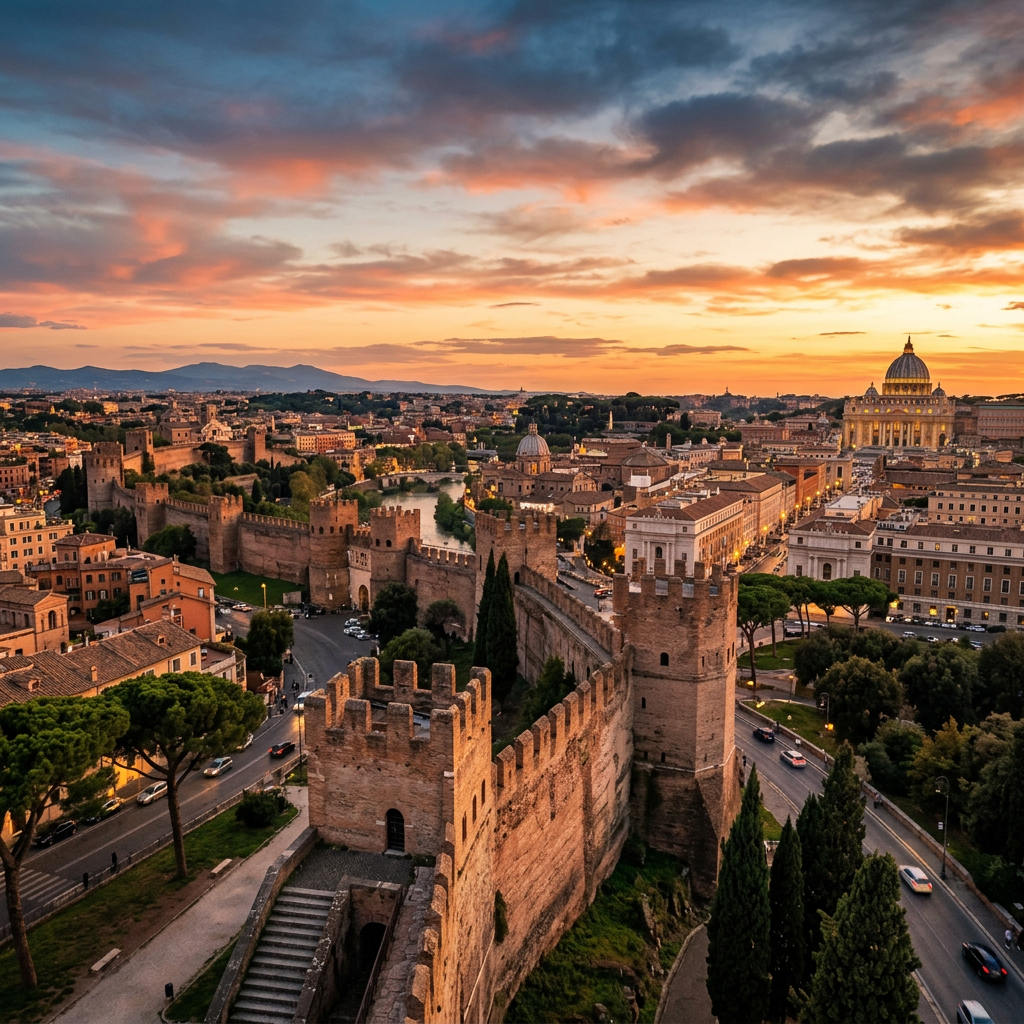
Rome is often imagined through its temples, forums, and amphitheaters, but one of its most impressive ancient monuments is something many visitors walk past without noticing: the Aurelian Walls. Stretching for nearly 19 kilometers at their greatest extent, these defensive walls once wrapped the city in a vast ring of brick and stone, defining Rome’s late antique skyline and shaping its development for over a millennium.
Why the Aurelian Walls Were Built
By the 3rd century CE, the Roman Empire was under pressure. External threats were increasing, and the long‑standing illusion that Rome itself was untouchable began to fade. For centuries, the city had relied on distance and legions, not on walls, for its safety. The older Servian Walls, built in the 4th century BCE, had long since become militarily obsolete.
Emperor Aurelian (reigned 270–275 CE) changed this. Facing repeated incursions and recognizing how vulnerable Rome had become, he ordered the construction of a new, monumental defensive circuit around the city. The aim was clear: to protect the political and symbolic heart of the empire from sudden attacks.
Work began around 271 CE and continued under Aurelian’s successor, Probus. Within a remarkably short time—barely a decade—Rome had a new set of fortifications that would stand, with modifications, for more than 1,500 years.
Design and Construction
The Aurelian Walls combined pragmatic engineering with imperial ambition. They were not merely thick barriers; they were complex defensive systems.
Scale and Materials
- Length: Originally around 19 km (about 12 miles), enclosing roughly 13 km².
- Height: Initially about 8 meters, later raised to around 16 meters under Emperor Honorius in the early 5th century.
- Thickness: About 3.5–4 meters in many sections.
- Materials: A mix of brick, tufa, and concrete, with extensive reuse of existing structures (spolia) to speed construction.
In several places, Aurelian’s engineers incorporated pre‑existing buildings into the line of defense—warehouses, aqueduct arches, even amphitheaters. This had a double benefit: it saved time and materials, and also strengthened the wall with massive masonry that was already in place.
Towers, Gates, and Defensive Features
The walls were equipped with:
- Towers every 30 meters or so, used as elevated firing positions and observation points.
- Walkways along the top, allowing soldiers to patrol and move quickly from one section to another.
- Arrow slits and embrasures for archers and artillery.
- Gates (Portae) that controlled movement of people and goods in and out of the city.
Some of the major gates became architectural landmarks in their own right:
- Porta Appia (Porta San Sebastiano): One of the best‑preserved and most imposing gates, now home to the Museum of the Walls.
- Porta Ostiense (Porta San Paolo): Guarding the road to the port of Ostia, near the Pyramid of Cestius.
- Porta Flaminia (Porta del Popolo): The northern entrance, later rebuilt in the Renaissance but still aligned with the ancient route.

Later Modifications: From Aurelian to Honorius and Beyond
The Aurelian Walls did not remain static. They were continuously repaired, strengthened, and adapted as warfare evolved.
Honorius and the Gothic Threat
In the early 5th century, as Visigothic and other “barbarian” threats loomed closer, Emperor Honorius undertook a major renovation around 401–402 CE. Key changes included:
- Raising the height of the walls to make scaling more difficult.
- Reinforcing towers and gatehouses.
- Updating defensive features to respond to new siege tactics.
Despite these improvements, Rome was eventually sacked—most famously by Alaric’s Visigoths in 410 CE. Even so, the walls did their job more often than not, deterring attackers and forcing long sieges that were costly and uncertain.
Medieval and Renaissance Role
As the empire in the West collapsed, the Aurelian Walls remained a vital line of defense for the city’s various rulers: Ostrogothic kings, Byzantine generals, medieval popes, and noble families.
Over the centuries:
- Gates were modified, narrowed, or decorated according to new tastes and needs.
- Sections were repaired after earthquakes, wars, and neglect.
- The walls became entwined with houses, gardens, monasteries, and fortifications, integrating them into the lived fabric of the city.
By the Renaissance, Rome’s identity as a walled city was firmly established. Artists, pilgrims, and diplomats arriving in the city encountered the same monumental ring that had once impressed late Roman travelers.
The Walls in the Modern City
With the unification of Italy in the 19th century and the advent of modern artillery, the Aurelian Walls lost their military importance. Parts were demolished to make way for railroads and new roads; others fell into disrepair.
Yet, remarkably, large stretches survive and are still a striking presence in the modern urban landscape:
- Along the Appian Way, you can walk for long sections beside the walls, seeing towers and battlements up close.
- Near San Giovanni in Laterano, the walls form a dramatic backdrop to one of Rome’s busiest intersections.
- Around Porta San Paolo, the walls frame the Pyramid of Cestius and the Protestant Cemetery, creating one of the city’s most evocative historical corners.
Today, they serve as both archaeological monument and urban boundary, reminding residents and visitors alike that Rome’s present is layered directly atop its past.

Symbolism and Legacy
The Aurelian Walls are more than a defensive structure; they are a powerful symbol of how Rome adapted to changing realities.
- From open city to fortified capital: For centuries, Rome’s security rested on its distance from frontiers. The construction of the walls signaled a new, more precarious age in which even the heart of the empire could no longer take safety for granted.
- Reuse and resilience: By incorporating existing buildings and materials, the walls embody a very Roman practicality—recycling the old to serve new purposes. This habit of reuse continued through the Middle Ages and beyond.
- Continuity of urban form: Unlike many ancient cities whose walls vanished entirely, Rome retained its late antique circuit well into the modern period. The Aurelian Walls shaped routes, neighborhoods, and perceptions of “inside” and “outside” for over 1,500 years.
- A living monument: Even today, the walls are not just museum pieces. They run beside apartment blocks, tram lines, and traffic arteries. They are part of the city’s daily life, quietly linking Rome’s imperial past with its modern present.
Visiting the Aurelian Walls Today
For those exploring Rome, the Aurelian Walls offer a different kind of experience from the more famous ruins:
- Walk the Appian stretch: Start near Porta San Sebastiano and follow the wall line. The Museum of the Walls inside the gate gives access to the ramparts and offers detailed explanations.
- Explore the gates: Each remaining gate tells a story—not just of Aurelian, but of medieval fortifications, papal renovations, and 19th‑century urban planning.
- Notice the layers: Look for reused blocks, inscriptions, and bricked‑up arches. They reveal how Romans of different eras reimagined their city’s defenses.
Fortisetliber’s View
The Aurelian Walls are often treated as background scenery to Rome’s more famous monuments, yet they express something essential about the late Roman world: a mixture of fear and determination. They admit that even Rome could be threatened, while at the same time proclaiming the city’s will to endure.
Their beauty is not the polished elegance of marble temples but the rough beauty of survival. Old buildings are folded into the circuit, stones are reused, towers raised higher under Honorius—each phase a visible edit in a long, anxious text. The walls are a palimpsest: Aurelian’s emergency project, Honorius’ reinforcement, medieval and papal adaptations, modern roads cut through their flanks.
For readers of history, they invite us to “read” a city the way we read a manuscript. Every gate and tower is a marginal note about power, danger, and how Rome defined the line between inside and outside. Over 1,700 years, that line has shifted in meaning but not in place.
In an age wary of walls, the Aurelian circuit reminds us that boundaries are not only about exclusion; they can also be about care—about protecting something fragile enough to need defense. The empire that built them has vanished, but this ring of brick and stone still stands, quietly insisting that true strength is less about invincibility than about the stubborn will to go on.
Leave a Reply