
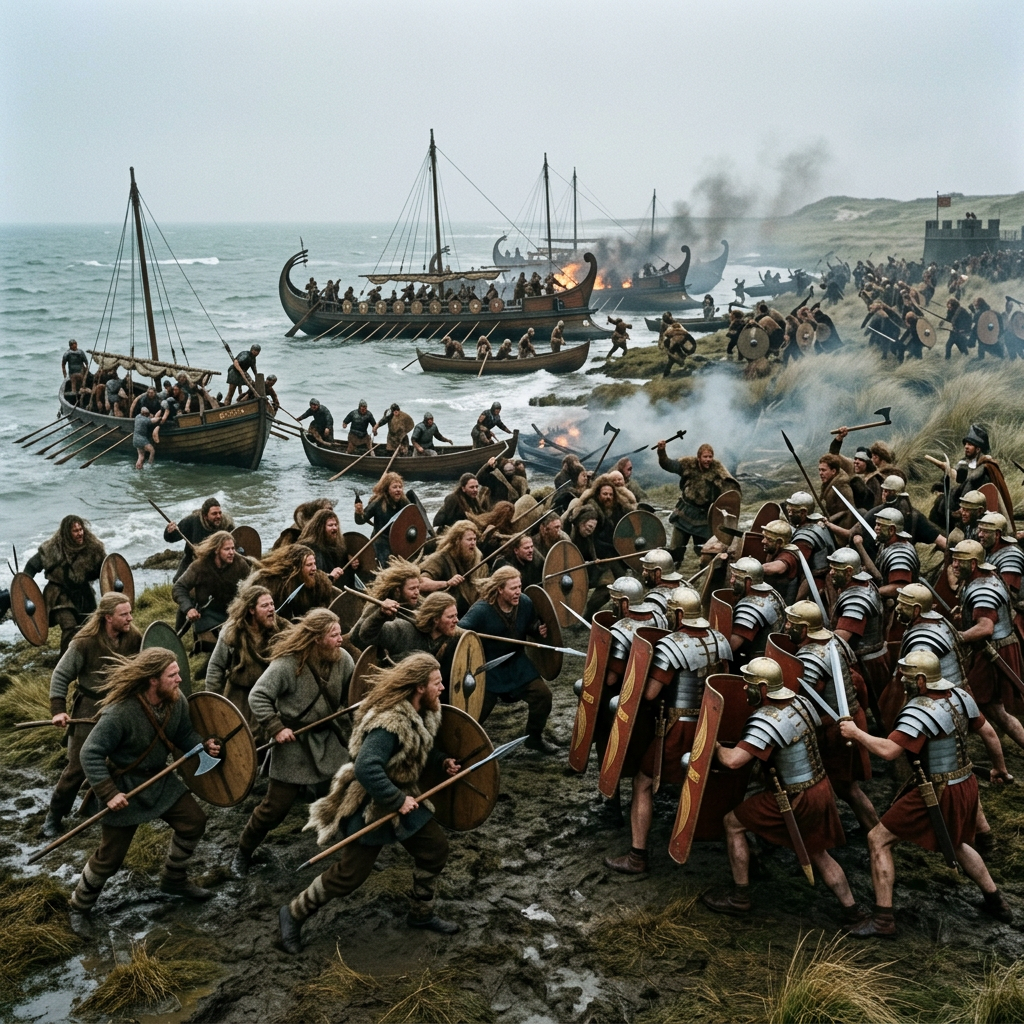
The Frisian revolt of 28 AD was a small frontier uprising on the edge of the Roman Empire, but it reveals a lot about how Rome ruled—and sometimes mishandled—its provincial allies. On the tidal coasts of the North Sea, a dispute over taxes and honor pushed the Frisii (Frisians) into open rebellion, tested Rome’s northern defenses, and foreshadowed the limits of imperial expansion in Germania.
Who Were the Frisii?
The Frisii were a Germanic people living along the North Sea coast in what is now the northern Netherlands and parts of northwestern Germany. Their homeland was a landscape of marshes, tidal flats, and low-lying fields, with communities built on artificial mounds (terpen) to escape flooding.
Unlike fully conquered provinces such as Gaul, the Frisii lived in a border zone of indirect Roman control:
- They were not turned into a Roman province.
- They kept a measure of internal autonomy.
- In return, they were expected to provide:
- Military support when called upon.
- Regular tribute and taxes.
- Loyalty to Roman authority in the region.
This loose arrangement could work—until Rome asked for too much.
Rome on the Northern Frontier
By the early 1st century AD, the Roman Empire had expanded deep into western Europe. Under Emperor Tiberius (r. 14–37 AD), Roman forces were trying to secure and stabilize the Rhine frontier and push influence further into Germania.
Key points about the Roman position:
- The Rhine river formed a major defensive line.
- Roman legions were stationed in fortified camps along the river.
- Client tribes and allied peoples beyond the Rhine, like the Frisii, helped buffer direct Roman territory from hostile Germanic groups.
However, Rome’s control in these areas depended heavily on diplomacy, sensible tribute demands, and the behavior of local governors. When that balance broke, revolts tended to follow.

The Spark: An Unbearable Tax
According to the historian Tacitus, the immediate cause of the Frisian revolt was a dispute over tribute—specifically, a tax paid in ox-hides.
Originally, the Frisii owed Rome a fixed number of hides each year. Over time:
- Roman officials reinterpreted or tightened the standard.
- They began to demand hides of exceptionally large, high‑quality cattle.
- This dramatically increased the real cost of the tax.
To meet the new demands, the Frisii tried to comply:
- They sold possessions to buy better cattle.
- When that wasn’t enough, they began surrendering their land and even family members into slavery to pay the tax.
Rather than seeing this as a warning sign, the Roman procurator (financial official) in charge, Oliutius (as some manuscripts have it; Tacitus names him generally as a greedy official), persisted—and even escalated his demands. This combination of greed, inflexibility, and ignorance of local conditions pushed the Frisii past their breaking point.
From Grievance to Revolt
As pressure mounted, the Frisii turned to resistance. What began as complaints against unfair taxation transformed into an armed uprising.
Key dynamics of the revolt:
- Local leadership: Frisian leaders rallied warriors who knew the marshes and waterways intimately.
- Targeting Roman symbols: They attacked Roman garrisons and officials, striking at the visible agents of Roman authority.
- Terrain advantage: The Frisii used their difficult coastal landscape to their benefit, luring Roman troops into inhospitable ground.
The revolt was not a massive pan-Germanic war like the earlier Arminius-led uprising, but it was serious enough to threaten Rome’s prestige and influence in the region.

The Roman Response: Lucius Apronius and the Legions
The Roman commander responsible for the area was Lucius Apronius, the governor of Lower Germania. Faced with the uprising, he mobilized the forces at his disposal:
- Legionary troops from Rhine camps.
- Auxiliaries drawn from other provincial peoples.
- Naval and logistical support for moving troops along rivers and coastal areas.
Apronius attempted to suppress the revolt militarily, but the campaign proved difficult:
- Harsh terrain
Roman heavy infantry was designed for set‑piece battles and sieges, not for marshes, tidal flats, and narrow dikes. The Frisii avoided open battle and fought where Roman formations were at a disadvantage. - Ambushes and attrition
Small‑scale engagements, ambushes, and skirmishes wore down Roman forces. Several detachments suffered significant losses. - Limited strategic gain
Even when Roman troops could push back Frisian bands, they struggled to deliver a decisive blow or impose stable control inland.
Tacitus describes one particularly costly action at a place called the Baduhenna Woods, where a Roman force was destroyed after being drawn into unfavorable terrain. Exact numbers are debated, but the defeat underlined the risks of pressing too far into hostile, unfamiliar country.
Outcome: An Uneasy Compromise
Unlike some Roman revolts that ended in complete destruction or mass enslavement, the aftermath of the Frisian uprising is more ambiguous.
We do not see:
- The full annexation and provincialization of Frisian territory.
- The total annihilation of the Frisii as a people.
- A large-scale permanent occupation deep in their homeland.
Instead, the outcome seems to have been:
- Roman withdrawal from direct interference in Frisian internal affairs for a time.
- A de facto reduction of Roman presence east and north of the Rhine.
- A recognition that the cost of imposing heavier control in this marshy frontier was not worth the benefit.
In effect, the revolt helped to define a limit: Rome would dominate the Rhine line and nearby areas but accept a looser grip further north along the North Sea coast.

Why the Frisian Revolt Matters
Although small in scale, the Frisian revolt of 28 AD is significant for several reasons.
1. The Dangers of Greed and Mismanagement
The revolt illustrates how local Roman officials could destabilize entire regions:
- The emperor and central government may not have ordered oppressive policies.
- But the behavior of a single corrupt or inflexible procurator could:
- Alienate allied peoples.
- Trigger violent uprisings.
- Force expensive military campaigns.
It is a reminder that empires often depend on everyday administration as much as on grand strategy.
2. The Limits of Roman Power in Germania
After major setbacks such as the defeat in the Teutoburg Forest (9 AD), Roman leaders became more cautious about deep expansion into Germany. The Frisian revolt reinforced that caution:
- Difficult terrain and hostile local populations made conquest costly.
- Even when Rome could win battles, holding territory was another matter.
- The empire gradually settled into a defensive posture along the Rhine, rather than pressing indefinitely east and north.
The revolt thus forms part of the broader story of why Germania never became a Roman province in the same way as Gaul or Spain.
3. Frontier Societies and Cultural Contact
The Frisii lived in a contact zone between worlds:
- They traded with Roman merchants.
- Some Frisian warriors served in Roman auxiliary units.
- Roman goods, coins, and customs filtered into Frisian society.
Yet, as the revolt shows, cooperation had limits. When Roman demands threatened the economic and social foundations of Frisian life, alliance turned to resistance. Frontier societies could benefit from Rome—but also push back when the balance became intolerable.
Legacy and Later History of the Frisii
The name “Frisii” appears in Roman sources for several generations, though the people themselves were not static:
- Environmental pressures, such as flooding and changing coastlines, altered settlement patterns over time.
- Migration, warfare, and shifting alliances reshaped identities in the North Sea region.
In the early Middle Ages, later groups known as Frisians appear in sources as seafarers and traders along the North Sea, especially in what is now the Netherlands and northern Germany. While the exact continuity between the Roman‑era Frisii and medieval Frisians is debated, the region retained a distinct identity rooted in its coastal environment and long history of engagement with outside powers.

Conclusion
The Frisian revolt of 28 AD began as a dispute over ox‑hides, but it revealed much deeper tensions along the Roman frontier. It showed how fragile Rome’s authority could be when based on heavy-handed taxation and misunderstanding of local conditions. It also demonstrated the practical limits of Roman military power in difficult landscapes far from the empire’s core.
On the windswept shores of the North Sea, a relatively small people forced Rome to adjust its ambitions—and, in doing so, helped shape the long-term boundary between the Roman world and the Germanic north.
Fortisetliber’s View
At Fortis et Liber we are drawn to moments when ordinary communities insist on being treated as more than resources to be squeezed. The Frisian revolt of 28 AD is one of those moments. It is not a grand epic of liberation, nor a clean victory over empire. It is a story of a small coastal people pushed too far by distant power and by one official’s greed.
What strikes us is how quietly such crises begin. No tyrant’s speech, no dramatic declaration—only a tax that becomes unbearable, a contract silently rewritten in Rome’s favor. Before there is open revolt, there is the slow erosion of dignity: selling possessions, then land, then family members, just to satisfy an abstract demand for “better” hides. By the time swords are drawn, the real violence has already happened.
The Frisii do not emerge as idealized heroes. They, like Rome, are enmeshed in trade, status, and negotiation. Yet their refusal to accept the final step into humiliation forces the empire to confront its limits. Along the windswept marshes, Roman legions learn that not every landscape can be tamed, not every ally can be reduced to a ledger entry, and not every revolt can be “solved” by a decisive battle.
For us, the lesson is not simple anti‑imperialism, but vigilance. Great systems—political, economic, even cultural—begin to rot at their edges, where power is least seen and most easily abused. The Frisian revolt reminds us that freedom is often defended not in spectacular battles, but in the stubborn insistence that agreements mean what they once meant, that tribute has a limit, and that human beings cannot be reduced indefinitely to numbers on a tax return.
Leave a Reply