
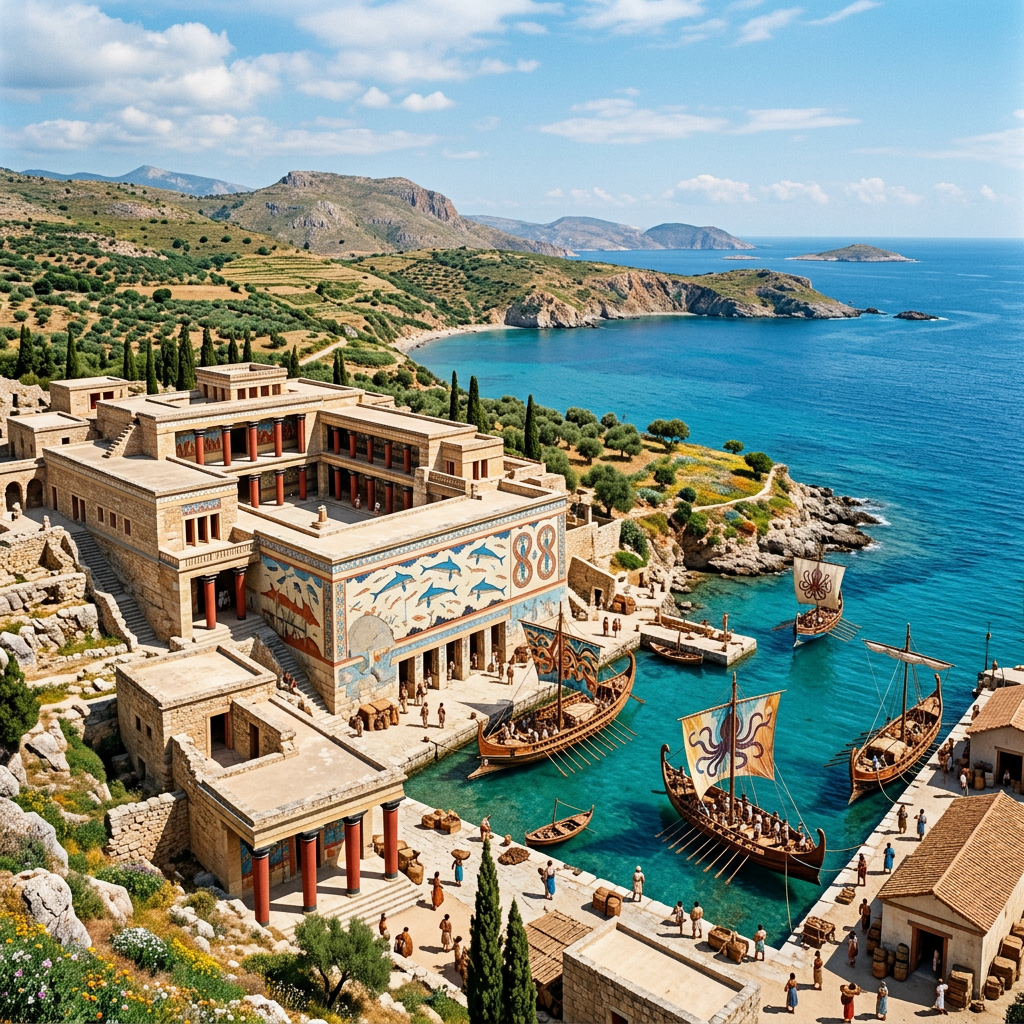
The Minoan civilization, centered on the island of Crete in the eastern Mediterranean, was one of the earliest complex societies in Europe. Flourishing roughly between 3000 and 1100 BCE, the Minoans built sophisticated cities, developed far-reaching trade networks, and produced distinctive art and architecture that still capture modern imagination.
Although many aspects of their culture remain partly unknown, archaeological discoveries over the last century have revealed a rich picture of Minoan life and their enduring influence on later Greek civilization.
- Historical Timeframe and Geographic Setting
The Minoan civilization emerged during the Early Bronze Age, around 3000 BCE, and reached its peak in the Middle and early Late Bronze Age, particularly between about 1900 and 1450 BCE.
After this high point, Minoan culture experienced disruption and gradual decline, with many of its features absorbed or replaced by the rising Mycenaean civilization from mainland Greece. By around 1100 BCE, the distinctively Minoan way of life had largely disappeared, although its legacy persisted.
Geographically, the Minoans occupied Crete, the largest Greek island, positioned at a crossroads between the Aegean, Near East, and North Africa. This advantageous location made the island a natural hub for maritime trade.
Minoan influence also extended to nearby islands in the Aegean, such as Thera (modern Santorini), and to coastal sites on the Greek mainland and the Levant. Their maritime orientation and relatively insular setting helped shape a culture that was both outward-looking and distinct within the broader Bronze Age world.
- Discovery of the Minoans and Major Archaeological Sites
The term “Minoan” was coined in the early 20th century by British archaeologist Sir Arthur Evans, who associated the civilization with the legendary King Minos of Greek myth. Prior to systematic excavations, knowledge of Bronze Age Crete was largely limited to scattered ruins and classical references.
The modern understanding of the Minoans began with large-scale archaeological projects that revealed extensive palatial complexes, towns, and rich material culture.
Knossos: The Largest and Most Famous Palace
Knossos, near modern Heraklion in north-central Crete, is the largest and best-known Minoan site. Excavated extensively by Evans from 1900 onward, the sprawling complex at Knossos is often described as a “palace,” though it also functioned as an administrative, religious, and economic center.
The site includes multi-story buildings, storerooms packed with large storage jars (pithoi), central courtyards, workshops, and elaborately decorated rooms featuring colorful frescoes.
Evans’s reconstructions at Knossos, some of which involved modern materials and interpretive restorations, have shaped public perceptions of the Minoans but are also debated among scholars.
Even with these controversies, Knossos remains essential for understanding the scale and complexity of Minoan architecture and administration, as well as their artistic style and ceremonial practices.

Phaistos: A Southern Power Center
Phaistos, located in south-central Crete overlooking the fertile Mesara Plain, was another major Minoan palace site. Excavated mainly by Italian archaeologists, Phaistos reveals a large central court, extensive storage areas, and grand staircases.
Its layout suggests a complex social and ceremonial life similar to, but distinct from, Knossos. The famous Phaistos Disc, a fired clay disc bearing stamped symbols arranged in a spiral, was discovered here and remains one of the most enigmatic artifacts from Bronze Age Crete.
The architecture at Phaistos is often considered less heavily reconstructed than Knossos, giving scholars a somewhat clearer look at original Minoan building techniques. Together, Knossos and Phaistos demonstrate that Minoan power was not concentrated in a single center but spread among multiple significant palatial sites.
Akrotiri: A Window into Everyday Life
Akrotiri, on the island of Thera (Santorini), was a Minoan-influenced town that provides an exceptional snapshot of Bronze Age Aegean life. Buried under volcanic ash from a catastrophic eruption in the late second millennium BCE, the site was preserved in remarkable detail, similar in some respects to Pompeii in Roman times.
Excavations have uncovered multi-story houses, elaborate frescoes, storage vessels, and everyday objects frozen in time.
The frescoes at Akrotiri show vibrant scenes of nature, seafaring, and ritual, offering insights into Minoan and Cycladic aesthetics and values. Although Akrotiri is not on Crete itself, the close stylistic and cultural connections to Minoan centers illustrate the wider cultural sphere shaped by Minoan trade and influence.
- Minoan Society and Daily Life
Social Structure and Administration
Minoan society appears to have been organized around palatial centers that coordinated economic, political, and religious activities. The palaces functioned as hubs that collected agricultural produce, stored surplus goods, and redistributed resources.
Administrative records written on clay tablets indicate complex systems of accounting and control, although the undeciphered nature of the primary Minoan script (Linear A) limits precise understanding.
Elite groups likely managed the palatial bureaucracies, oversaw trade, and sponsored religious ceremonies. Below the elite, a broad segment of farmers, artisans, sailors, and laborers sustained the economy.
There is limited evidence of large-scale fortifications in earlier phases, which some scholars interpret as suggesting a relatively secure environment, perhaps protected by naval strength rather than defensive walls.

The Role of Women
Visual evidence from Minoan art suggests that women held a prominent and possibly influential role in religious and social life. Frescoes frequently depict women participating in rituals, processions, and ceremonies, often in positions that seem central rather than marginal.
They are shown wearing elaborate dresses, jewelry, and distinctive hairstyles, suggesting high status and cultural importance.
While it is difficult to reconstruct legal and political rights from artistic evidence alone, the ubiquity and prominence of female figures have led some scholars to propose that Minoan religion may have included powerful goddesses and female officiants.
However, caution is necessary; the archaeological record does not definitively prove matriarchy or full gender equality, but it does point to a society in which women were far from invisible.
Trade, Economy, and Maritime Connections
The economy of the Minoan civilization was heavily based on agriculture, craft production, and maritime trade. Crete’s fertile plains supported the cultivation of cereals, olives, and grapes, while its mountainous terrain provided timber and other resources.
Minoan artisans produced high-quality pottery, metalwork, textiles, and luxury goods that were exported across the eastern Mediterranean.
Archaeological evidence shows Minoan objects and stylistic influences in places as far afield as Egypt, the Levant, and the Aegean islands. In return, the Minoans imported raw materials such as copper, tin, and perhaps exotic goods like ivory.
Their ships, depicted in frescoes and model representations, underline the centrality of seafaring and suggest a sophisticated knowledge of navigation and shipbuilding.
Palaces, Towns, and Urban Life
Minoan palaces were surrounded by towns and villages that housed a substantial population of farmers, craftsmen, and merchants. Urban centers such as Knossos appear to have had planned layouts, paved streets, drainage systems, and multi-story houses.
Many buildings included light wells and open courtyards that maximized natural light and ventilation, reflecting both functional and aesthetic concerns.
Domestic life, as seen in house layouts and artifacts, suggests a society with varied social strata. Some homes were relatively modest, while others had multiple rooms, storage areas, and decorative features.
Everyday objects such as cooking pots, loom weights, tools, and personal ornaments reveal a material culture that combined practicality with attention to design. The integration of workshops and storage areas into urban neighborhoods indicates a close connection between residence, production, and commerce.

- Religion, Art, and Architecture
Frescoes and Visual Culture
Minoan art is best known for its vibrant frescoes, painted on the walls of palaces and elite residences. These frescoes depict a wide range of subjects, including processions, religious rituals, athletic activities, marine life, landscapes, and decorative patterns.
The style is characterized by fluid lines, bright colors, and dynamic compositions that convey movement and energy.
Human figures in Minoan frescoes often appear in profile with stylized features and elaborate clothing. Animals and plants are rendered with close observation, especially marine creatures such as dolphins, octopuses, and fish.
The emphasis on nature and the sea reflects both the island environment and the central role of maritime activity in Minoan life.
Bull-Leaping and Sacred Symbols
One of the most iconic Minoan images is that of bull-leaping, shown in several frescoes and small-scale artworks. In these scenes, acrobats, both male and female, appear to vault over the backs of charging bulls.
The exact nature of this practice remains debated: it may have been a real athletic and ritual performance, a symbolic representation, or a combination of both. Regardless, bulls clearly held significant symbolic weight in Minoan culture.
Other recurring sacred symbols include the so-called “horns of consecration” (stylized bull horns), double axes (labrys), and sacred trees or pillars. These symbols appear in palatial architecture, religious spaces, and portable objects, suggesting a rich iconographic system.
Shrines and peak sanctuaries on mountaintops and hilltops indicate that religious practices took place both within palaces and in the wider landscape.
Palaces, Architecture, and Nature Motifs
Minoan palaces such as Knossos, Phaistos, Malia, and Zakros were complex architectural ensembles. Typically organized around large central courts, they included storerooms, ceremonial halls, administrative offices, workshops, and residential quarters.
Features such as columned porticoes, grand staircases, and decorated chambers reveal a sophisticated approach to space, light, and movement.
Architectural decoration frequently incorporated nature motifs, echoing those seen in frescoes and pottery. Spiral designs, floral patterns, and marine imagery adorned walls, floors, and vessels.
This integration of built space with representations of the natural world reinforces the impression of a culture that saw strong connections between human activity, the environment, and the divine.
- Minoan Writing Systems: Cretan Hieroglyphs and Linear A
The Minoans developed at least two major writing systems: Cretan Hieroglyphs and Linear A. Cretan Hieroglyphs, attested mainly on seal stones and some clay documents, use pictorial signs that resemble but are distinct from Egyptian hieroglyphs.
This script appears earlier in the Bronze Age and may have served administrative and possibly ritual purposes.
Linear A, which emerged later, is a more abstract, linear script written on clay tablets and other objects. It is generally associated with palatial administration from the Middle and early Late Bronze Age.
Despite decades of scholarly effort, Linear A has not yet been conclusively deciphered, largely because the underlying Minoan language is unknown and there are limited bilingual texts. As a result, much of the detail of Minoan governance, law, and religion remains inaccessible.
A related script, Linear B, appears slightly later and is clearly derived from Linear A signs but used to write an early form of Greek. Linear B tablets, found at Mycenaean sites such as Pylos and Mycenae as well as at later levels at Knossos, were deciphered in the 1950s.
They reveal a bureaucratic system for recording rations, personnel, and offerings. Although Linear B belongs to the Mycenaeans rather than the Minoans, its connection to Linear A underscores the transfer of administrative practices from Crete to the Greek mainland as political dominance shifted.
- Theories about the Decline of the Minoan Civilization
The decline of the Minoan civilization is one of the central debates in Aegean archaeology. There is no single universally accepted explanation; instead, scholars propose a combination of environmental, seismic, volcanic, economic, and political factors that unfolded over several centuries.

The Thera (Santorini) Eruption
One of the most dramatic events affecting the Minoan world was the massive volcanic eruption on Thera (Santorini), usually dated to the 17th or 16th century BCE. This eruption devastated the island of Thera and would have generated tsunamis and climatic disturbances across the eastern Mediterranean.
For a maritime society like the Minoans, heavily engaged in Aegean trade, such a catastrophe could have caused major economic and social disruption.
However, the precise relationship between the Thera eruption and the decline of Minoan palaces remains debated. Some palatial centers on Crete continued to function for a time after the eruption, indicating resilience and adaptation.
The eruption was likely a severe blow, but not necessarily the sole or immediate cause of Minoan collapse.
Earthquakes and Natural Disasters
Crete lies in a seismically active region, and archaeological evidence suggests that earthquakes damaged Minoan palaces on multiple occasions. Many sites show phases of destruction followed by rebuilding, indicating that earthquakes were a recurring challenge rather than a single terminal event.
Over time, repeated seismic shocks could have weakened the economic and political structures that supported palatial life.
In combination with volcanic events, changing sea levels, and possible shifts in climate, natural disasters may have strained agricultural production, trade, and social cohesion. The cumulative impact of these environmental stresses likely contributed significantly to the transformation of Minoan society.
Invasion, Mycenaean Expansion, and Shifts in Trade
Another key factor in the decline of the Minoan civilization is the rise of the Mycenaeans, a Greek-speaking culture on the mainland. From around the 15th century BCE, Mycenaean influence becomes increasingly visible on Crete, especially in the later phases at Knossos.
Changes in pottery styles, burial practices, and the appearance of Linear B tablets in place of Linear A suggest that Mycenaean elites either took control of or heavily influenced certain Cretan centers.
Whether this process involved outright military invasion, more gradual infiltration, or some combination of political alliances and conflicts remains debated. At the same time, shifts in trade routes and the emergence of new economic powers in the eastern Mediterranean may have reduced Minoan commercial advantages.
By the late Bronze Age, Mycenaean palaces, and later other states in the region, dominated networks that had once favored Crete.

- Legacy and Significance of the Minoans
Despite their eventual decline, the Minoans left a lasting mark on later Greek culture and on modern understanding of the ancient world. Many features that came to characterize Greek mythology and religious imagination—such as tales of labyrinths, bull-related myths like that of the Minotaur, and stories of sea-faring heroes—have often been linked, at least symbolically, to memories of Bronze Age Crete.
Mycenaean elites appear to have adopted and adapted aspects of Minoan art, architecture, and religious practice. For example, motifs found in Mycenaean palaces and tombs, including certain fresco styles and luxury goods, clearly draw on Minoan prototypes.
The use of Linear B, derived from the Minoan Linear A script, shows that Mycenaean administration built upon earlier Cretan models, even as it expressed a different language and political order.
In modern scholarship, the Minoans occupy a central position in debates about the origins of European civilization. Early 20th-century interpretations often romanticized them as a peaceful, artistically inclined people living in a kind of pre-Greek utopia.
More recent research has painted a more nuanced picture that recognizes both the achievements and the complexities of Minoan society, including competition, hierarchy, and possible episodes of conflict.
The ongoing study of Minoan archaeology, art, and undeciphered writing continues to refine understanding of how early complex societies developed in the Aegean and how cultural innovations spread across the Mediterranean.
New excavations, scientific dating methods, and interdisciplinary approaches are constantly adding detail and sometimes challenging long-held assumptions.
Conclusion: Why the Minoans Still Fascinate Us
The Minoan civilization fascinates modern audiences because it combines striking achievements with enduring mysteries. Its vivid frescoes and elegant architecture bring a distant world to life, showing scenes of rituals, seafaring, and everyday activity in remarkable detail.
Yet the undeciphered Linear A script and incomplete archaeological record leave many aspects of Minoan religion, politics, and identity unknown.
As one of the earliest advanced societies in Europe, the Minoans stand at a crucial crossroads in the history of the Mediterranean. Their influence on later Greek culture, their role in Bronze Age trade networks, and the dramatic story of their rise and decline continue to inspire research and imagination.
The interplay of what can be seen and what remains hidden ensures that the Minoan civilization will remain a compelling subject for historians, archaeologists, and the wider public for years to come.
Fortisetliber’s View
The Minoan world reminds us that complexity, beauty, and vulnerability often coexist in every civilization. On Crete, power was not only expressed in walls and weapons, but in color, movement, and the careful choreography of ritual and trade.
Their frescoes, palaces, and undeciphered scripts suggest a society confident enough to invest enormous energy in symbol and ceremony, yet exposed to the unpredictable forces of nature and history.
For Fortisetliber, the Minoans matter because they challenge simple stories about “beginnings.” European civilization does not spring fully formed from classical Athens; it grows out of older, more fragile experiments in living together—experiments like those in Bronze Age Crete.
To study the Minoans is to confront a culture that helped shape the Aegean world and yet left us with more questions than answers. In that tension between what we can recover and what is lost, we learn humility about our own reconstructions of the past—and perhaps about the permanence of our present societies as well.
Leave a Reply