
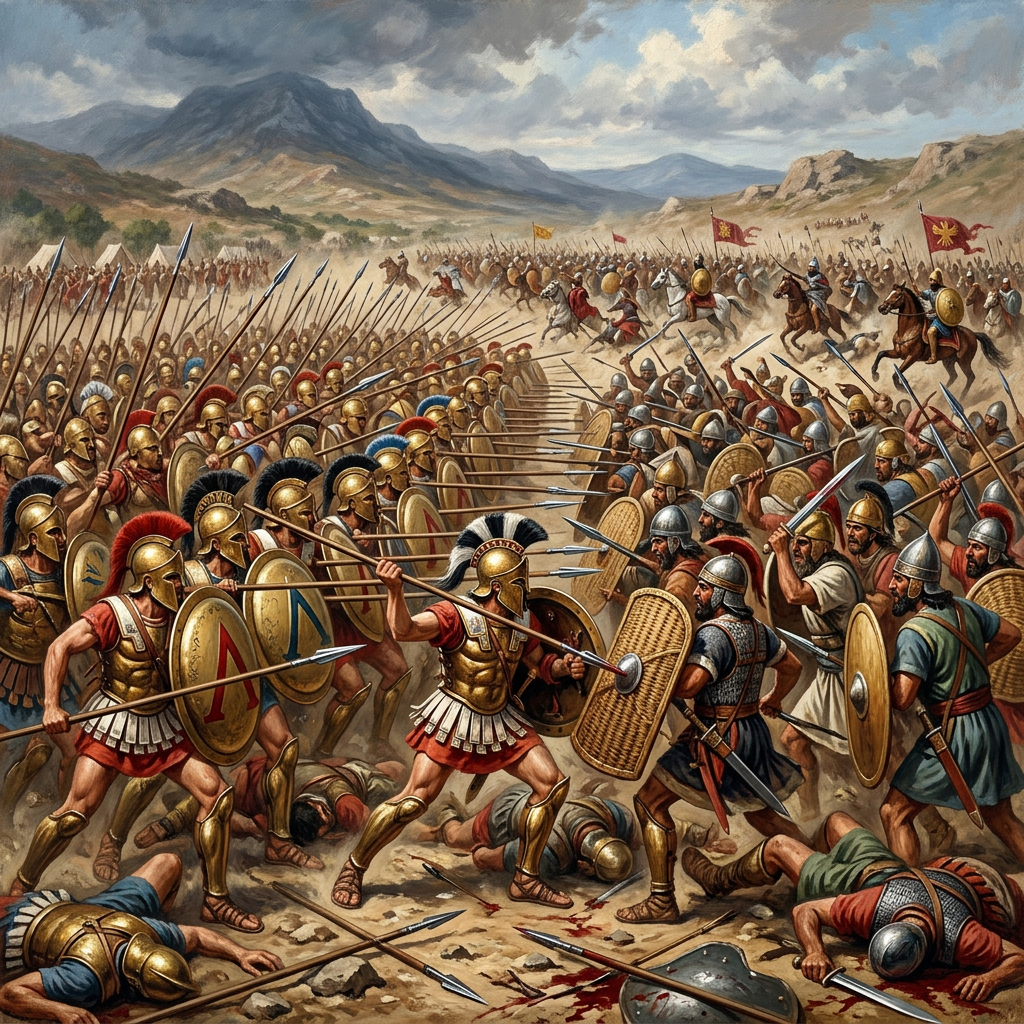
The Battle of Plataea, fought in 479 BC, marked the decisive land victory of the Greek city-states over the invading Persian Empire during the Greco-Persian Wars. Coming one year after the famous stand at Thermopylae and the naval triumph at Salamis, Plataea effectively ended the Persian attempt to conquer mainland Greece and reshaped the balance of power in the ancient Mediterranean.
Background: After Thermopylae and Salamis
In 480 BC, King Xerxes I of Persia launched a massive invasion of Greece. His forces initially swept through northern and central Greece, defeating the Spartans and their allies at Thermopylae and occupying Athens. Yet the Persians suffered a serious setback at the naval Battle of Salamis, where the Greek fleet, led by Themistocles, won a brilliant victory in the narrow straits near Athens.
Following the defeat at Salamis, Xerxes withdrew much of his army back to Asia, fearing that his lines of supply might be cut. He left a large and still formidable land force in Greece under his general Mardonius, with the mission of finishing the conquest and bringing the Greek mainland under Persian control.
Mardonius offered favorable terms to certain Greek states, hoping to break their alliance. Some cities in central Greece sided with the Persians, but the core of the Greek resistance—especially Sparta and Athens—refused. Instead, they prepared to meet Mardonius in a decisive land battle.
Forces and Commanders
On the Persian side, Mardonius commanded a multi-ethnic army drawn from across the empire: Persians, Medes, and contingents from various subject peoples. Despite losses at Salamis and earlier campaigns, his army was still large, highly experienced, and supported by cavalry—an area in which the Persians traditionally excelled.
The Greek alliance mustered a coalition army under Spartan leadership. Key components included:
- Spartans and their Peloponnesian allies
- Athenians, who had recently returned to a devastated city after evacuating before the Persian advance
- Other Greek city-states, including contingents from Corinth, Megara, and Plataea itself
Overall command was given to Pausanias, a Spartan regent acting on behalf of the young king Pleistarchus. The Greeks fielded a large hoplite army—heavily armed infantry equipped with bronze armor, large shields (aspis), and long spears—fighting in tightly packed phalanx formation.

The Road to Plataea
Mardonius initially camped in Boeotia, in central Greece, near the town of Plataea, an ally of Athens. He hoped to exploit the Persian cavalry, harass the Greeks, and possibly lure them into attacking on unfavorable ground.
The Greeks advanced north out of the Peloponnese, crossed into central Greece, and took position in the hills near Plataea. Their strategy was cautious. They wanted to minimize the effectiveness of Persian cavalry and fight on terrain favorable to the hoplite phalanx.
For days, the two sides maneuvered and skirmished. Persian cavalry raids cut off supply lines and harassed Greek positions, making it difficult for the coalition army to maintain its forward position. Mardonius hoped to disrupt the Greek formation, isolate individual contingents, and defeat them in detail.
The Battle Unfolds
The decisive clash came after a period of tense stalemate. Under pressure from dwindling supplies and Persian harassment, the Greeks decided to shift to a more secure position closer to their supply lines. This nighttime movement, however, went poorly. Miscommunication and confusion meant that some units fell back more quickly than others, leaving apparent gaps between Greek contingents.
At dawn, Mardonius saw what looked like a general Greek retreat. Interpreting this as a sign of weakness, he seized the opportunity and ordered a full attack, hoping to crush the Greeks while they were disorganized.
Initial Persian Successes
Persian forces, supported by their cavalry, advanced rapidly. They pressed especially hard on the center and left of the Greek line, where units were still trying to re-form. Intense fighting broke out along the front.
Despite the chaos of the Greek repositioning, the hoplite contingents managed to establish defensive formations. Their heavy armor and shield wall helped them withstand the initial Persian assault. While Persian infantry were numerous and battle-hardened, many were more lightly armored and relied on missiles and shorter spears, putting them at a disadvantage in close combat against organized phalanxes.
The Spartan and Tegean Counterattack
The key moment came on the Greek right, where the Spartans and their allies from Tegea formed a solid line. When Persian infantry under Mardonius advanced against them, a brutal and prolonged hand-to-hand struggle followed.
Gradually, the better-protected and more cohesive Greek hoplites began to push the Persians back. According to ancient sources, Mardonius himself was killed during this phase of the battle, possibly struck down by a Spartan warrior. Whether or not this detail is exact, the death of the Persian commander had a profound effect on morale and coordination.
With Mardonius dead and the front line starting to break under the Spartan and Tegean pressure, Persian resistance faltered. What began as a fierce engagement turned into a general rout as the Persian center and right began to collapse.

The Collapse of the Persian Army
On other parts of the battlefield, Greek contingents—including the Athenians—also held firm and counterattacked. The cumulative effect was devastating. Persian forces attempted to retreat to a fortified camp, but the Greeks, emboldened by their successes, stormed it.
Once inside, the Greek hoplites inflicted heavy casualties. Without unified leadership and locked in a defensive position unsuited to their strength, the Persian troops suffered a crushing defeat. Many were killed; others fled in disarray.
The Role of the Plataeans
The battle took place on the territory of Plataea, a small but loyal ally of Athens. Although their numbers were limited compared to the major powers, Plataean hoplites fought alongside the Athenians and their allies.
For Plataea, the battle was both a defense of their own homeland and a contribution to the wider Hellenic cause. In later years, the Greeks commemorated their victory at Plataea with dedications and annual rites, and Plataea itself was remembered as a sacred place associated with the struggle for Greek freedom.
Aftermath and Significance
The Battle of Plataea had far-reaching consequences:
- End of the Persian Land Campaign in Greece
Following the defeat, the remaining Persian forces in Greece withdrew. The Persian Empire abandoned large-scale attempts to conquer the mainland Greek city-states by land. - Naval Victory at Mycale
On the same day or shortly after Plataea—ancient sources differ on the exact timing—the Greeks also won a major naval victory at Mycale, off the coast of Asia Minor. Together, Plataea and Mycale marked the end of the second Persian invasion. - Rise of Greek Confidence and Power
Victories at Salamis, Plataea, and Mycale fostered a powerful sense of shared Greek identity and confidence. They proved that the city-states, when united, could resist one of the largest empires in the ancient world. - Shift in Greek Political Dynamics
After the Persian withdrawal, Athens emerged as a naval superpower and soon led the Delian League, a coalition initially formed to continue the war against Persia. Sparta, while retaining prestige for its leadership at Plataea, became more focused on affairs within the Peloponnese. These developments laid the foundations for the later rivalry between Athens and Sparta. - Cultural Legacy
The memory of Plataea, alongside Marathon and Salamis, became part of the broader Greek cultural narrative: a story of courage, sacrifice, and resistance against overwhelming odds. Historians like Herodotus preserved accounts of the battle, shaping how later generations understood the conflict between Greece and Persia.

Why Plataea Matters
While Thermopylae and Salamis are often more famous in popular imagination, Plataea was arguably the decisive land engagement of the Greco-Persian Wars. It turned what had been a desperate defensive struggle into a clear Greek victory. By destroying the main Persian field army in Greece, the allies not only saved their cities from conquest but also opened the way for a new era in Greek history.
The decades following Plataea saw an extraordinary flourishing of Greek culture: the rise of classical Athenian democracy, great works of drama, philosophy, art, and architecture, and new political experiments that would influence the wider Mediterranean world. In that sense, the victory at Plataea helped preserve the conditions under which classical Greek civilization could develop.
Fortisetliber’s View
From the perspective of Fortisetliber, Plataea is more than a military turning point; it is a lesson in how fragile freedom is—and how costly it is to defend. The Greek coalition did not win because it was the strongest power in the Mediterranean, but because a group of jealous, quarrelsome city‑states accepted discipline, risk, and sacrifice for something larger than their own advantage.
Plataea reminds us that liberty survives only when free communities are willing to endure confusion, setbacks, and genuine danger rather than accept a comfortable submission. The Greeks could have taken Persian gold and guarantees of safety; instead they chose a harder road whose rewards they would never fully see. In that sense, Plataea speaks to every age: if we wish to remain “fortes et liberi”—strong and free—we must be prepared, in our own way and our own time, to stand firm when retreat would be easier.
Leave a Reply