
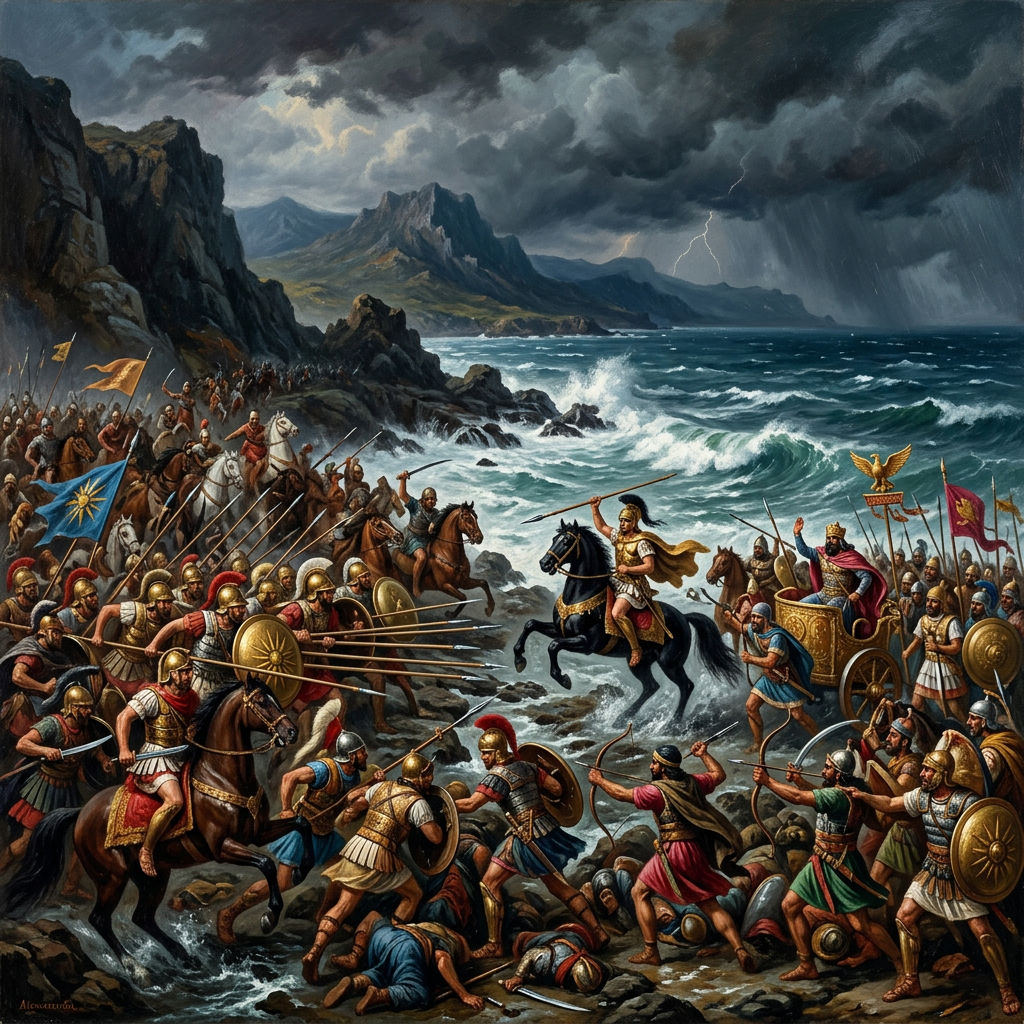
The Battle of Issus, fought in November 333 BCE on the southern coast of modern-day Turkey, was one of the decisive engagements of Alexander the Great’s campaign against the Achaemenid Persian Empire.
Pitting Alexander’s smaller but highly disciplined Macedonian army against the much larger forces of King Darius III, Issus showcased Alexander’s tactical brilliance and marked a turning point in the struggle for control of the eastern Mediterranean.
Historical Background
By 333 BCE, Alexander had already secured his position in Greece and begun his ambitious invasion of Asia. In 334 BCE he crossed the Hellespont (the Dardanelles today), proclaiming himself the avenger of earlier Persian invasions of Greece and the liberator of the Greek cities of Asia Minor.
His first major victory over Persian forces came at the Battle of the Granicus River in 334 BCE, where he defeated a satrapal army commanded by local Persian governors.
Following this success, Alexander moved systematically down the coast of Asia Minor, capturing key cities and naval bases such as Miletus and Halicarnassus. This strategy undercut Persian naval power and ensured his supply lines.
Darius III, recognizing the growing threat, decided to confront Alexander personally. Rather than allowing the Macedonians to continue advancing unopposed, Darius assembled a large imperial army drawn from various regions of his vast empire. The stage was set for a direct clash between the Persian Great King and the Macedonian king.
The Road to Issus
Alexander advanced south along the coast of Cilicia, a region of narrow plains and mountain passes along the northeastern Mediterranean. After recovering from a serious illness at Tarsus, he pushed through the Cilician Gates, a key mountain pass, and moved toward Syria.
Darius, meanwhile, attempted a bold maneuver. Instead of waiting deeper inside his empire, he marched his army northward through the Amanus Mountains, passing behind Alexander’s position. By doing so, he cut Alexander’s communication line back to Asia Minor and placed himself between Alexander and his rear.
The two armies eventually found themselves near the small town of Issus, with the River Pinarus (often identified with a modern stream in the region) running through the battlefield. The terrain would prove critical to the outcome.

Opposing Armies
The Macedonian Army
Alexander’s army was relatively small, perhaps around 30,000–40,000 men, including:
- The Macedonian phalanx: Heavy infantry armed with long spears (sarissas), fighting in deep, disciplined formations.
- Companion cavalry (hetairoi): Elite heavy cavalry units, personally led by Alexander on the right wing.
- Thessalian and allied Greek cavalry: Providing strong support on the left and center.
- Light troops and skirmishers: Including peltasts (javelin-armed infantry), archers, and Agrianian javelin-throwers.
Despite being outnumbered, the Macedonian army had several advantages: professional training, a coherent command structure, and experience fighting together in Alexander’s earlier battles.
The Persian Army
Persian numbers at Issus vary widely in ancient sources, ranging from 100,000 to several hundred thousand; modern historians usually assume a large but more modest figure, perhaps 60,000–100,000. The army was heterogeneous, comprising:
- Persian and allied infantry: Including Greek mercenaries, reputedly among the best infantry in Darius’s army.
- Cavalry: Many from Iran and its satrapies, traditionally the strength of Persian forces.
- Royal Guard and nobles: Elite units clustered around Darius, who fought from a war chariot.
The Persian army’s diversity brought both strengths and weaknesses: access to many troop types, but also challenges in coordination and cohesion.
The Battlefield
The battlefield at Issus was constrained by geography. The Mediterranean Sea lay to the west, while mountains pressed closely from the east, creating a narrow coastal plain. The Pinarus River, more a stream than a major river, cut across this narrow plain.
This terrain limited the ability of the larger Persian army to fully deploy its numbers. While on a wide open plain Darius might have exploited his superiority in manpower and cavalry, at Issus he was forced into a relatively confined space, which better suited Alexander’s smaller, more maneuverable force.
The Course of the Battle
Initial Deployment
Alexander, learning that Darius had moved behind him, quickly reversed his march and headed north to confront the Persian king.
Upon reaching Issus, he arrayed his troops with the Macedonian phalanx in the center, Companion cavalry and elite light troops on his right (near the foothills), and Thessalian cavalry with other contingents on his left (toward the coast).
Darius positioned his Greek mercenary infantry in the center, directly opposite Alexander’s phalanx, with Persian infantry and cavalry extending out toward both wings. He placed himself conspicuously in the center, standing in his chariot, a visible symbol of royal authority—but also a high-value target.
Clash on the Right Wing
Alexander initiated the battle with an aggressive move on the right. Leading the Companion cavalry in person, he aimed to attack the Persian left. Before engaging fully, he used light infantry and archers to disrupt the Persian front line, particularly around the river’s banks, where the terrain favored defenders.
The Macedonian advance across the Pinarus was difficult. The Persians had fortified the far bank in places, and the uneven ground broke up the Macedonian formation. However, once Alexander and the Companions gained a foothold on the opposite side, their superior training and cohesion began to tell.
Alexander’s decisive thrust struck the Persian left hard, gradually pushing it back and creating a gap in the Persian line.

Struggle in the Center
In the center, the Macedonian phalanx engaged the Greek mercenaries and Persian infantry across the river. The Greeks in Persian pay were experienced and fought stubbornly, inflicting significant casualties. For a time, the outcome in the center was uncertain.
Because of the constricted space, the phalanx could not deploy in its ideal formation everywhere, and parts of the Macedonian line were pushed back. However, the overall alignment held long enough for Alexander’s success on the right to become decisive.
Crisis on the Macedonian Left
On Alexander’s left, near the sea, the situation was more precarious. Persian cavalry attempted to exploit any openings, and for a moment the Macedonian line there was under heavy pressure. The Thessalian cavalry and allied troops performed a critical holding action, preventing a breakthrough that might have rolled up the Macedonian flank.
The battle on the left was essentially a struggle for time: if the Macedonians could avoid collapse while Alexander attacked on the right, the strategic advantage would eventually shift decisively.
The Turning Point: Darius’s Flight
The critical moment came when Alexander, having broken through on the right, turned toward the Persian center. With his Companion cavalry and supporting units, he wheeled inward and drove directly at the position where Darius stood in his chariot.
The sight of Alexander charging toward him, combined with the disintegration of parts of the Persian left, seems to have shaken Darius’s resolve. Ancient authors report that Darius turned his chariot and fled the field, later abandoning even the chariot itself in his haste to escape.
Once the Great King’s withdrawal became evident, Persian morale collapsed. What had been a hard-fought battle turned into a rout:
- Many Persian soldiers threw down their weapons and fled.
- The Macedonian army pursued, cutting down large numbers, especially in the congested terrain where escape routes were limited.
- Darius’s immediate entourage suffered heavy losses; some of his close relatives and high-ranking nobles were killed.
The departure of the king, in a system where royal charisma and presence were central to cohesion, made further organized resistance impossible.

Aftermath and Consequences
The Battle of Issus had far-reaching consequences, both immediate and long-term.
Captives and Spoils
In the Persian camp, Alexander captured immense treasure, as well as Darius’s family:
- Darius’s mother, wife, and children were taken prisoner.
- According to the sources, Alexander treated them with notable respect, a gesture that enhanced his reputation and undermined Persian propaganda portraying him as a barbaric invader.
The captured wealth helped finance Alexander’s continued campaigns and pay his troops, securing their loyalty.
Strategic Shift in the Eastern Mediterranean
Issus effectively gave Alexander control over the eastern Mediterranean coastline:
- The land route through Syria and into the Levant was opened.
- Persian authority in the region was gravely weakened, enabling Alexander to proceed to the sieges of Tyre (332 BCE) and Gaza, and eventually into Egypt.
By removing Darius’s army from the immediate theater, Issus allowed Alexander to secure the coastal cities and ports systematically, making it nearly impossible for what remained of the Persian navy to project power effectively.
Political and Psychological Impact
Politically, Issus exposed Darius as vulnerable:
- The Great King’s flight, widely reported, damaged his prestige within his own empire.
- Some satraps and local rulers began to waver in their allegiance, cautiously approaching Alexander or at least hedging their bets.
Psychologically, the battle demonstrated that Macedonian forces, under Alexander’s command, could defeat the main royal Persian army in a pitched battle, not just local satrapal forces. This enhanced Alexander’s stature among both Greeks and non-Greeks as a leader favored by fortune and skill.
Alexander’s Strategy and Tactics at Issus
Issus is often cited as a classic example of Alexander’s operational and tactical methods:
- Rapid Maneuvering
When he realized Darius had moved behind him, Alexander did not hesitate. He reversed direction and forced-marched north, denying Darius freedom to choose a more favorable battlefield. - Use of Terrain
Although Darius had chosen the position, the narrow coastal plain worked against the Persians. Alexander recognized that his smaller force would suffer less from being compressed, while Darius could not fully exploit his superior numbers. - Concentration on a Decisive Point
Alexander focused his strongest troops—particularly the Companion cavalry—on one wing, with the aim of breaking through and then striking at the enemy center and the person of the king. - Leadership from the Front
Alexander’s visible presence in the thick of battle encouraged his troops and intimidated the enemy. In contrast, Darius’s decision to retreat at a critical moment helped tip the psychological balance.

Issus in Historical Memory
The Battle of Issus became a staple of ancient and later historiography. Ancient authors such as Arrian, Diodorus Siculus, and Plutarch treat it as a defining moment in Alexander’s ascent. In later centuries, artists used Issus as a symbol of the clash between East and West, monarchy and heroic leadership:
- The famous “Alexander Mosaic” from Pompeii, believed to be based on a Hellenistic painting, likely depicts the dramatic confrontation between Alexander and Darius at Issus, capturing both the chaos of cavalry combat and the moment of the Persian king’s flight.
- Medieval and Renaissance writers and artists revisited the story of Issus as part of the broader “Alexander Romance,” transforming the historical battle into a semi-legendary scene of bravery and destiny.
Conclusion
The Battle of Issus (333 BCE) was far more than a tactical victory. It marked a major strategic and psychological turning point in Alexander’s campaign against the Persian Empire.
By defeating Darius III in person on a battlefield that constrained Persian numerical superiority, Alexander proved the effectiveness of his army, his talent for exploiting terrain and timing, and his willingness to lead from the front.
In the years that followed, Alexander would build on the foundations laid at Issus to conquer the Levant, Egypt, and eventually the Persian heartland itself. Issus thus stands as a key milestone on the road from Macedonian kingdom to sprawling Hellenistic empire.
Fortisetliber’s View
From the vantage point of Fortisetliber, the Battle of Issus is more than a clash of armies; it is a study in how personality, perception, and decision‑making can redirect the course of empires.
On paper, Darius III possessed the stronger position: a vast empire, numerical superiority, and the aura of the Great King. Yet Issus exposes how fragile power becomes when it rests too heavily on image and too lightly on disciplined preparation and clear command.
Alexander’s strength at Issus did not lie merely in superior tactics, but in coherence. His army was smaller but integrated: phalanx, cavalry, and light troops drilled to act as a single instrument in the hands of a commander willing to share danger at the front.
Darius, by contrast, presided over a magnificent but unwieldy coalition, where prestige substituted for presence until the moment of crisis. When the king turned his chariot to flee, the fiction of invincibility dissolved, and with it the resolve of his army.
Issus also reminds us how decisive terrain and timing can be in human affairs. The narrow coastal plain that should have cautioned Darius to withdraw instead became the stage of his undoing. Alexander accepted the constraints of the landscape and turned them to advantage; Darius ignored them and paid the price. In this sense, Issus stands as a cautionary episode: power that refuses to reckon with reality—whether geographic, political, or psychological—soon finds itself surprised by events it should have foreseen.
Finally, Issus forces us to reflect on the double edge of charismatic leadership. Alexander’s presence in the mêlée inspired uncommon endurance and daring; Darius’s visible retreat shattered a world. Both outcomes sprang from the same principle: when authority is intensely personalized, victory and collapse alike become sudden and absolute.
To read Issus, therefore, is not only to revisit a famous field in Cilicia, but to confront perennial questions about leadership, legitimacy, and the slender margin on which the fortunes of states so often turn.
Leave a Reply