
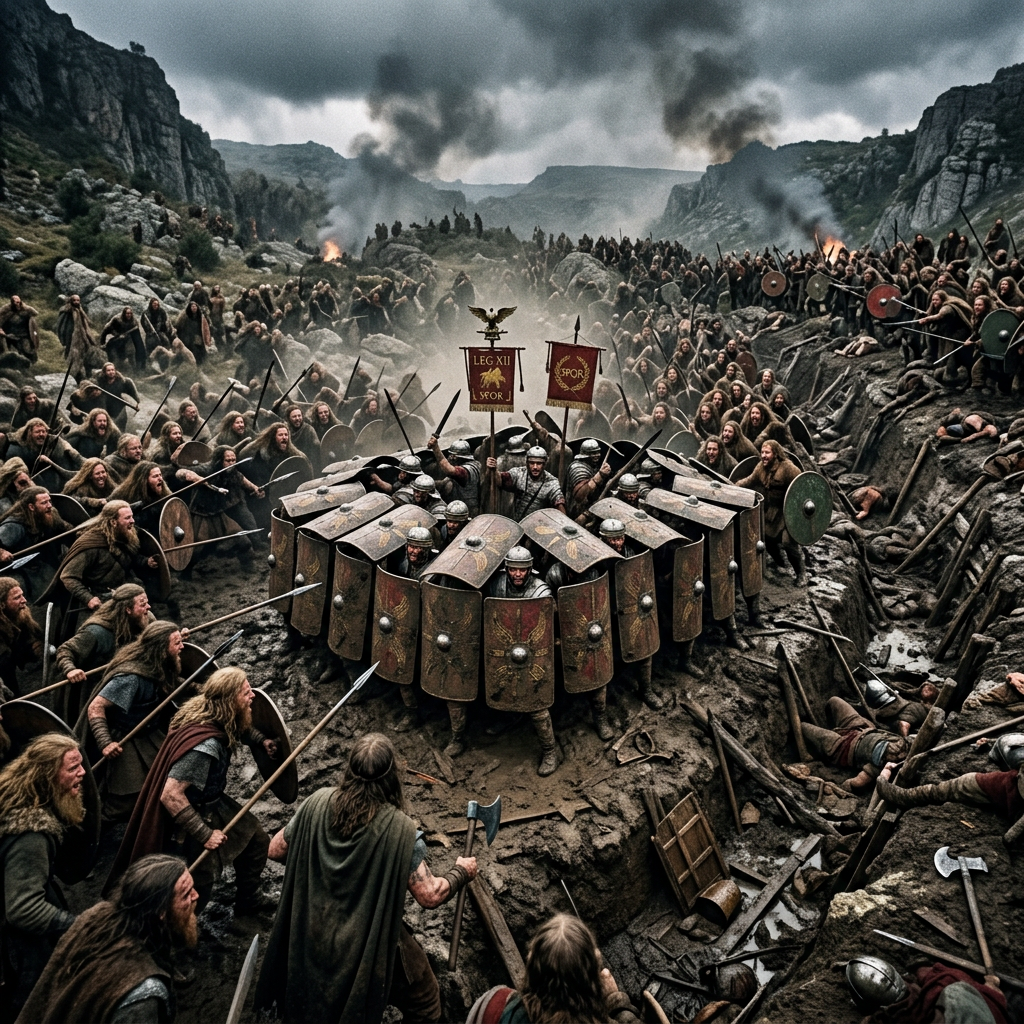
The Battle of the Great Foss, fought in 343 BC, was a decisive engagement between the Roman Republic and the Samnites during the First Samnite War (343–341 BC).
The battle is primarily known through the account of the Roman historian Livy, though many modern historians debate aspects of its accuracy. Regardless of uncertainties, the battle is remembered as a dramatic Roman victory achieved under desperate circumstances.
Historical Background
In the early 4th century BC, Rome was expanding its influence in central Italy. The Samnites, a powerful confederation of hill tribes from the Apennine region, were also expanding westward.
Tensions escalated when the Campanian city of Capua sought Roman protection against Samnite aggression. Rome’s decision to intervene led to open war.
Early in the conflict, Roman forces campaigned in Samnium under the command of Consul Aulus Cornelius Cossus. The Samnites, skilled in mountain warfare, sought to exploit the difficult terrain to their advantage.
The Crisis
According to Livy, the Roman army was lured into a trap in a narrow valley surrounded by high ground. The Samnites occupied the heights and threatened to block all avenues of escape. The Romans faced possible annihilation — cut off, outmaneuvered, and vulnerable.
At this critical moment, a military tribune named Publius Decius Mus volunteered to lead a small detachment to seize a hill that overlooked the Samnite position. By capturing this key terrain, Decius created confusion among the Samnites and diverted their attention from the main Roman force.
Under the cover of this diversion, the Roman army managed to withdraw to safer ground. Decius and his men were briefly surrounded but escaped during the night.

The Battle
The following day, the Romans regrouped and prepared for battle. Now on more favorable terrain, they engaged the Samnite army directly.
Roman discipline and organization, combined with renewed morale after their narrow escape, turned the tide.
Livy reports that the Samnites suffered heavy casualties and were decisively defeated.
Though the precise scale of the victory is uncertain, the battle restored Roman confidence and stabilized their position in the war.
Significance
The Battle of the Great Foss is significant for several reasons:
- Demonstration of Roman resilience: The Romans recovered from near disaster through bold leadership and tactical improvisation.
- Heroic tradition: The actions of Publius Decius Mus became legendary. His family would later become famous for acts of devotion — ritual self-sacrifice in battle.
- Strategic impact: The victory helped secure Rome’s position in Campania and maintain momentum in the First Samnite War.
Modern historians debate whether Livy’s narrative exaggerates the scale or drama of the event, and some question whether the battle occurred exactly as described.
However, the episode reflects important themes of early Roman military culture: discipline, adaptability, and individual heroism in service of the Republic.

Conclusion
Though not as famous as later Roman battles, the Battle of the Great Foss stands as a powerful story of crisis and recovery.
Whether fully historical or partially embellished, it illustrates the qualities that would define Rome’s rise — determination under pressure and leadership in moments of danger.
Fortisetliber’s View
The Battle of the Great Foss is more than a dramatic military episode — it is a study in composure under pressure. What stands out is not simply Roman victory, but Roman recovery.
Faced with encirclement and possible destruction, the army did not collapse. Instead, leadership, discipline, and calculated boldness transformed imminent defeat into strategic advantage.
Whether Livy’s account is embellished or not, the deeper truth remains compelling: civilizations are tested not in moments of triumph, but in moments of crisis.
The Great Foss illustrates a recurring Roman principle — that order, courage, and sacrifice in the face of chaos create the foundation of lasting power.
For us, the lesson is clear. Strength is not the absence of danger; it is clarity and resolve within it.
Leave a Reply