
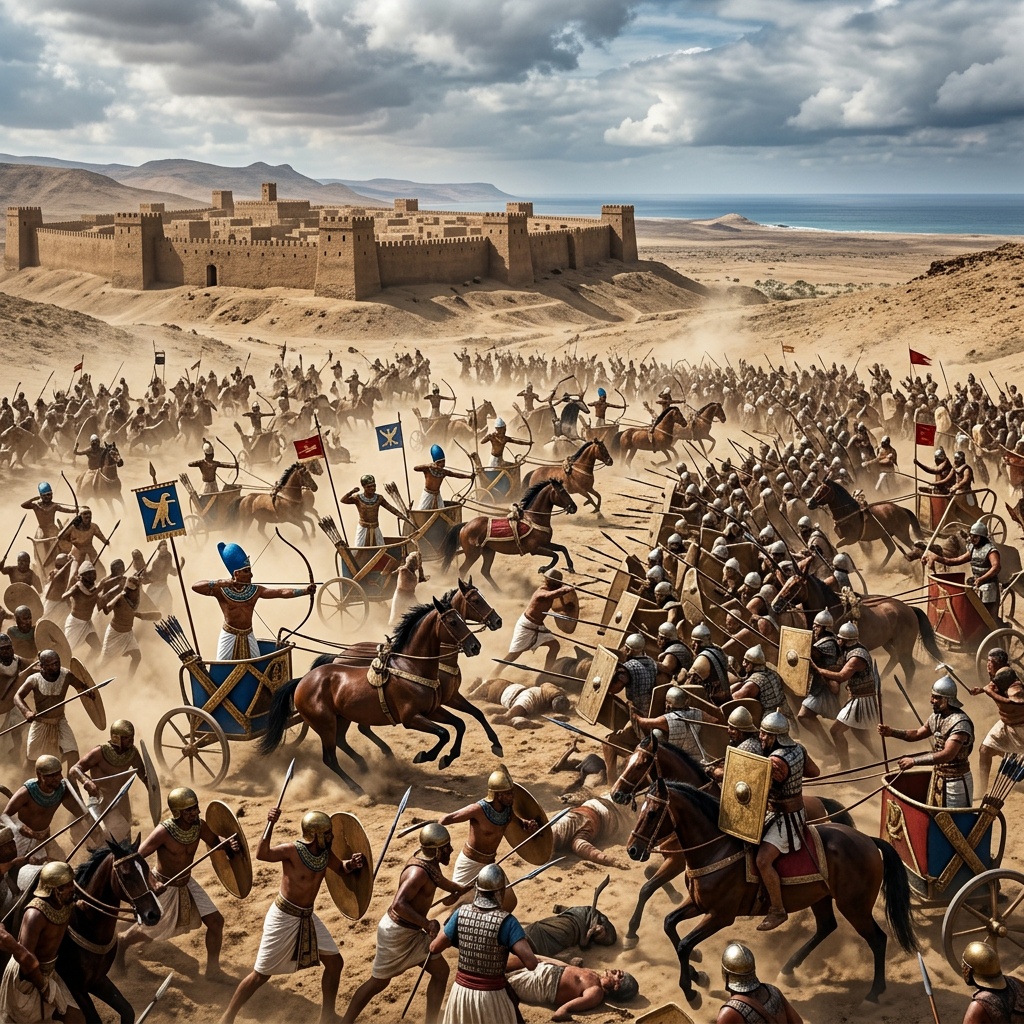
The engagement commonly referred to as the Battle of Migdol, fought in 601 BC between the Neo-Babylonian Empire under Nebuchadnezzar II and Egypt under Necho II, was a pivotal moment in the struggle for control of the Levant after the fall of Assyria.
Although the surviving sources are brief, they allow a reasonably clear picture of the geopolitical context, the course of the campaign, and its consequences for the wider Near East, including the Kingdom of Judah.
Historical Background
The Neo-Babylonian Empire under Nebuchadnezzar II
The Neo-Babylonian Empire (c. 626–539 BC) emerged as the dominant power in Mesopotamia after the decline of the Assyrian Empire. Nebuchadnezzar II (reigned 605–562 BC), son of Nabopolassar, inherited an expanding state that had already played a decisive role in the destruction of Assyria.
Under his rule, Babylon consolidated control over former Assyrian territories in northern Mesopotamia and the Levant. Nebuchadnezzar is best known from both Babylonian and biblical sources as a powerful monarch, an active campaigner, and a builder whose projects transformed the city of Babylon.
Militarily, Nebuchadnezzar continued the Assyrian tradition of annual campaigning, seeking both to secure Babylon’s frontiers and to maintain dominance over vassal kingdoms.
Western campaigns into Syria-Palestine were particularly important, not only to control trade routes linking Mesopotamia and Egypt but also to prevent Egypt from reasserting influence in the region.
Egypt under Necho II
Necho II (reigned c. 610–595 BC) of the Twenty-Sixth (Saite) Dynasty ruled an Egypt that had briefly been a crucial ally of the Assyrian Empire.
In the late seventh century BC, Egyptian forces intervened in Syria-Palestine in an effort to prop up the weakening Assyrian state and to secure Egyptian interests in the Levant. Although Assyria ultimately fell, Egypt retained a significant presence in the region for several years.
Necho’s policies combined internal consolidation with ambitious foreign ventures. Herodotus later associates him with naval and canal projects, while Near Eastern sources emphasize his military campaigns in the Levant. By the time of the Battle of Migdol, Egypt was attempting to preserve or regain influence in Syria-Palestine against the advancing Babylonians.

Geopolitical Context after the Fall of Assyria
The fall of the Assyrian Empire at the end of the seventh century BC profoundly reshaped the political map of the Near East.
The capture and destruction of Nineveh in 612 BC, followed by subsequent campaigns, left a power vacuum in northern Mesopotamia and Syria. Babylon, in alliance at times with the Medes, emerged as Assyria’s principal successor in Mesopotamia, while Egypt sought to extend its influence northward into the former Assyrian provinces of Syria-Palestine.
Between 609 and 605 BC, the region became a contested frontier zone. Egypt advanced as far as northern Syria, while Babylon pushed westward. The decisive Babylonian victory at Carchemish (605 BC), mentioned in both the Babylonian Chronicles and the Hebrew Bible (e.g., Jeremiah 46:2), checked Egyptian expansion and established Babylonian predominance in the Levant.
Nevertheless, Egypt retained significant strength and continued to contest Babylonian control along the southern Levantine corridor and the Sinai frontier.
The smaller kingdoms of the Levant, including Judah, found themselves caught between these two great powers. Their political choices—alliances, vassal status, or rebellion—were shaped by the shifting balance between Babylonian and Egyptian forces. The Battle of Migdol occurred within this broader struggle for regional dominance.
Causes of the Conflict
The direct cause of the Babylonian–Egyptian confrontation near Migdol in 601 BC was Nebuchadnezzar’s decision to campaign westward and test Egyptian power on or near Egypt’s northeastern frontier.
After consolidating his authority in Babylon and the core Mesopotamian territories, Nebuchadnezzar sought to secure the Levant and to prevent any Egyptian resurgence that might threaten Babylonian hegemony.
From Egypt’s perspective, the Levant was strategically and economically vital. Control over the land routes through Palestine and the coastal plain affected access to trade from Arabia and Mesopotamia.
The loss at Carchemish had diminished Egyptian prestige, but it had not eliminated Egypt’s capacity to project power. Necho II’s continued involvement in the southern Levant reflects a policy aimed at retaining a buffer zone beyond the Nile Delta.
The surviving Babylonian Chronicle entry for 601 BC records Nebuchadnezzar’s advance toward Egypt and states that the Babylonian and Egyptian armies engaged in a fierce battle.
Although the text does not elaborate on diplomatic antecedents, the encounter fits a pattern of Babylonian attempts to impose firm control over Syria-Palestine and Egyptian efforts to resist that control near the Sinai and Delta approaches.

The Campaign and the Battle
Babylon’s Westward March
The Babylonian Chronicles, a series of Akkadian cuneiform tablets, are the principal source for Nebuchadnezzar’s campaigns.
The chronicle covering his early years reports that in his fourth regnal year (601 BC) he marched to the west “against Egypt.” It notes that the Babylonian army encountered the Egyptians and that a major battle ensued.
Although the chronicle does not describe the route in detail, earlier and later campaigns indicate that Babylonian forces typically moved through Syria, then south along the Levantine corridor, passing through or near the territories of vassal states such as Judah, before approaching the Sinai and Egyptian frontier fortifications.
The campaign of 601 BC appears to have followed this general pattern, culminating in a confrontation in the vicinity of Migdol.
The Battle near Migdol
The Babylonian Chronicle summarizes the battle succinctly, stating that Nebuchadnezzar and the king of Egypt fought and that both sides suffered heavy losses.
The text indicates that the engagement was intense enough to force Nebuchadnezzar to withdraw his army to Babylon for refitting in the following year. While the account is concise, it clearly implies a costly and indecisive battle in which neither power achieved a decisive breakthrough.
The Hebrew Bible does not provide a narrative of this specific battle but does refer to Egyptian strongholds such as Migdol and to the broader Babylonian–Egyptian rivalry in the region (e.g., Jeremiah 44:1 mentions Jews residing in Migdol, Tahpanhes, and other Egyptian locations).
These references are consistent with the picture of a contested frontier zone on Egypt’s northeastern border during the late seventh and early sixth centuries BC.
The Likely Location of Migdol
The term Migdol (meaning “tower” or “fortress” in Northwest Semitic) appears in several ancient sources in connection with Egypt’s northeastern frontier. Biblical texts such as Exodus 14:2, Ezekiel 29:10, and 30:6 refer to a Migdol associated with the border region, while Jeremiah 44:1 suggests a Migdol as a settlement where Judeans had taken refuge in Egypt.
Egyptian and archaeological evidence indicate that the eastern Delta and Sinai approaches were dotted with fortified sites controlling entry from Asia.
Modern scholarship generally locates Migdol in the northeastern Nile Delta or near the coastal route into Egypt, though the precise identification of the site remains debated.
The available textual evidence supports placing the battlefield somewhere near this frontier zone, where Egyptian fortifications and garrisons would have confronted an invading Babylonian army approaching from the Levant. Within these limits, the exact coordinates of Migdol and the battlefield are not securely established in current research.

Military Forces and Strategies
Composition of the Armies
Both Babylon and Egypt inherited and adapted the military traditions of the earlier Assyrian Empire. The Babylonian army under Nebuchadnezzar consisted of professional core units—infantry, archers, and chariot or early cavalry elements—supplemented by contingents from subject peoples.
Siege warfare, logistical support along royal roads, and the use of fortified staging points were all well-established features of Mesopotamian campaigning by this period.
Egyptian forces under Necho II drew on the long-standing military institutions of the Nile Valley, including chariotry, infantry, and specialized units stationed in frontier fortresses.
Greek and other foreign mercenaries are known to have served in the Egyptian army during the Saite period, though the extent of their role in this particular campaign cannot be determined precisely from surviving texts.
Strategic Aims and Battlefield Dynamics
Nebuchadnezzar’s strategic objective in 601 BC was to demonstrate Babylonian power at Egypt’s border, to discourage Levantine states from relying on Egyptian support, and to secure the southern flank of his western holdings.
Advancing toward Migdol aligned with this goal by threatening the eastern approaches of the Nile Delta and testing the Egyptian capacity to defend its frontier.
Egypt’s strategy, by contrast, focused on defending the Delta and preventing Babylonian penetration into Egyptian territory. Frontier forts such as Migdol functioned as both early warning posts and strongpoints from which Egyptian forces could concentrate against an invading army.
The heavy casualties reported in the Babylonian Chronicle suggest a large-scale engagement, likely involving sustained close combat between sizable formations, although the sources do not permit a more detailed reconstruction of tactical maneuvers.
Outcome and Immediate Consequences
The Babylonian Chronicle notes that both Babylonian and Egyptian forces suffered substantial losses and that Nebuchadnezzar subsequently returned to Babylon. In the following year, the chronicle records that he remained in his homeland to rebuild his chariot forces and prepare for future campaigns.
This implies that, although Nebuchadnezzar was not defeated in a decisive sense, the battle did not yield a clear Babylonian victory and forced a temporary pause in Babylonian offensive operations to the west.
For Egypt, the battle appears to have achieved the limited objective of preventing a Babylonian breakthrough into the Nile Delta, at least in the short term. However, there is no indication in the surviving sources that Egypt was able to exploit the outcome to recover its former position in Syria-Palestine.
Instead, the aftermath points to a kind of strategic stalemate along the frontier, with Babylon still recognized as the dominant power in the Levant.

Long-Term Significance for the Levant and the Kingdom of Judah
The longer-term consequences of the 601 BC campaign were especially significant for the small kingdoms of the Levant, and in particular for Judah. The apparent Babylonian setback, or at least lack of a clear victory, encouraged some western vassals to reconsider their allegiance.
According to the biblical account (2 Kings 24:1), King Jehoiakim of Judah, who had been a vassal of Babylon, rebelled after a period of submission; this decision is often linked by scholars to perceptions of Babylonian vulnerability following the costly campaign against Egypt.
In the medium term, however, the consequences for Judah were disastrous. Nebuchadnezzar eventually resumed his western operations. The Babylonian response to Judah’s rebellion included the siege and capture of Jerusalem in 597 BC, the deposition of King Jehoiachin, and the first major deportation of Judean elites to Babylonia (2 Kings 24:10–17).
A second revolt later led to the destruction of Jerusalem and the temple in 586 BC (2 Kings 25). The Battle of Migdol, therefore, figures indirectly in the chain of events that culminated in the end of the Judahite monarchy and the beginning of the Babylonian Exile.
More broadly, the inability of Egypt to reassert control over the Levant after 601 BC confirmed Babylon’s status as the principal imperial power in the region until the rise of the Persian Empire under Cyrus the Great.
The battle thus forms part of the wider transition from Assyrian to Babylonian, and eventually to Persian, dominance in the ancient Near East.
Ancient Sources and Their Testimony
The Babylonian Chronicles
The most important primary source for the Battle of Migdol is the Babylonian Chronicle known in scholarship as the “Jerusalem Chronicle” or “Nebuchadnezzar Chronicle” (BM 21946).
Written in Akkadian cuneiform, it provides an annalistic account of key events in Nebuchadnezzar’s early reign, including the battle of Carchemish, the first capture of Jerusalem in 597 BC, and the campaign against Egypt in his fourth year.
The entry for 601 BC states that Nebuchadnezzar marched to the west against Egypt, that the two kings engaged in battle, and that the kings “inflicted great havoc” on each other’s forces.
The brevity of the account reflects the chronicle’s general style, which favors concise records over detailed narratives. Nevertheless, it is the clearest contemporary testimony to the scale and cost of the engagement.

References in the Hebrew Bible
The Hebrew Bible does not offer a narrative description of the 601 BC battle itself, but several passages illuminate the broader context. Jeremiah 46 refers to the Egyptian defeat at Carchemish and to subsequent events involving Egypt and Babylon.
Other passages mention Migdol and related frontier sites: Jeremiah 44:1 lists Migdol among the places in Egypt where Judean communities had settled, while Ezekiel 29:10 and 30:6 use the formula “from Migdol to Syene” to describe the extent of Egypt.
Historical books such as 2 Kings and 2 Chronicles, though focused on Judah, reflect the shifting power balance between Egypt and Babylon. They depict Judah’s kings navigating between the two powers, with Egyptian involvement evident earlier in the reigns of Josiah and Jehoahaz and Babylonian dominance becoming increasingly clear under Jehoiakim and his successors.
These texts, read alongside the Babylonian Chronicle, help situate the Battle of Migdol within a coherent sequence of regional events.
Later Traditions and the Limits of the Evidence
Later classical sources, such as Herodotus, provide information about Necho II’s reign and Egyptian military activities more generally, but they do not preserve a detailed account of the 601 BC battle.
Modern reconstructions, therefore, rely primarily on the Babylonian Chronicle, biblical references to Egypt’s northeastern frontier and to Migdol, and archaeological evidence for fortifications in the eastern Delta and Sinai.
Within these constraints, the main contours of the event are well established: a major confrontation between Babylon and Egypt near Egypt’s northeastern frontier, heavy casualties on both sides, and a strategic pause in Babylonian campaigning that had significant repercussions for vassal states in the Levant.
Beyond these points, the lack of detailed narrative sources limits further reconstruction, and responsible historical interpretation remains closely tied to the testimony of the extant texts.
Conclusion
The Battle of Migdol in 601 BC stood at the intersection of two great powers competing for the legacy of Assyria and for control of the Levantine land bridge.
Though tactically indecisive, the battle’s strategic consequences were far-reaching. It confirmed that Egypt could still defend its own borders but could not overturn Babylonian dominance in Syria-Palestine, and it contributed to political calculations in smaller states like Judah, whose ill-fated rebellions against Babylon reshaped the religious and cultural history of the region.
Fortisetliber’s View
The Battle of Migdol in 601 BC illustrates a recurring pattern in ancient Near Eastern history: great powers testing the limits of expansion in the shadow of recent victory. Nebuchadnezzar II, fresh from his triumph at Carchemish, sought to press Babylonian dominance further into the Levant and toward Egypt’s frontier.
Yet Migdol demonstrates that imperial momentum is not inexhaustible. Even the most formidable states could encounter resistance that imposed caution, recalibration, and a strategic pause.
From Fortisetliber’s perspective, the significance of Migdol lies less in tactical outcomes than in structural consequences. The battle appears to have been indecisive in immediate terms, but strategically, it stabilized a frontier.
Egypt survived as an independent power; Babylon consolidated rather than overextended. In this sense, Migdol functioned as a balancing moment—one that prevented rapid escalation into deeper conquest while preserving a tense equilibrium in the eastern Mediterranean.
The engagement also underscores the limits of our sources. A few terse lines in the Babylonian Chronicle, scattered biblical references, and later traditions form the fragile scaffolding of reconstruction. History here must proceed with discipline and restraint, resisting the temptation to fill silence with certainty.
Ultimately, the Battle of Migdol reminds us that history is often shaped not only by decisive victories but by hard-fought stalemates.
Empires endure not merely through conquest, but through adaptation. In 601 BC, both Babylon and Egypt stepped back from the brink—and in doing so, shaped the political trajectory of the Levant for decades to come.
Leave a Reply