
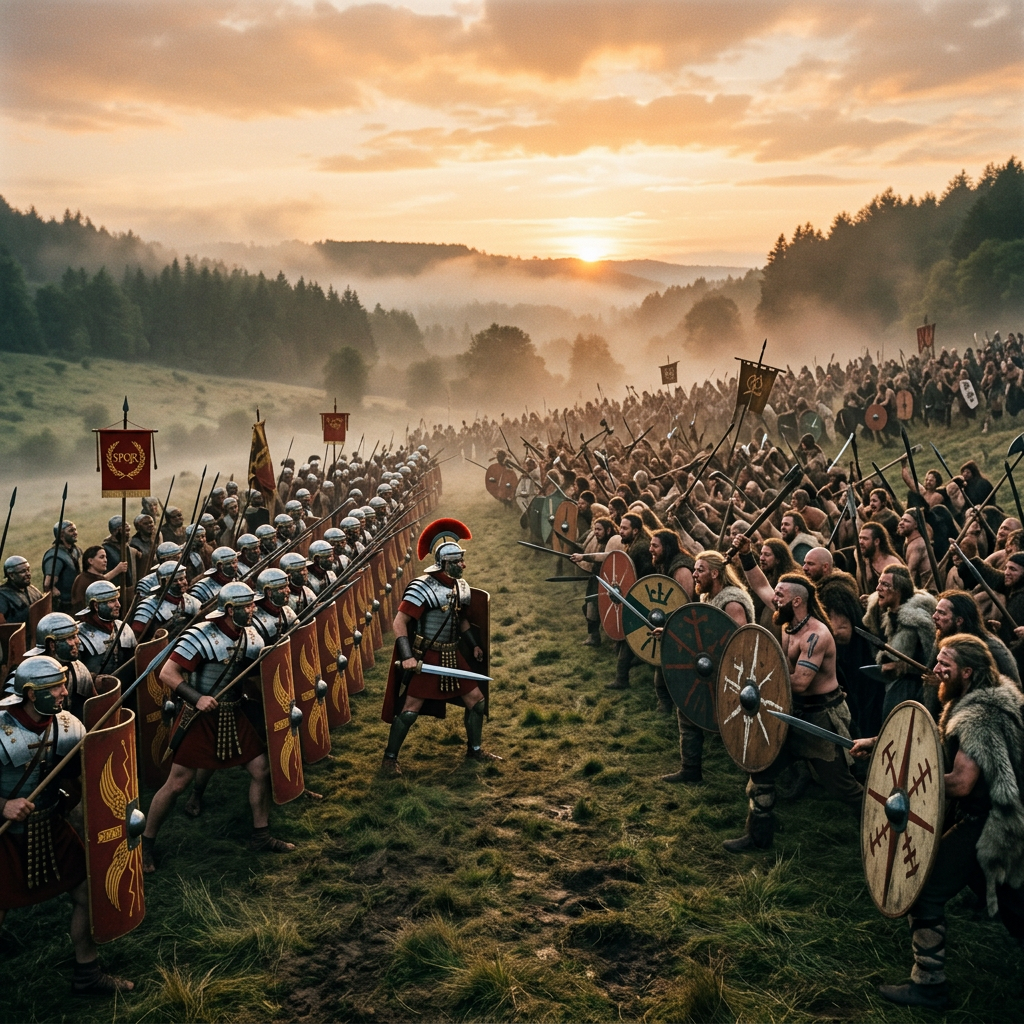
The Battle of Argentovaria, fought in 378 AD near the town of Argentovaria (modern-day Horbourg-Wihr in Alsace, France), was a significant military engagement between the Western Roman Empire and the Alamanni, a confederation of Germanic tribes.
Though less famous than the catastrophic Battle of Adrianople fought the same year, Argentovaria was an important Roman victory that helped stabilize the Rhine frontier during a period of profound crisis for the Empire.
Historical Background
By the late 4th century, the Roman Empire was under immense pressure along its borders. Germanic tribes frequently crossed the Rhine and Danube frontiers, testing Roman defenses.
The Alamanni, who had long inhabited regions east of the Rhine, were among the most persistent challengers to Roman authority in Gaul.
In 378 AD, while the Eastern Roman Emperor Valens faced the Gothic threat that would culminate in defeat at Adrianople, the Western Empire—under the leadership of Emperor Gratian—confronted Alamannic incursions into Roman territory.
Gratian, still a young ruler but already experienced in military matters, took direct command of Roman forces in Gaul to repel the invaders.
The Opposing Forces
The Roman army at Argentovaria consisted primarily of field troops (comitatenses) supported by frontier units.
These forces were professional, disciplined, and accustomed to fighting in coordinated formations. Roman cavalry likely played a key role, as mobility was essential in countering tribal war bands.
The Alamanni, on the other hand, fought in traditional tribal formations. Their warriors were known for their ferocity and skill in close combat.
Leadership was typically provided by chieftains or kings who inspired loyalty through personal valor and reputation.

The Battle
The battle took place near Argentovaria along the Rhine frontier. According to the Roman historian Ammianus Marcellinus, Gratian’s forces decisively defeated the Alamanni.
The Roman army reportedly inflicted heavy casualties—ancient sources suggest thousands of Alamanni were killed.
Roman discipline and tactical organization appear to have been decisive factors. The ability to maintain formation, coordinate infantry and cavalry movements, and exploit weaknesses in the enemy’s lines allowed Gratian’s forces to overwhelm the tribal warriors.
The defeat weakened the Alamanni’s capacity for further large-scale invasions in the immediate aftermath. Many survivors retreated across the Rhine, and Roman control over the region was temporarily restored.
Significance
Although overshadowed by the dramatic and disastrous Battle of Adrianople later in 378, the victory at Argentovaria was strategically important.
It demonstrated that the Western Roman army remained effective and capable of defending its borders, even as the Empire faced mounting internal and external challenges.
Gratian’s success enhanced his military reputation and secured the Rhine frontier at a critical moment. However, the broader pressures of migration, political instability, and economic strain would continue to challenge Roman authority in the decades to come.
Conclusion
The Battle of Argentovaria stands as a reminder that the late Roman Empire was not merely in decline but was still capable of military resilience and effective leadership.
While history often remembers 378 AD for Roman defeat in the East, the events at Argentovaria reveal a different story—one of discipline, strategy, and a temporary but meaningful victory along the Rhine.

Fortisetliber’s View
At Fortisetliber, we see the Battle of Argentovaria as a powerful reminder that history is rarely a simple tale of decline.
In the same year that Rome suffered catastrophe at Adrianople, it also demonstrated discipline, resolve, and strategic clarity along the Rhine.
Argentovaria reveals the enduring strength of Roman organization and leadership. Gratian’s victory shows that even in periods of crisis, preparation and unity could still secure stability.
It is a testament to the idea that civilizations do not fall in a single moment—they struggle, adapt, and at times, prevail.
For us, Argentovaria symbolizes resilience: the quiet victories that history often overlooks, yet which sustain order in uncertain times.
Leave a Reply