
More than two thousand years ago, in the sunlit city of Syracuse on the island of Sicily, a man began exploring ideas that would change the world forever.
His name was Archimedes. Though he lived in the 3rd century BCE, long before modern science and technology, his discoveries in mathematics, physics, and engineering continue to shape the world we live in today.
From understanding the principles of buoyancy to designing ingenious war machines, Archimedes was not merely a mathematician—he was a visionary whose mind bridged theory and practical invention.
Archimedes was born around 287 BCE, likely into a family connected with learning and astronomy.
His father, Phidias, is believed to have been an astronomer, and this intellectual environment may have influenced the young Archimedes.
At some point in his early life, he traveled to Alexandria in Egypt, one of the greatest centers of learning in the ancient world.
There he encountered the works of Euclid and other leading scholars. Alexandria sharpened his mathematical talents, but Syracuse would become the stage for his greatest achievements.
What makes Archimedes remarkable is not only the number of discoveries he made, but the depth and originality of his thinking. He approached mathematics not as a collection of formulas, but as a living system of reasoning.
His work laid foundations for geometry, calculus, mechanics, and hydrostatics centuries before these disciplines were formally defined.
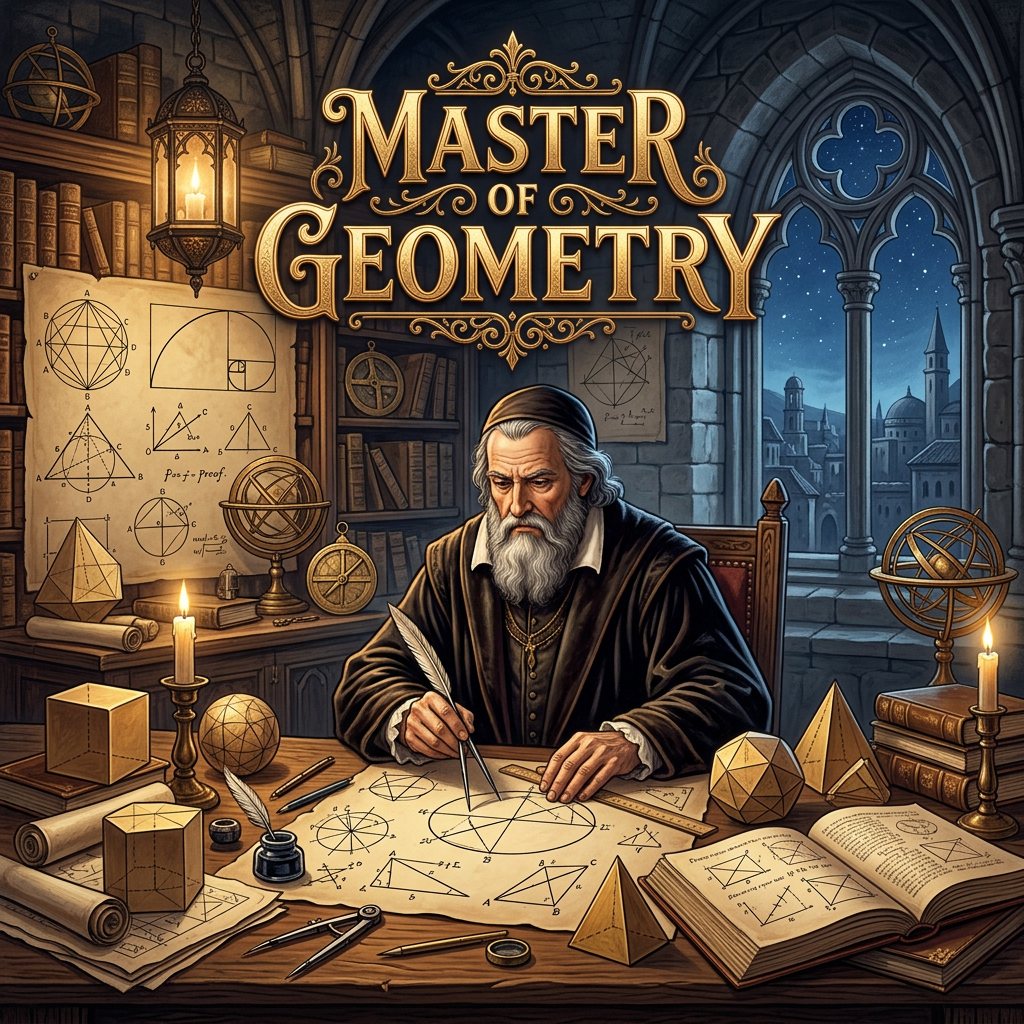
Master of Geometry
Archimedes’ most celebrated contributions lie in geometry. He possessed an extraordinary ability to calculate areas and volumes with stunning precision.
One of his greatest achievements was determining the exact relationship between the volume of a sphere and the cylinder that encloses it. He proved that the volume of a sphere is two-thirds that of a cylinder with the same height and diameter.
So proud was he of this discovery that he requested a sphere and cylinder be engraved on his tombstone.
Even more astonishing was his approximation of π (pi), the ratio of a circle’s circumference to its diameter. Using a method of inscribed and circumscribed polygons, Archimedes calculated that π lay between 3 1/7 and 3 10/71.
This method anticipated integral calculus nearly two millennia before Newton and Leibniz. Without algebraic notation or modern tools, he relied purely on geometric reasoning and logic.
His method of exhaustion, used to find areas and volumes, was especially revolutionary. By progressively refining shapes within other shapes, he was able to approach an exact value through logical limits.
In many ways, Archimedes was practicing an early form of calculus centuries before the concept existed. His work demonstrated the power of pure reasoning and showed that mathematics could unlock the secrets of nature.

The Eureka Moment
Perhaps the most famous story about Archimedes involves a bathtub and a golden crown. According to legend, King Hiero II of Syracuse suspected that a goldsmith had cheated him by mixing silver into a crown that was supposed to be pure gold.
He asked Archimedes to determine whether the crown was genuine without damaging it.
While bathing, Archimedes noticed that water overflowed from the tub when he stepped in. He realized that the volume of water displaced must equal the volume of his body.
Suddenly, he understood how to measure the volume of irregular objects like the crown. By comparing the water displaced by the crown to that displaced by an equal weight of pure gold, he could determine whether the crown had been adulterated.
Overcome with excitement, he reportedly leapt from the bath and ran through the streets shouting “Eureka!” meaning “I have found it!” Whether entirely true or somewhat embellished, the story captures the spirit of scientific discovery.
Archimedes had uncovered the principle of buoyancy: a body immersed in fluid experiences an upward force equal to the weight of the fluid it displaces.
Today, this principle governs shipbuilding, submarine design, and fluid mechanics. Every time a massive steel ship floats on the ocean, it silently confirms Archimedes’ insight.
Engineer and Inventor
Archimedes was not only a theorist; he was also a brilliant engineer. His inventions were practical, powerful, and sometimes fearsome.
Among his most famous creations is the Archimedean screw, a device used to raise water for irrigation. Consisting of a helical surface inside a cylinder, it could move water upward efficiently and remains in use today in agriculture and water systems.
During the Roman siege of Syracuse in 214–212 BCE, Archimedes turned his genius toward defense. Ancient sources describe powerful catapults, cranes capable of lifting enemy ships from the sea, and possibly even mirrors that concentrated sunlight to burn attacking vessels.
While historians debate the practicality of the “death ray” mirrors, there is little doubt that his mechanical defenses delayed Roman conquest for years.
His famous statement, “Give me a place to stand, and I will move the Earth,” refers to his work on levers. Archimedes thoroughly studied the principles of leverage and balance.
He demonstrated mathematically how small forces could move large objects if applied at the correct distance from a pivot. This foundational understanding of mechanics remains central to engineering today.

The Scholar’s Mind
What distinguished Archimedes from many inventors was his preference for pure thought. Historical accounts suggest he was often so absorbed in solving mathematical problems that he neglected practical matters—even food and hygiene. He reportedly drew geometric figures in sand and ash, contemplating their relationships for hours.
His works, including On the Sphere and Cylinder, On Floating Bodies, and The Method, reveal a disciplined and elegant mathematical style. In The Method, rediscovered in the early 20th century in a palimpsest manuscript, Archimedes explained how he used mechanical reasoning to arrive at geometric conclusions before proving them rigorously.
This glimpse into his thinking process shows a scientist far ahead of his time, blending intuition with strict proof.
Unlike many ancient scholars whose work was lost, a significant portion of Archimedes’ writings survived through copies preserved by Byzantine and Islamic scholars. His influence spread across cultures and centuries, shaping medieval mathematics and later inspiring Renaissance scientists.
A Tragic End
In 212 BCE, after a prolonged siege, Syracuse fell to the Romans. According to tradition, Archimedes was so engrossed in a mathematical problem that he failed to notice a Roman soldier approaching.
When ordered to accompany the soldier, he reportedly replied, “Do not disturb my circles.” The soldier, angered or impatient, killed him.
Though the exact details may be romanticized, the story symbolizes a life devoted entirely to intellectual pursuit.
The Romans themselves reportedly regretted his death. General Marcellus, who admired Archimedes’ genius, had given orders that he be spared.
Legacy Across the Ages
Archimedes’ legacy is immense. His mathematical techniques anticipated calculus. His principles of mechanics laid groundwork for physics.
His insights into buoyancy remain fundamental to fluid dynamics. Galileo called him his “master,” and Isaac Newton built upon foundations that Archimedes helped establish.
In modern times, his name appears in scientific laws, engineering devices, and even space missions. Yet beyond the formulas and inventions lies something even more powerful: a model of intellectual courage.
Archimedes showed that the universe could be understood through reason. He demonstrated that mathematics is not merely abstract—it is a language capable of describing reality.
His work reminds us that true discovery requires patience, creativity, and relentless curiosity. Without telescopes, computers, or advanced instruments, he uncovered truths that remain valid today. His life proves that ideas can outlast empires.

The Man Who Moved the World
Archimedes did not move the Earth with a lever, as he once suggested might be possible with the right fulcrum. Instead, he moved the world in a different way.
He shifted humanity’s understanding of mathematics and science. He showed that logical reasoning could solve practical problems. He bridged theory and application in a way that continues to define scientific progress.
More than two thousand years after his death, students still study his proofs. Engineers still apply his principles.
Scientists still admire his brilliance. His story endures because it captures the timeless power of the human mind.
Archimedes stands as one of history’s greatest thinkers—not only because of what he discovered, but because of how he discovered it. In an age without modern technology, he relied on imagination, logic, and relentless inquiry.
Through geometry and mechanics, through water and levers, through quiet contemplation and sudden insight, Archimedes truly became the mathematician who moved the world.
Fortisetliber’s View
At Fortis et Liber, we reflect on figures whose strength of mind reshaped the course of history. Archimedes stands among them—not as a conqueror of lands, but as a conqueror of ignorance. His weapons were not swords or armies, but reason, geometry, and disciplined thought.
What strikes us most about Archimedes is not merely his brilliance, but his intellectual courage. In a world governed by myth and speculation, he insisted on proof. In an age without modern tools, he trusted the power of the human mind.
He showed that reality could be measured, examined, and understood. This spirit—fortis (strong) and liber (free)—is the essence of true scholarship.
Archimedes teaches us that strength is not only physical or political; it is intellectual. It is the patience to wrestle with a problem for hours. It is the humility to test ideas rigorously. It is the freedom that comes from knowledge—the liberation that arises when truth replaces uncertainty.
In a time when distractions are constant and depth is rare, his example calls us back to seriousness of thought. To study Archimedes is to remember that civilization advances not only through power, but through clarity.
For us, he represents the enduring triumph of disciplined inquiry. His life reminds us that ideas outlive empires, and that the quiet force of reason can move the world more profoundly than any machine.
Leave a Reply