
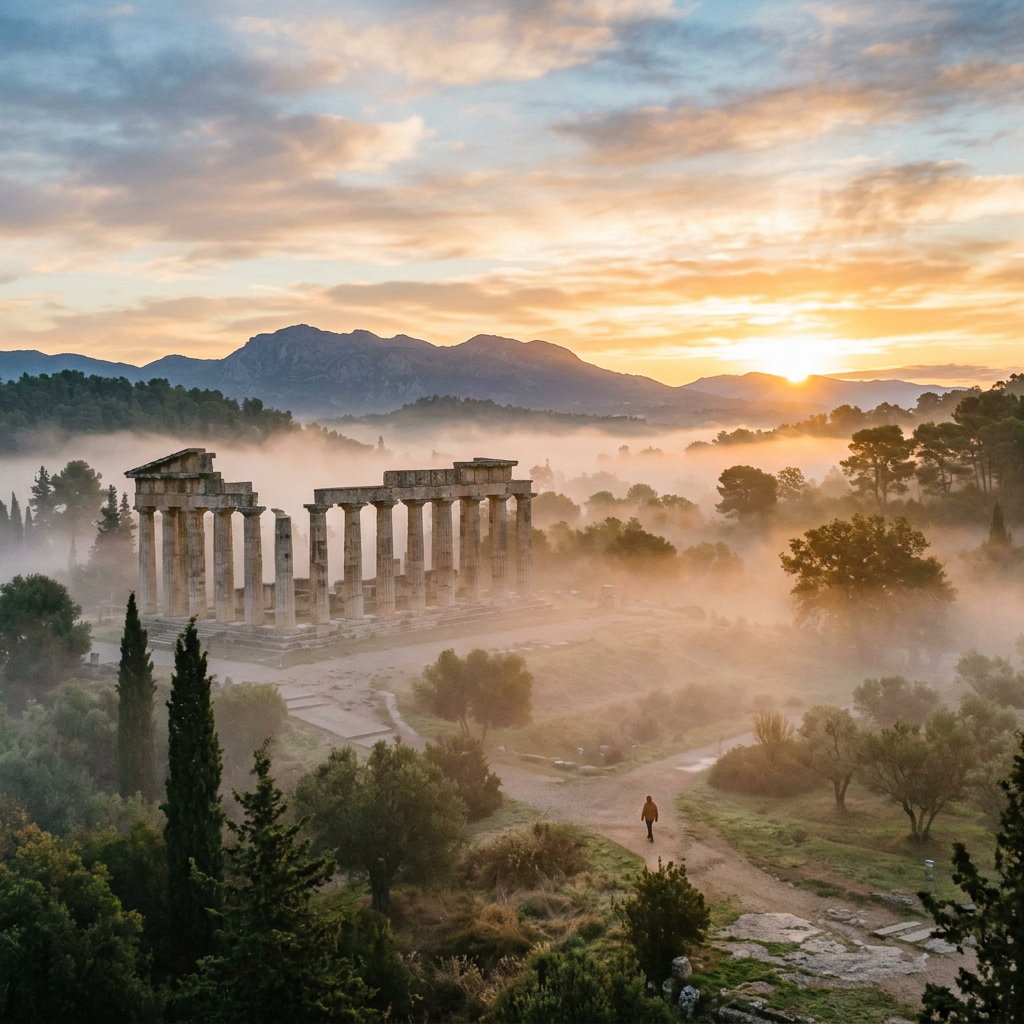
The Temple of Hera stands as one of the most significant architectural and religious monuments of ancient Greece.
Dedicated to Hera, the queen of the Olympian gods and goddess of marriage and family, these temples were centers of worship, civic pride, and artistic achievement.
Among the most famous are the Temple of Hera at Olympia and the Temple of Hera I (the “Basilica”) at Paestum in southern Italy.
The Temple of Hera at Olympia
Built around 590 BCE, the Temple of Hera at Olympia is one of the oldest monumental temples in Greece. Located within the sacred Altis sanctuary—where the Olympic Games were held—the temple played a central role in religious ceremonies associated with the games.
Originally constructed in the Doric style, the temple featured six columns at the front and sixteen along the sides.
Interestingly, many of its original wooden columns were gradually replaced with stone over time, reflecting the architectural evolution of the Archaic and Classical periods.
The temple also housed important treasures, including the famous statue of Hermes with the Infant Dionysus by Praxiteles, which was discovered in its ruins in the 19th century and remains one of the masterpieces of classical sculpture.
The Temple of Hera I at Paestum
Another remarkable example is the Temple of Hera I at Paestum, built around 550 BCE. This temple is one of the best-preserved Greek temples in the world. Its robust Doric columns, wide spacing, and heavy entablature give it a powerful and commanding presence.
Unlike later Greek temples, the Paestum temple has nine columns across the front instead of the typical six, giving it a unique and slightly unusual symmetry.
Its interior included a central row of columns that divided the space into two aisles—an early architectural experiment that demonstrates the development of Greek temple design.

Religious and Cultural Significance
Hera was worshipped as a protector of women, marriage, and childbirth.
Temples dedicated to her were not only religious centers but also social and political landmarks.
Festivals held in her honor, such as the Heraia at Olympia, included athletic competitions for women, offering rare insight into the roles women played in ancient Greek society.
These temples symbolized stability, order, and divine protection.
Their grandeur reflected the importance of religion in everyday Greek life and the desire of city-states to demonstrate their devotion and prosperity through monumental architecture.
Architectural Legacy
The Temple of Hera contributed significantly to the development of the Doric order—one of the three classical Greek architectural styles. Its heavy columns, simple capitals, and balanced proportions influenced countless temples built afterward.
Even in ruin, these temples continue to inspire scholars, architects, and travelers. They serve as enduring reminders of the spiritual devotion, artistic skill, and architectural innovation of ancient Greece.

Fortisetliber’s View
At Fortis et Liber, the Temple of Hera represents more than stone and symmetry — it embodies permanence in a world of change.
These columns, weathered yet unbroken, remind us that strength is not merely force, but endurance.
Hera, guardian of marriage and sacred bonds, stood as a symbol of order within both household and cosmos.
Her temple was not only a place of ritual, but a declaration: that civilization is built upon loyalty, discipline, and reverence for higher principles.
The Doric columns rise without ornamentation, firm and restrained — much like the virtues the ancients esteemed. There is no excess, no indulgence. Only structure. Only balance. Only purpose.
Even in ruin, the Temple of Hera teaches us something essential: greatness does not fade when its foundations are sound. Strength and freedom — fortis et liber — are sustained not by impulse, but by devotion to enduring truths.
Leave a Reply