
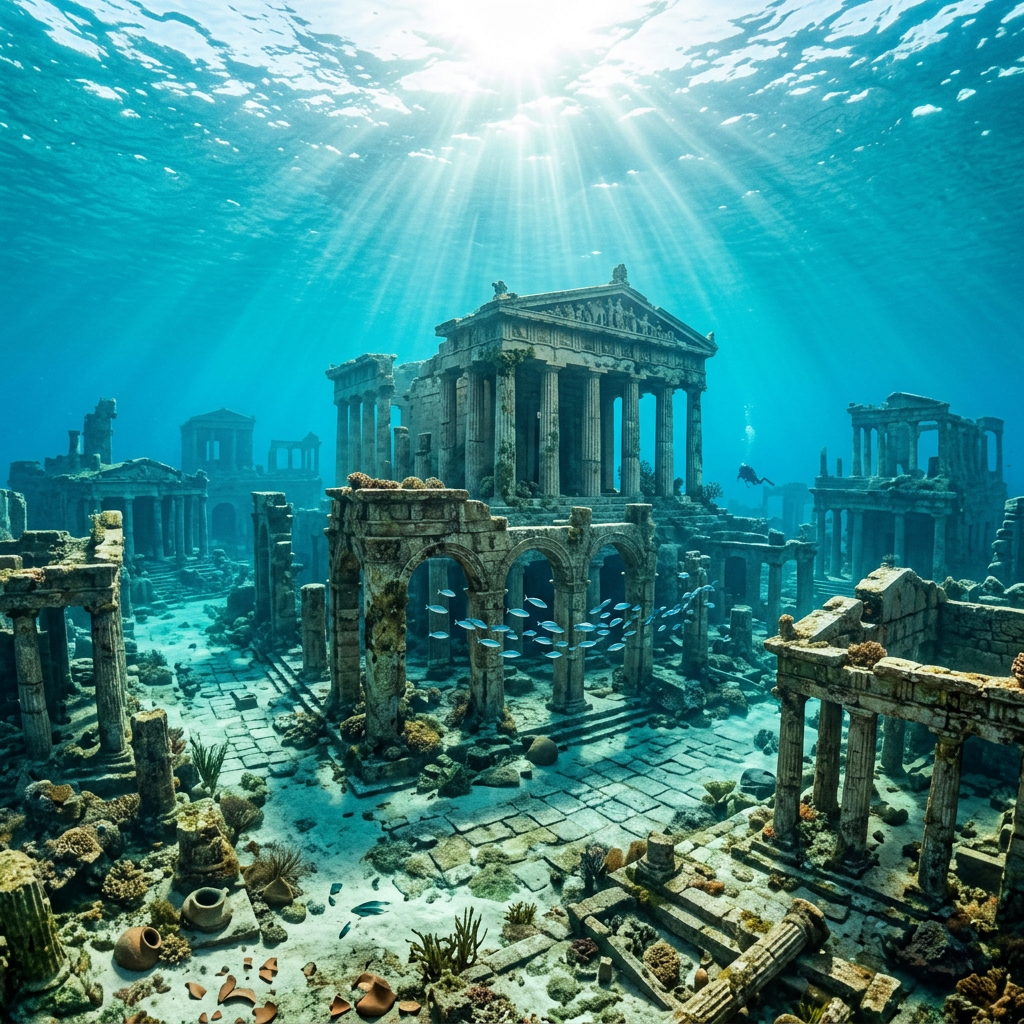
Beneath the turquoise waters off the southern coast of Laconia in Greece lies Pavlopetri, one of the most extraordinary archaeological discoveries of the modern era.
Often described as the world’s oldest known submerged city, Pavlopetri offers a rare and haunting glimpse into urban life more than 5,000 years ago.
A City Lost to the Sea
Pavlopetri dates back to at least 3000 BCE, during the Early Bronze Age, though some evidence suggests parts of the site may be even older.
Unlike many ancient settlements that were built over repeatedly across centuries, Pavlopetri was submerged and preserved beneath the sea, protecting its layout in remarkable detail.
The city was rediscovered in 1967 by British oceanographer Dr. Nicholas Flemming and later mapped in 1968 by a team from the University of Cambridge.
Modern surveys using advanced 3D sonar mapping technology have since revealed an entire urban plan beneath the waves.
An Advanced Bronze Age Settlement
What makes Pavlopetri truly exceptional is not just its age, but its sophistication. The submerged ruins include:
- Multi-roomed houses
- Courtyards
- Streets
- A complex water management system
- Rock-cut chamber tombs
The city covers approximately 9 acres (around 3.6 hectares), suggesting a thriving and organized community.
The layout indicates planned urban development, with streets arranged in a structured pattern—an impressive achievement for such an early period.
Artifacts found at the site, including pottery from Minoan Crete, show that Pavlopetri was likely engaged in maritime trade across the Mediterranean.
Its coastal position would have made it a strategic and prosperous hub.

Why Did Pavlopetri Sink?
The submergence of Pavlopetri is believed to have been caused by a combination of tectonic activity and rising sea levels.
Southern Greece lies in a seismically active region, and repeated earthquakes over centuries likely caused the gradual subsidence of the land.
Rather than being destroyed in a single catastrophic event, Pavlopetri appears to have slowly slipped beneath the sea, preserving the city’s foundations in situ.
A Window into Prehistoric Life
Pavlopetri is invaluable to archaeologists because it provides a complete snapshot of a prehistoric town. Most ancient cities were continuously rebuilt over time, but Pavlopetri remained frozen in its Bronze Age form.
This allows researchers to study domestic architecture, social organization, and trade patterns in ways rarely possible elsewhere.
Underwater archaeology at the site continues to shed light on early Aegean civilization and its connections to the wider Mediterranean world.
Preserving an Underwater Heritage
Today, Pavlopetri faces threats from pollution, boat anchors, and natural erosion. Efforts are underway to protect the site and raise awareness of its importance.
As one of the oldest known submerged cities on Earth, Pavlopetri is not just a Greek treasure—it is a global one.
Hidden beneath gentle waves, this silent city reminds us that human civilization has always lived in close relationship with the sea—sometimes prospering beside it, and sometimes disappearing beneath it.
Fortisetliber’s View
Beneath the quiet waters of southern Greece lies Pavlopetri — not a ruin shattered by conquest, but a city claimed by time itself.
Older than classical Athens, older even than Homer’s epics, Pavlopetri stands as one of humanity’s earliest known urban footprints. Streets, courtyards, tombs, and homes still rest where life once unfolded nearly five millennia ago.
Unlike cities buried by sand or rebuilt upon their own ashes, Pavlopetri was submerged.
The sea did not erase it; it preserved it. In this stillness, we glimpse the Bronze Age not as myth, but as lived reality — a society with structure, planning, and quiet sophistication.
These were not primitive people wandering at history’s dawn. They were builders, traders, and thinkers shaping an organized world.
Its sinking was gradual — the patient consequence of earthquakes and shifting earth.
There was no single apocalyptic moment, only the slow reminder that civilizations, no matter how advanced, stand upon fragile ground. Pavlopetri teaches us that endurance is not permanence.
Strength lies not in resisting change forever, but in leaving a mark so clear that even the sea cannot erase it.
At FortisLiber, we see Pavlopetri not merely as an archaeological site, but as a symbol: of resilience, of memory, and of humility before nature.
The waves above it whisper a simple truth — civilizations may fall silent, but their foundations continue to speak.
And if we listen carefully, history always answers.
Leave a Reply