
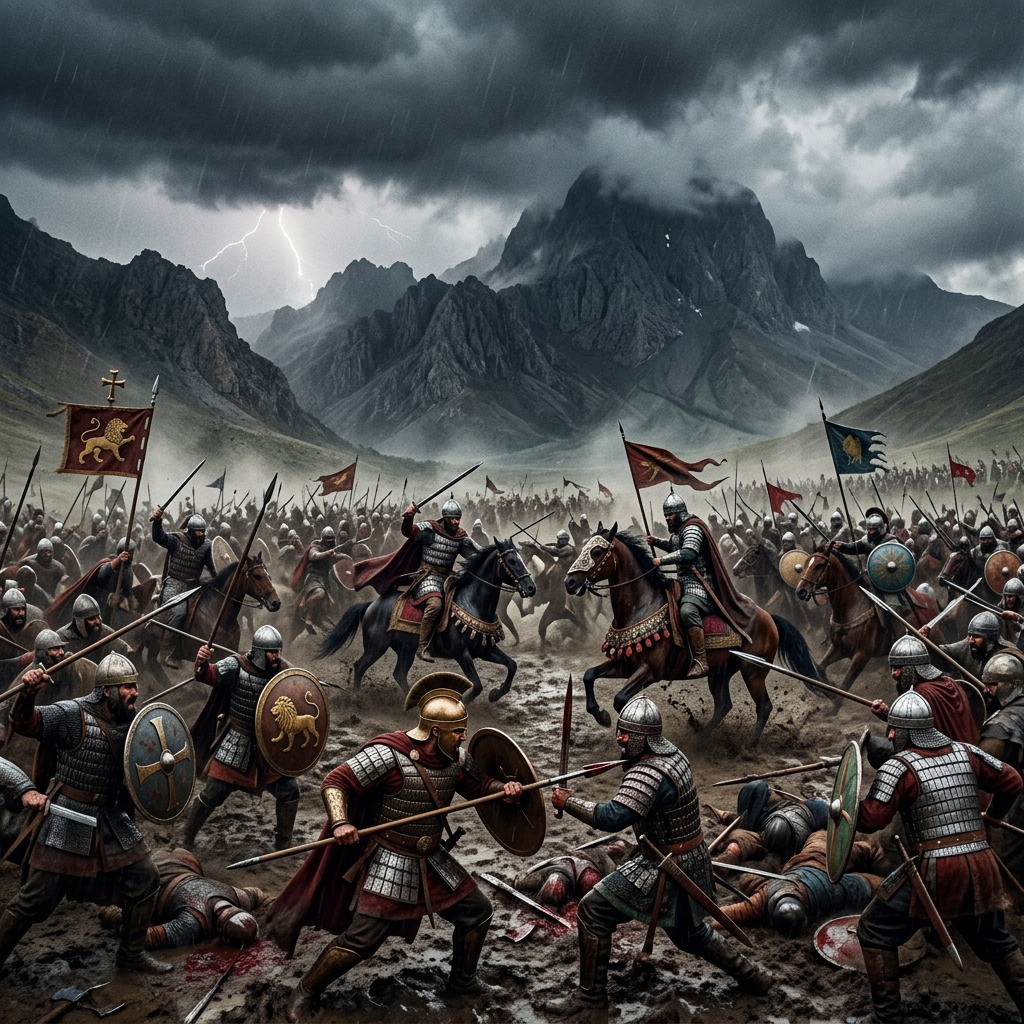
The Battle of Bagavan, fought in 371 CE, was a decisive confrontation between the forces of the Kingdom of Armenia and the Sasanian Persian Empire.
Taking place near the town of Bagavan in the region of Taron, the battle marked a turning point in Armenia’s struggle to preserve its political autonomy and Christian identity amid the rivalry of two great powers: Rome and Persia.
Historical Background
During the fourth century, Armenia occupied a precarious position between the Roman (Byzantine) Empire to the west and the Sasanian Empire to the east. Both sought influence over the strategically vital Armenian Highlands.
The Arsacid (Arshakuni) dynasty ruled Armenia, but internal instability and foreign pressure often weakened the kingdom.
In 368 CE, the Armenian king Arshak II was captured by the Persian shah Shapur II under the pretense of negotiation. Armenia was subsequently invaded, and Persian authorities attempted to impose direct control.
Shapur II also aimed to suppress Christianity in Armenia, which had been adopted as the state religion in 301 CE—the first kingdom in history to do so.
Armenian resistance soon coalesced around loyal nobles (nakharars) and military leaders, notably Mushegh Mamikonian, a prominent sparapet (commander-in-chief) from the powerful Mamikonian family.
With Roman support, Armenian forces rallied to expel Persian influence.
The Battle
The confrontation at Bagavan in 371 CE brought together Armenian forces, reinforced by Roman troops, against the Sasanian army.
While precise troop numbers are unknown, contemporary and later Armenian historians describe the battle as fierce and decisive.
Mushegh Mamikonian played a central role in organizing and leading the Armenian resistance. The Armenian-Roman alliance capitalized on Persia’s extended campaigns elsewhere and launched a coordinated effort to reclaim Armenian territory.
The result was a significant victory for the Armenians and their Roman allies.
Persian forces were driven back, and Sasanian attempts to directly annex Armenia were thwarted—at least temporarily.

Consequences and Significance
The victory at Bagavan restored Armenian sovereignty under King Pap (Papas), the son of Arshak II, who returned to the throne with Roman backing.
Although Armenia remained caught between imperial rivals, the battle reinforced its political independence and affirmed its Christian identity against Persian Zoroastrian influence.
However, the triumph did not bring lasting peace. Armenia continued to face external pressures and internal divisions.
In 387 CE, only sixteen years after Bagavan, the kingdom was formally partitioned between Rome and Persia, ending unified Armenian independence for centuries.
Despite this, the Battle of Bagavan holds enduring importance in Armenian history.
It symbolizes resistance against foreign domination and the defense of national and religious identity.
The leadership of the Mamikonian family, especially Mushegh, became emblematic of patriotic struggle and martial valor.
Legacy
In Armenian historical tradition, Bagavan is remembered not merely as a military victory but as a moment of national resilience.
It demonstrated that, even amid the ambitions of empires, Armenia could assert its agency and shape its destiny—if only for a time.
The battle remains a key episode in understanding late antique geopolitics in the Near East and the enduring Armenian struggle to survive between competing imperial powers.

Fortisetliber’s View
At FortisLiber, we see the Battle of Bagavan not merely as a clash of armies, but as a defining assertion of civilizational will. In 371 CE, Armenia stood at the crossroads of empires—pressed by Persian ambition and entangled in Roman strategy—yet it chose resistance over submission.
That choice is the heart of Bagavan.
What makes this battle enduring is not only its military outcome, but its moral posture. Armenia had already embraced Christianity as a state faith, anchoring its identity in something higher than political convenience.
When Shapur II sought domination and religious suppression, the response was not passive endurance but organized defiance under leaders such as Mushegh Mamikonian.
Bagavan reminds us that small nations are not merely pawns in imperial games. They possess memory, conviction, and agency.
Even when history later bends under the weight of partition and compromise, moments like Bagavan stand as proof that sovereignty is first defended in spirit before it is secured in territory.
From a FortisLiber perspective, Bagavan is a testament to disciplined strength—fortitude guided by belief.
It shows that resilience, even if temporary in political terms, leaves a permanent mark on national consciousness.
Leave a Reply