
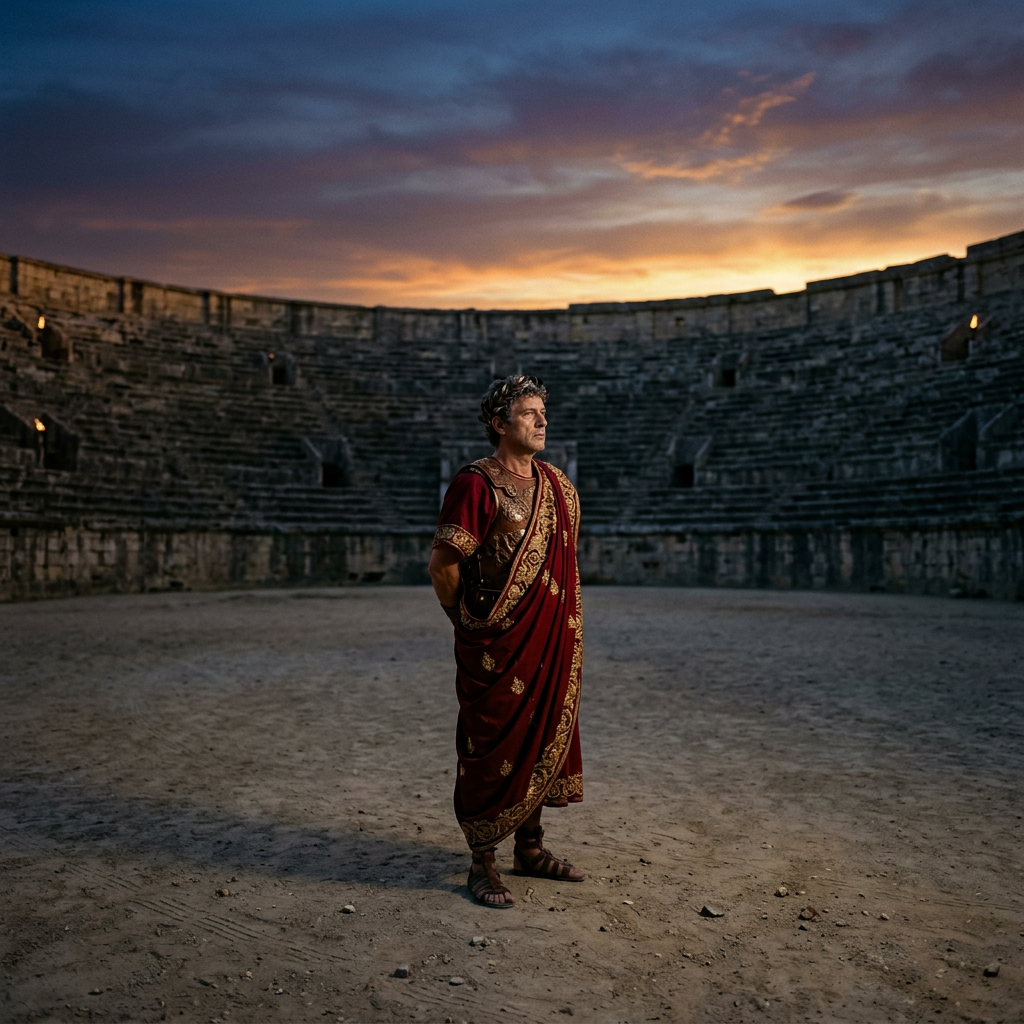
Few Roman emperors are remembered as controversially as Commodus. Ruling from 180 to 192 CE, he is often portrayed by ancient historians as a ruler who abandoned imperial duty in favor of personal spectacle, especially his fascination with gladiatorial combat.
His life marks a dramatic turning point in the history of the Roman Empire, where political authority, public image, and personal obsession collided in unprecedented ways.
Commodus is frequently contrasted with his father, Marcus Aurelius, the Stoic philosopher-emperor. Where Marcus Aurelius represented discipline and duty, Commodus is often depicted as indulgence and self-glorification.
Early Life and Rise to Power
Born in 161 CE, Commodus was the son of Marcus Aurelius and Faustina the Younger. Unlike many emperors who rose through political or military struggle, Commodus was named co-emperor at a young age and later became sole ruler after his father’s death.
This inheritance made him one of the youngest emperors to rule Rome without having to earn power through traditional means. While this secured stability in succession, it also meant Commodus lacked the military and political experience that had defined many of his predecessors.
The Emperor and the Arena
What made Commodus infamous was not just his rule, but his obsession with the arena. Unlike traditional Roman elites, who viewed gladiatorial combat as entertainment for the masses, Commodus actively participated in it.
He fought as a gladiator in the Colosseum, reportedly taking part in staged matches where victory was carefully controlled. He also portrayed himself as a hero in mythological reenactments, famously claiming the identity of Hercules in public displays.
To many Roman senators and historians, this behavior was scandalous. The emperor, who was supposed to embody dignity and authority, was instead performing for applause in the same arenas where enslaved fighters risked their lives.

Power, Performance, and Control
Commodus understood something important about Roman society: power was not only political, but also performative. By entering the arena, he placed himself at the center of public spectacle, bypassing traditional institutions and appealing directly to the crowd.
He renamed the months of the year after himself, renamed Rome “Colonia Commodiana,” and presented himself as a divine figure. These actions were not merely eccentric—they were attempts to reshape Roman identity around his personal image.
However, this concentration of power and ego created deep tension between Commodus and the Roman elite.
Opposition and Decline
As Commodus grew more autocratic, political instability increased. Ancient sources describe growing fear among senators, officials, and members of the imperial court. Assassination attempts and conspiracies became more frequent.
Eventually, Commodus was assassinated in 192 CE, reportedly after a conspiracy involving members of his inner circle, including his wrestling partner Narcissus.
His death marked the end of the Antonine dynasty and led to a period of civil conflict known as the Year of the Five Emperors.
Historical Debate
Modern historians debate how accurate the ancient accounts of Commodus truly are. Much of what is known comes from sources that were hostile to him, such as the Roman historian Cassius Dio.
Some scholars argue that Commodus was exaggerated into a “mad emperor” figure by political enemies who benefited from discrediting his rule. Others believe that while his behavior was indeed unusual, it must be understood within the broader context of imperial politics and Roman spectacle culture.
Symbolism of Commodus
Commodus has become a symbol of several enduring ideas.
The Corruption of Power
His reign is often used as an example of how absolute power can distort judgment and identity.
The Politics of Spectacle
Commodus blurred the line between ruler and performer. His rule highlights how public image can become as important as governance itself.
The Isolation of Authority
Despite his visibility in the arena, Commodus was politically isolated. His reliance on spectacle may reflect a deeper disconnection from traditional institutions of governance.

Legacy
Commodus remains one of the most controversial figures in Roman history. His life inspired numerous portrayals in literature and film, often emphasizing the tension between tyranny and performance.
Whether viewed as a mad emperor or a misunderstood ruler, Commodus represents a turning point in Roman imperial culture—where the emperor was no longer only a political figure, but also an entertainer on the public stage.
Conclusion
Commodus stands as a reminder of the complex relationship between power, identity, and spectacle. His decision to step into the arena symbolized both confidence and contradiction: an emperor seeking legitimacy not through governance, but through performance.
In the end, his legacy is defined not only by how he ruled, but by how he chose to be seen.
Fortisetliber’s View
Commodus represents the moment where power loses balance with purpose.
From a Fortis Liber perspective, his story is not only about excess, but about the confusion between authority and identity.
He sought meaning in spectacle, turning governance into performance and leadership into display. Yet true strength is not found in being seen, but in being responsible.
The arena gave Commodus attention, but not stability. It amplified his presence while weakening the foundations of trust and order around him.
His reign illustrates a key Fortis Liber principle: when power becomes self-referential—when it exists primarily to affirm itself—it loses connection to its higher purpose.
Commodus reminds us that freedom without discipline becomes instability, and strength without responsibility becomes illusion.
Leave a Reply