
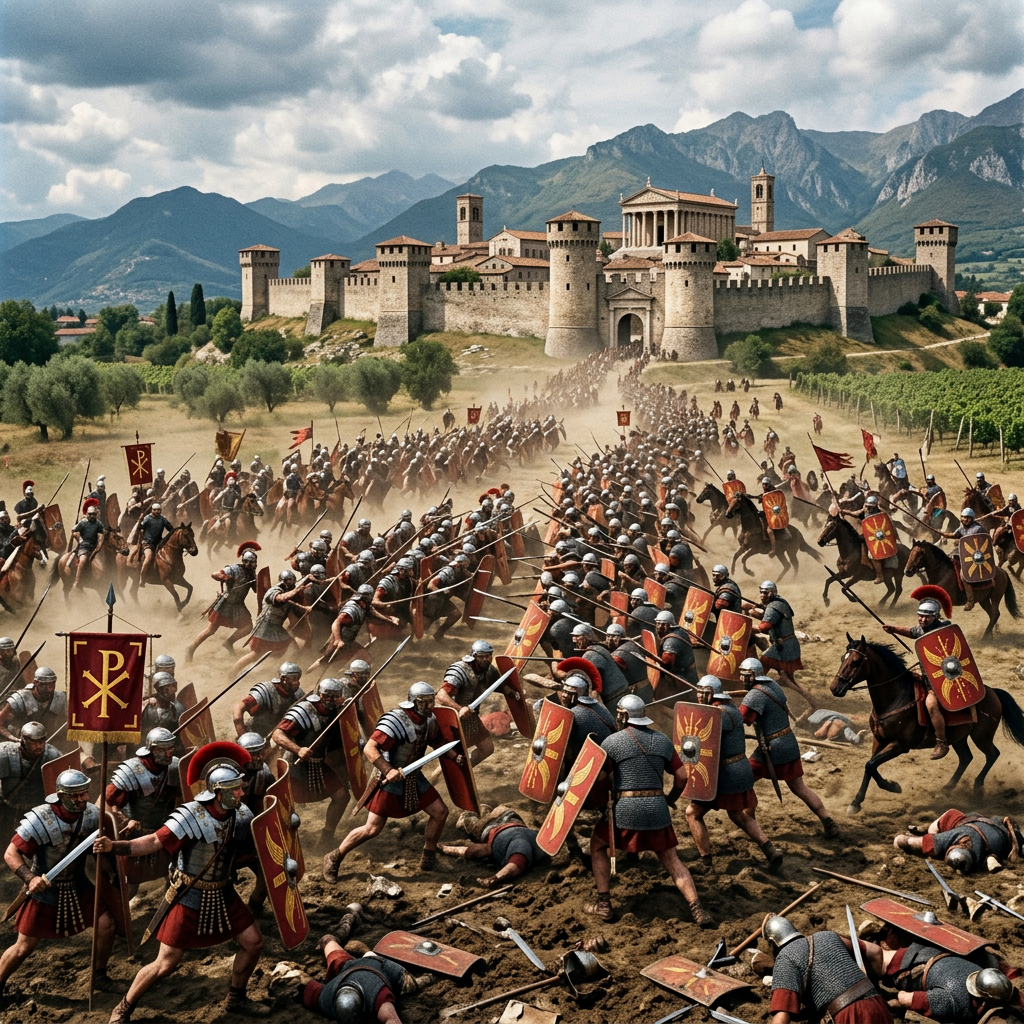
The Battle of Brescia, fought in 312 CE, was a pivotal engagement in the civil war between Constantine I and Maxentius.
Though often overshadowed by the more famous Battle of the Milvian Bridge later that same year, Brescia played a crucial role in Constantine’s successful campaign to seize control of the Western Roman Empire.
Background: The Collapse of the Tetrarchy
By the early 4th century, the Roman Empire was ruled under the system of the Tetrarchy, established by Emperor Diocletian.
Power was divided among multiple emperors to maintain stability across the vast empire.
However, after Diocletian’s abdication in 305, rivalries and competing claims to authority quickly destabilized the system.
Maxentius, the son of former Emperor Maximian, had seized control of Rome in 306.
Constantine, proclaimed emperor by his troops in Britain after the death of his father Constantius Chlorus, also claimed imperial authority. By 312, tensions between Constantine and Maxentius escalated into open warfare.
Constantine’s Italian Campaign
In the spring of 312, Constantine launched a bold and rapid campaign into northern Italy. Crossing the Alps with a relatively small but highly disciplined army, he achieved early victories at Segusio (modern Susa) and Augusta Taurinorum (Turin).
These successes weakened Maxentius’ northern defenses and encouraged several cities to surrender to Constantine without resistance.
The next significant obstacle was the city of Brescia (ancient Brixia), strategically positioned in northern Italy. Control of Brescia was vital for securing supply lines and maintaining momentum toward Rome.
The Battle
The exact details of the Battle of Brescia are not extensively documented in surviving sources, but it is clear that Constantine faced forces loyal to Maxentius, likely commanded by one of his senior generals.
Following his victory at Verona—where Constantine defeated the capable general Ruricius Pompeianus—Constantine moved swiftly against remaining opposition in the region. At Brescia, he encountered resistance but overcame it decisively.
The engagement appears to have been relatively brief compared to the siege of Verona, suggesting that Constantine’s forces maintained superior discipline, morale, and tactical coordination.
Constantine’s strategy emphasized speed, surprise, and concentrated force. Rather than becoming bogged down in prolonged sieges, he sought rapid victories to prevent Maxentius from consolidating his forces further south.

Strategic Importance
Although Brescia was not the largest or most decisive battle of the campaign, it was strategically significant for several reasons:
- Secured Northern Italy: With Brescia subdued, Constantine effectively neutralized Maxentius’ remaining northern strongholds.
- Maintained Momentum: The victory ensured Constantine’s continued advance toward Rome without disruption.
- Psychological Impact: Success bred further defections from Maxentius’ side, weakening his political and military position.
Each victory reinforced Constantine’s reputation as a capable and divinely favored commander—a perception that would become central to later imperial propaganda.
Toward the Milvian Bridge
Following his successes in northern Italy, Constantine marched south toward Rome. Maxentius, who had largely remained within the capital relying on defensive preparations and prophetic assurances, finally confronted Constantine outside the city at the Battle of the Milvian Bridge in October 312.
Constantine’s victory there resulted in the death of Maxentius and secured Constantine’s control over the Western Roman Empire.
The triumph also marked a turning point in Roman religious history, as Constantine later attributed his success to divine favor associated with the Christian God.
Conclusion
The Battle of Brescia was a crucial step in Constantine’s 312 campaign. Though less famous than the Milvian Bridge, it demonstrated Constantine’s operational skill and strategic vision.
By systematically dismantling Maxentius’ defenses in northern Italy, Constantine ensured that his final confrontation near Rome would occur on his terms.

Fortisetliber’s View
The Battle of Brescia reminds us that history is often shaped not only by grand, decisive clashes, but by the steady accumulation of smaller victories.
Brescia was not the most famous engagement of Constantine’s campaign, yet it demonstrated the discipline, momentum, and clarity of purpose that defined his march through northern Italy.
Success there reinforced confidence—both within his ranks and among the populations watching events unfold.
At Fortisetliber, we see Brescia as a lesson in strategic persistence.
Strength is rarely expressed in a single dramatic moment; it is built through preparation, resolve, and the courage to act decisively when opportunity appears.
Constantine’s advance toward the Milvian Bridge was not accidental—it was constructed step by step.
Brescia stands as one of those steps: quiet in scale, but powerful in consequence.
Leave a Reply