
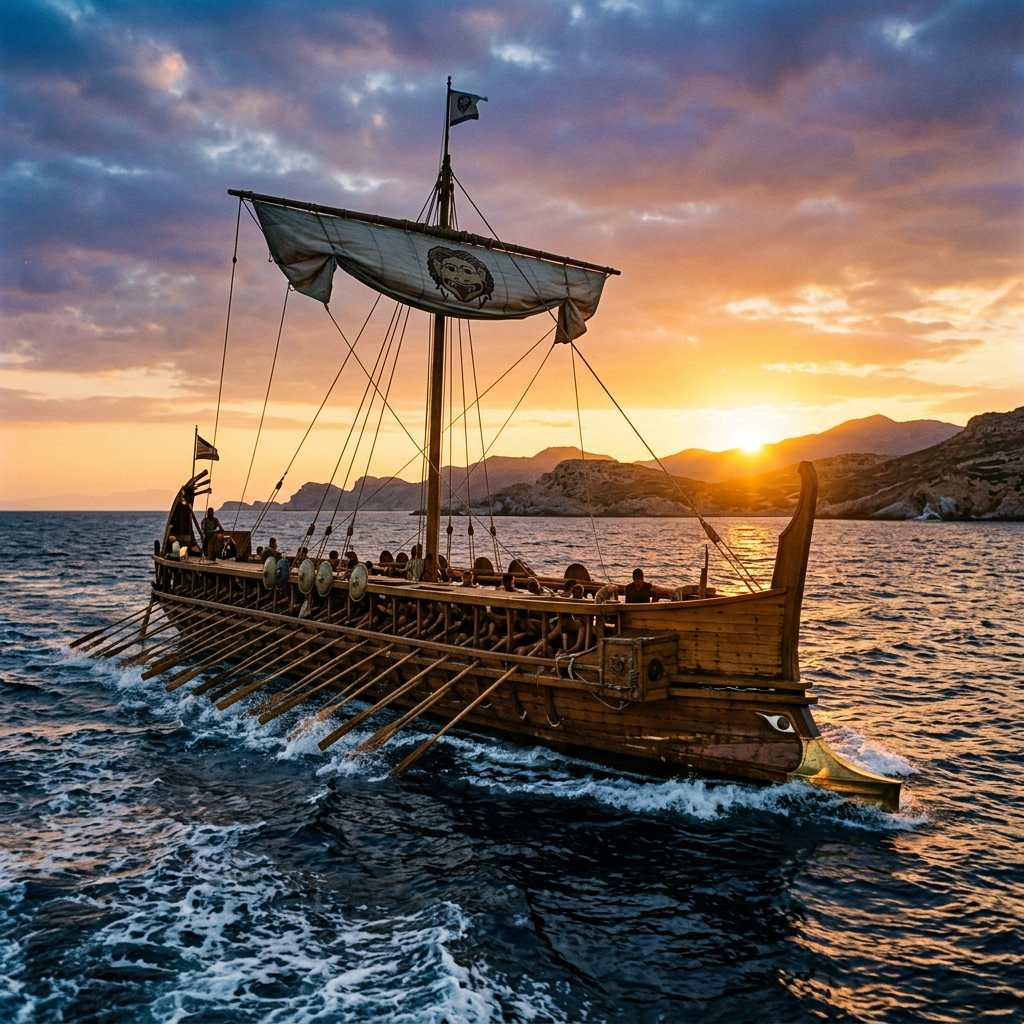
Among the many technological achievements of the ancient world, few had a greater impact on warfare, politics, and the rise of empires than the trireme.
For nearly three centuries, this sleek and powerful warship dominated the waters of the Mediterranean, allowing naval powers such as Athens, Phoenicia, and later Rome to project military strength far beyond their coastlines.
Combining innovative engineering, disciplined manpower, and sophisticated tactics, the trireme became one of history’s most influential fighting vessels.
Origins of the Trireme
The exact origins of the trireme remain a subject of scholarly debate. Most historians believe that the design evolved from earlier types of galleys used by the Phoenicians and Greeks during the early first millennium BCE.
Before the trireme, naval powers relied primarily on biremes, which featured two levels of rowers.
As maritime warfare became more competitive, shipbuilders sought ways to increase speed and power without making vessels excessively long. The solution was the development of a ship with three vertically arranged banks of oarsmen.
This innovation produced the trireme, a vessel that could carry a large number of rowers while maintaining a relatively compact and agile hull.
By the sixth century BCE, triremes had become the principal warships of many Mediterranean states. The Greeks refined the design and used it extensively during conflicts among city-states and against foreign powers such as the Persian Empire.
Design and Construction
The trireme was a masterpiece of ancient naval engineering. Most vessels measured between 35 and 40 meters (115–130 feet) in length and approximately 5 meters (16 feet) in width. Their long, narrow shape reduced water resistance and maximized speed.
Unlike later sailing ships, triremes were designed primarily for combat rather than cargo transport. Every aspect of their construction reflected this purpose.
Hull Construction
Ancient shipbuilders used lightweight woods such as pine, fir, and cypress. The hull had to be strong enough to withstand combat while remaining light enough for high-speed maneuvers.
The ship’s structure consisted of:
- A central keel running the length of the vessel.
- Wooden ribs supporting the hull.
- Planking fastened together with mortise-and-tenon joints.
- Reinforcing cables, known as hypozomata, that helped maintain structural integrity.
Because triremes were relatively light, crews often pulled them ashore at night rather than leaving them anchored for extended periods.
The Three Banks of Oars
The feature that gave the trireme its name was its arrangement of three rows of oarsmen on each side.
The rowers were divided into three groups:
- Thranites – top-level rowers.
- Zygites – middle-level rowers.
- Thalamites – lower-level rowers.
Each rower operated a single oar. This arrangement allowed approximately 170 men to propel the vessel.
The exact seating arrangement was carefully designed to ensure that oars did not interfere with one another. Despite the crowded conditions, experienced crews could achieve remarkable coordination.
Sail Rigging
Although triremes relied on oars during battle, they also carried sails for longer journeys. Typically, a large square sail provided propulsion when speed and maneuverability were less important.
Before combat, sailors lowered and stored the mast and sails to prevent damage and reduce weight.

The Crew
A trireme required a surprisingly large crew. A typical complement consisted of approximately 200 men, including:
- 170 rowers
- 10–20 sailors
- Officers and navigators
- Marines and archers
The Rowers
Contrary to a common misconception, Greek triremes were generally not powered by slaves. Most rowers were free citizens, hired professionals, or resident foreigners.
Rowing a trireme demanded significant physical conditioning and training. Success in battle depended on every rower moving in perfect synchronization. Even a slight disruption in rhythm could reduce speed and maneuverability.
The rowers sat in cramped conditions for hours at a time. During battle, they worked under intense pressure, responding instantly to commands from officers.
Officers and Specialists
The ship’s commander was known as the trierarch. In Athens, wealthy citizens were often required to finance and command a trireme as a form of public service.
Other specialists included:
- Helmsmen
- Navigators
- Boatswains
- Signal officers
Together they coordinated the ship’s movement and combat operations.
Speed and Performance
The trireme’s greatest advantage was speed.
Modern experiments conducted with the reconstructed trireme Olympias have shown that a well-trained crew could sustain speeds of around 7 knots and achieve bursts approaching 9 knots under favorable conditions.
This performance was extraordinary for an ancient vessel.
The ship could:
- Accelerate rapidly.
- Turn sharply.
- Reverse direction quickly.
- Execute complex tactical maneuvers.
These characteristics made it ideal for naval warfare in the confined waters of the Mediterranean.
The Bronze Ram
The primary weapon of the trireme was its ram.
Mounted at the bow, this bronze-covered structure weighed several hundred kilograms. Rather than carrying heavy artillery, triremes sought to disable enemy vessels through collision.
A successful ramming attack could:
- Tear open an enemy hull.
- Break oars.
- Cause flooding.
- Render a ship immobile.
The effectiveness of the ram depended on speed, timing, and precision. Captains trained extensively to strike vulnerable areas of opposing vessels while avoiding damage to their own ships.

Naval Tactics
Ancient naval warfare was highly sophisticated.
Success depended not only on individual ships but also on coordinated fleet maneuvers.
Diekplous
One of the most famous Greek tactics was the diekplous.
In this maneuver, triremes sailed through gaps in the enemy line. Once through, they turned sharply and attacked enemy vessels from the side or rear, where they were most vulnerable.
Periplous
Another tactic was the periplous.
This involved sailing around the enemy formation to attack its flanks. Fast and agile triremes excelled at this strategy.
Boarding Actions
Although ramming was preferred, crews sometimes engaged in boarding combat.
Marines armed with spears and shields crossed onto enemy ships and fought hand-to-hand battles. Archers provided supporting fire from a distance.
The Persian Wars
The trireme reached the height of its fame during the Greco-Persian Wars.
The Persian Empire assembled one of the largest naval forces of the ancient world, drawing ships from across its territories. To resist this threat, the Greek city-states invested heavily in trireme construction.
The Battle of Salamis
The most famous trireme battle occurred during the Battle of Salamis.
After the Persian king Xerxes I invaded Greece, the Greek fleet lured the larger Persian navy into the narrow waters near the island of Salamis.
The confined space prevented the Persians from fully utilizing their numerical advantage.
Greek triremes exploited their superior maneuverability and knowledge of local waters. The result was a decisive Greek victory that helped preserve the independence of the Greek city-states.
Many historians regard Salamis as one of the most consequential naval battles in human history.
Athens and Maritime Power
No city was more closely associated with the trireme than Athens.
Under the leadership of Themistocles, Athens invested heavily in naval expansion during the early fifth century BCE.
Silver discovered in the mines of Laurium financed the construction of hundreds of triremes. This fleet transformed Athens into the dominant naval power of the eastern Mediterranean.
The Athenian navy:
- Protected trade routes.
- Defended allies.
- Collected tribute.
- Projected military power across the Aegean Sea.
The wealth generated by maritime dominance helped fund many of Athens’ greatest cultural achievements, including its architecture, drama, philosophy, and democratic institutions.
Triremes During the Peloponnesian War
During the Peloponnesian War, triremes played a central role in the struggle between Athens and Sparta.
Naval engagements occurred throughout the Aegean and eastern Mediterranean. Control of the sea often determined the success of military campaigns on land.
Athens initially benefited from its powerful fleet, but years of warfare depleted resources and manpower. Eventually, Sparta developed its own navy with Persian financial assistance.
The conflict demonstrated both the strengths and vulnerabilities of a maritime empire dependent upon triremes.

Life Aboard a Trireme
Service aboard a trireme was physically demanding.
Space was extremely limited. Rowers sat shoulder-to-shoulder in narrow compartments. There were no comfortable sleeping quarters, and provisions had to be carefully rationed.
Daily life involved:
- Training exercises.
- Equipment maintenance.
- Navigation duties.
- Physical labor.
During combat, rowers endured intense heat, noise, and exhaustion while maintaining precise coordination.
Despite these hardships, experienced crews developed strong bonds and a sense of collective identity.
Decline of the Trireme
By the fourth century BCE, naval warfare began to change.
Rulers sought larger vessels capable of carrying more soldiers and heavier weapons. New ship types such as quadriremes and quinqueremes gradually replaced the trireme.
These larger ships sacrificed some speed and agility in exchange for increased combat power.
The successors of Alexander the Great and later the Roman Republic favored these heavier warships for major fleet engagements.
Although triremes remained in use for some time, they no longer dominated Mediterranean warfare.
Modern Reconstruction and Research
Interest in triremes has remained strong among historians and archaeologists.
One of the most important projects was the construction of the reconstructed vessel Olympias in the 1980s.
Built using historical evidence and ancient shipbuilding techniques, Olympias provided valuable insights into:
- Rowing arrangements.
- Speed capabilities.
- Structural design.
- Crew coordination.
Sea trials demonstrated that ancient accounts of trireme performance were remarkably accurate.
Legacy
The trireme represents far more than an ancient warship. It was a technological innovation that reshaped politics, warfare, and commerce throughout the Mediterranean.
Through its speed and effectiveness, the trireme enabled the rise of naval empires, influenced the outcome of historic conflicts, and contributed to the development of some of the most important civilizations in Western history.
Its success depended not on overwhelming firepower but on engineering, discipline, teamwork, and tactical intelligence. More than two thousand years after the last triremes disappeared from the seas, they remain enduring symbols of human ingenuity and the maritime achievements of the ancient world.

Fortisetliber’s View
From the perspective of Fortis Liber, few vessels in history better symbolize the relationship between strength, discipline, and freedom than the ancient trireme.
At first glance, the trireme was merely a warship of the ancient Mediterranean.
Long, narrow, and powered by hundreds of oars, it carried the naval ambitions of Greek city-states across the seas. Yet its true significance extends far beyond its military purpose.
A trireme could not function through individual effort alone. Its speed and effectiveness depended upon the coordinated actions of approximately 170 rowers working in perfect harmony. Every man had a role, and every stroke mattered.
The success of the vessel was determined not by the strength of a single individual but by the discipline and cooperation of the entire crew.
This principle was particularly evident in ancient Athens, where the trireme became an instrument of both defense and civic participation. The citizens who rowed these ships were not merely sailors; they were stakeholders in the future of their city.
Their collective effort helped secure victories such as the Battle of Salamis and contributed to the preservation of Greek independence during one of history’s defining conflicts.
The trireme also reminds us that technological innovation often shapes the course of civilization. Through superior design and strategic thinking, smaller Greek fleets were frequently able to overcome larger opponents.
The ship demonstrated that intelligence, preparation, and organization can be as decisive as numbers and raw power.
Today, the trireme stands as a symbol of resilience, teamwork, and determination.
Its legacy endures not because of the battles it fought, but because it illustrates a timeless truth: great achievements are possible when individuals unite behind a common purpose.
In an age that often celebrates individual accomplishment, the trireme serves as a powerful reminder that lasting success is built upon cooperation, shared responsibility, and collective strength.
Leave a Reply