
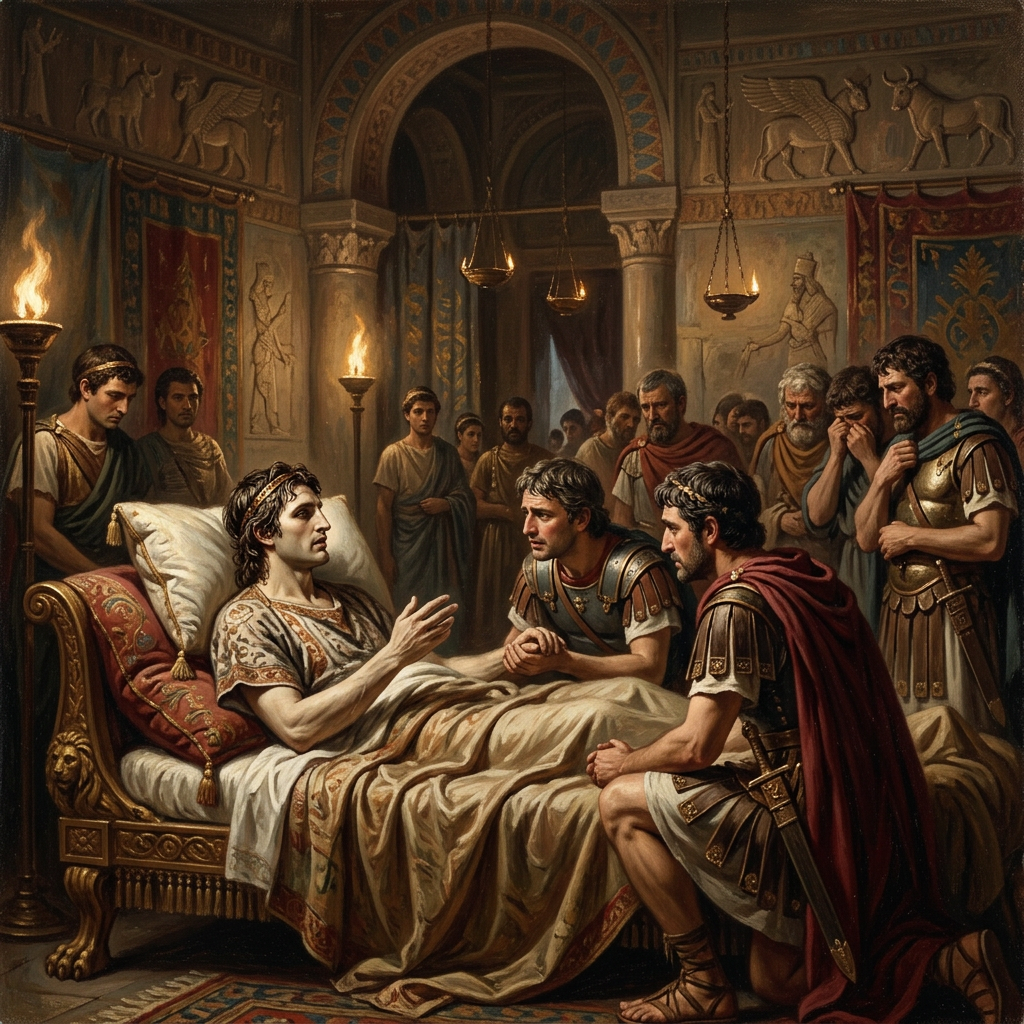
Alexander the Great, one of history’s most renowned conquerors, died in 323 BCE at the age of 32. His sudden death shocked the ancient world and has fueled debate for centuries.
Despite his legendary achievements—creating one of the largest empires in history stretching from Greece to India—the exact cause of his death remains uncertain, with historians proposing several possibilities.
Background
By 323 BCE, Alexander had spent over a decade leading relentless military campaigns. He had conquered the Persian Empire, founded multiple cities (including Alexandria in Egypt), and spread Greek culture across a vast territory.
However, his health had been strained by years of continuous warfare, injuries sustained in battles, and possibly heavy drinking.
The Illness
Historical accounts, primarily from ancient writers like Arrian, Plutarch, and Diodorus, describe Alexander falling ill in Babylon.
Reports indicate that he developed a high fever, severe abdominal pain, and weakness. Over the course of 10 to 12 days, his condition worsened, eventually leading to his death.
Some key points noted by ancient historians include:
- Alexander was unable to speak during the last days of his life.
- He reportedly retained full mental awareness until near the end.
- No wounds or battle injuries were considered the immediate cause of death.
Theories on His Death
Because the exact cause of Alexander’s death was not recorded with modern medical knowledge, historians and scientists have suggested several possibilities:
1. Natural Causes
- Malaria or Typhoid Fever: Some scholars argue that Alexander may have died from an infectious disease common in Mesopotamia at the time. Symptoms of fever and weakness fit descriptions of malaria or typhoid.
- Pancreatitis or Liver Disease: Chronic alcohol consumption, combined with battle injuries, could have led to liver failure or pancreatitis.
2. Poisoning
- Ancient rumors suggested that Alexander might have been poisoned by political rivals seeking to take control of his empire.
- Modern historians are skeptical, noting that the prolonged duration of his illness (10–12 days) does not fit the rapid-acting poisons known in antiquity.
3. Autoimmune or Genetic Conditions
- Some modern researchers have suggested rare conditions like Guillain–Barré syndrome or other neurological disorders that could explain his gradual paralysis and death.

Legacy After Death
Alexander’s death left a power vacuum that led to the fragmentation of his empire. His generals, known as the Diadochi, fought over control, eventually dividing the territories into separate Hellenistic kingdoms.
Alexander’s body was embalmed and placed in a golden sarcophagus in Alexandria, Egypt, though its exact location remains unknown today.
Despite the uncertainty surrounding his death, Alexander’s legacy as a military genius and cultural influencer remains undeniable. His campaigns spread Greek culture, language, and ideas across three continents, laying the foundation for the Hellenistic world.
Conclusion
The death of Alexander the Great remains one of history’s great mysteries. Whether due to illness, poisoning, or a combination of factors, his sudden end at 32 marked the close of one of the most extraordinary lives in human history.
The debate over his death continues to captivate historians, scientists, and enthusiasts alike, reflecting the enduring fascination with a man who seemed almost larger than life.
Fortisetliber’s View
Alexander conquered an empire stretching from Greece to India before reaching the age of thirty-three. He defeated kings, crossed deserts, and built a legacy that would outlive centuries.
Yet despite all his victories, he could not conquer the one enemy that comes for every man: death.
In Babylon, at the height of his power, Alexander fell ill and died at just thirty-two years old. Historians still debate the cause—disease, fever, poisoning, or exhaustion—but the lesson remains unchanged.
The greatest conqueror of the ancient world was ultimately subject to the same fate as the humblest citizen.
For FortisLiber, Alexander’s death is not a story of tragedy but of perspective. Life is finite. Power, wealth, and glory are temporary.
What endures is the impact of our actions, the courage of our choices, and the legacy we leave behind.
Alexander reminds us that we do not control how long we live, but we do control how we use the time we are given. The question is not whether we will die, but whether we will live boldly before that day comes.
“The fate of every man is death; the measure of a man is what he does before it arrives.”
Leave a Reply