
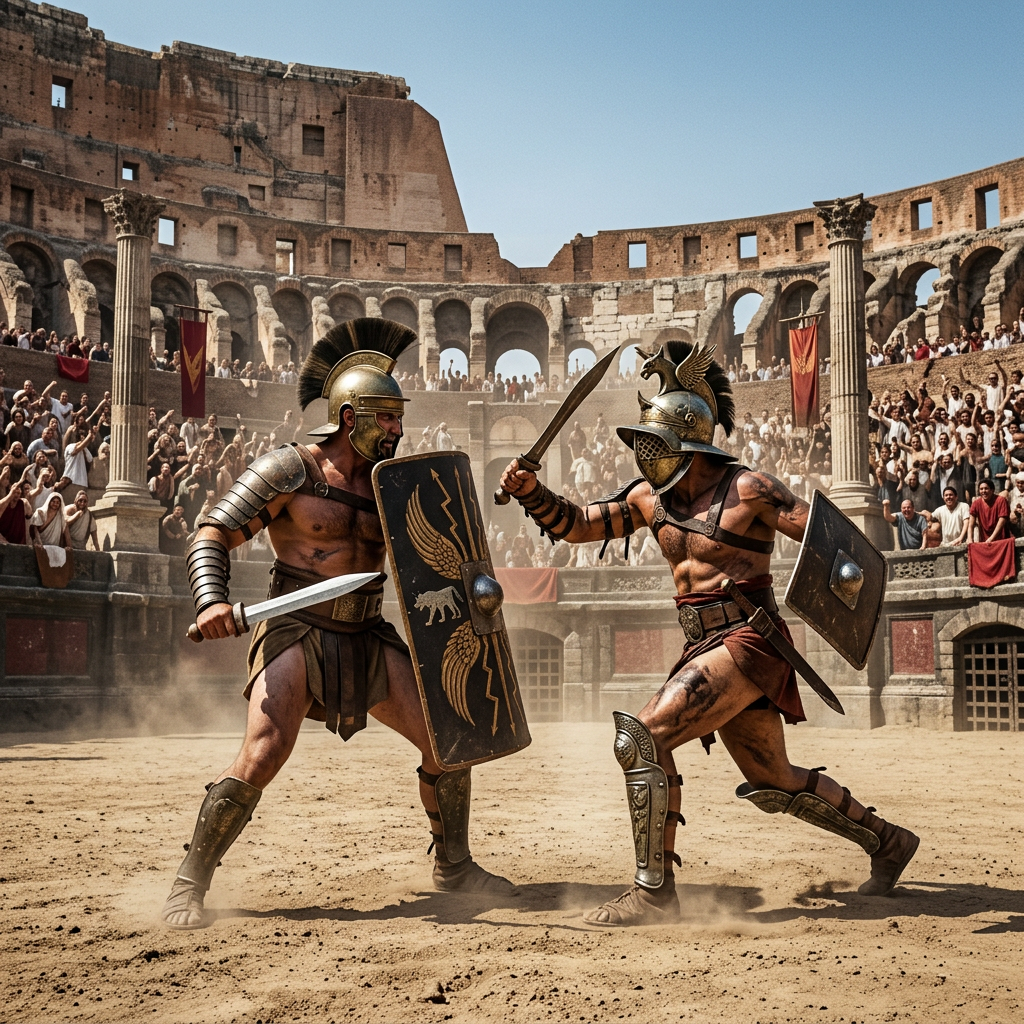
Among the countless gladiatorial combats held in the Roman Empire, one duel stands out not for its brutality, but for its rare outcome and historical significance.
The fight between Priscus and Verus, two elite gladiators of the Flavian Amphitheatre inaugural games—better known as the Colosseum—became legendary because it ended in an unprecedented decision: both men were granted freedom.
This encounter was recorded by the Roman poet Marcus Valerius Martialis, whose account preserves one of the most extraordinary moments in gladiatorial history.
The Setting: Rome’s Greatest Arena
The duel took place during the grand opening games of the Colosseum in 80 CE, under the emperor Titus. These games were designed to demonstrate imperial power, generosity, and control over life and death.
Thousands of spectators filled the arena. The atmosphere was one of spectacle and expectation, as Rome showcased its finest fighters in a series of contests meant to entertain and impress.
Priscus and Verus were not ordinary gladiators. They were highly skilled, evenly matched, and carefully selected to fight in a duel that would symbolize the excellence of Roman training and discipline.
The Battle Between Equals
According to Martial’s poetic account, the fight between Priscus and Verus was long, balanced, and intensely fought. Neither man could gain a decisive advantage. Blow after blow was exchanged, yet neither fell.
As the duel continued, the crowd grew increasingly captivated. Unlike many gladiatorial matches that ended in swift victory or brutal defeat, this combat became a test of endurance, skill, and mutual respect.
The longer the fight lasted, the more unusual it became. In a system designed to produce winners and losers, Priscus and Verus appeared perfectly matched.

The Emperor’s Decision
Eventually, the stalemate reached a point where neither gladiator could overcome the other. The crowd demanded judgment from Emperor Titus.
In a rare and symbolic decision, Titus declared both men victorious. Instead of forcing a fatal conclusion, he granted freedom to both Priscus and Verus.
They were awarded the rudis, the wooden sword symbolizing liberation from gladiatorial service.
This outcome was extraordinary. In most gladiatorial contests, one fighter’s death or defeat was required. Here, however, skill and endurance led not to execution, but to liberation.
Meaning of the Duel
The fight between Priscus and Verus became famous not because of violence, but because it disrupted expectations.
Equality and Balance
Their duel symbolized perfect equality. Neither fighter could dominate the other, suggesting that excellence can sometimes result in equilibrium rather than conquest.
Imperial Authority and Mercy
Titus’s decision reflects the emperor’s role as ultimate judge of life and death in the arena. By granting freedom to both men, he demonstrated a rare act of mercy within a system built on spectacle and control.
The Limits of Violence
The duel also highlights a paradox: when two equally skilled opponents face each other, violence does not always produce resolution. Instead, it can lead to exhaustion, reflection, or alternative outcomes.
Historical Significance
The account of Priscus and Verus survives primarily through Martial’s writing, making it one of the few documented cases of dual liberation in gladiatorial history.
Their story is often interpreted as a symbolic moment in the early history of the Colosseum, representing both the grandeur and the contradictions of Roman entertainment culture.
While most gladiators fought to the death or until a clear victor emerged, Priscus and Verus became an exception—remembered not for killing, but for enduring.

Legacy
Over time, their duel has been interpreted as a metaphor for balance, honor, and the possibility of resolution beyond destruction.
In modern discussions of Roman history, Priscus and Verus are often cited as examples of how even within violent systems, moments of humanity and fairness can emerge.
Their story endures because it challenges the assumption that competition must end in ruin. Instead, it suggests that excellence can sometimes lead to mutual recognition.
Conclusion
The duel between Priscus and Verus remains one of the most remarkable events in gladiatorial history. Fought in the grandeur of the Colosseum during its opening games, their battle ended not in death, but in shared victory and freedom.
In a world where the arena demanded blood, their story stands as a rare moment of balance—where strength met strength, and the result was not destruction, but liberation.
Fortisetliber’s View
The duel between Priscus and Verus reveals a deeper truth about strength: not all conflicts require a loser. From a Fortis Liber perspective, their encounter represents the moment where skill, discipline, and resilience reach equilibrium.
Neither man was defeated, because neither lacked strength. Instead, their equality transformed the nature of the contest itself. What began as a struggle for dominance became a demonstration of mastery.
The decision to grant freedom to both fighters highlights another principle: authority at its highest form is not only power, but judgment. Emperor Titus recognized that true greatness sometimes lies in ending conflict without destruction.
Priscus and Verus remind us that strength is not always measured by victory over another. It can also be measured by endurance, balance, and the ability to meet opposition without collapse.
Their story reflects a Fortis Liber ideal: that freedom is most meaningful when it emerges from discipline, and that honor can exist even within systems built on struggle.
Leave a Reply