
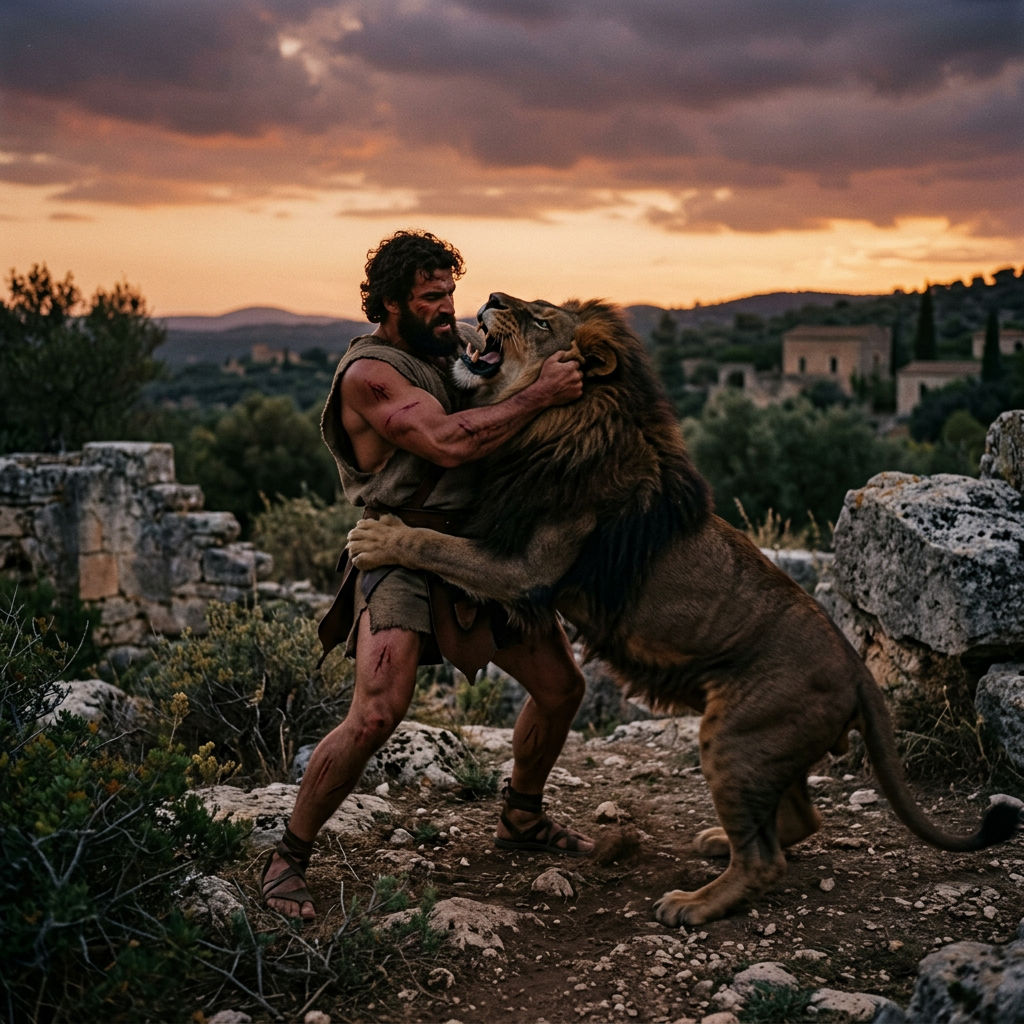
Heracles, known as Hercules in Roman mythology, is one of the most famous and enduring heroes of the ancient world.
Celebrated for his extraordinary strength, courage, and perseverance, he occupies a central place in Greek mythology.
His adventures have inspired countless works of art, literature, and popular culture for more than two thousand years.
Origins and Early Life
According to Greek mythology, Heracles was the son of Zeus, king of the gods, and Alcmene, a mortal woman.
His divine parentage made him exceptionally powerful, but it also brought him trouble. Zeus’s wife, Hera, was enraged by her husband’s infidelity and became Heracles’ lifelong enemy.
Even as an infant, Heracles displayed remarkable strength.
One famous story tells how Hera sent two serpents to kill him in his cradle, but the baby hero strangled them with his bare hands.
The Twelve Labors
The most famous chapter of Heracles’ life is the Twelve Labors. After Hera drove him into a fit of madness, he committed a terrible crime and was required to perform a series of seemingly impossible tasks as penance. These labors included:
- Slaying the Nemean Lion.
- Killing the Lernaean Hydra.
- Capturing the Ceryneian Hind.
- Capturing the Erymanthian Boar.
- Cleaning the Augean Stables in a single day.
- Driving away the Stymphalian Birds.
- Capturing the Cretan Bull.
- Obtaining the Mares of Diomedes.
- Acquiring the Belt of Hippolyta, Queen of the Amazons.
- Stealing the Cattle of Geryon.
- Retrieving the Golden Apples of the Hesperides.
- Capturing Cerberus, the three-headed guardian of the Underworld.
Through intelligence, determination, and immense physical power, Heracles completed each challenge and earned lasting fame.

Other Adventures
Beyond the Twelve Labors, Heracles participated in many other legendary exploits.
He fought monsters, rescued people from danger, and aided gods and mortals alike.
His travels took him across the known world, where he encountered giants, kings, and mythical creatures.
Heracles was not portrayed as a flawless hero. Ancient stories often emphasize his struggles with anger, suffering, and personal tragedy. These imperfections made him a complex and deeply human figure despite his divine heritage.
Death and Apotheosis
Heracles’ life ended in tragedy when he was poisoned by a garment unknowingly tainted with a deadly substance.
Unable to endure the pain, he ordered a funeral pyre to be built. As the flames consumed his mortal body, the gods granted him immortality.
After his death, Heracles ascended to Mount Olympus, where he was welcomed among the gods.
There he achieved divine status and was reconciled with Hera, bringing an end to their long conflict.
Legacy
Heracles remains one of the most recognizable heroes in world mythology. His stories symbolize the triumph of perseverance over adversity and the struggle to overcome personal flaws.
The image of the strong hero confronting impossible challenges continues to resonate with audiences today.
From ancient Greek temples to modern films, books, and television series, Heracles has endured as a symbol of courage, strength, and the human capacity to achieve greatness against overwhelming odds.

Fortisetliber’s View
From a Fortis et Liber (“Strong and Free”) perspective, Heracles stands as one of the greatest symbols of human resilience and self-mastery.
Although gifted with immense strength, his true greatness was not found in physical power alone.
It was demonstrated through his willingness to confront hardship, accept responsibility for his actions, and persevere through challenges that seemed impossible.
The Twelve Labors of Heracles can be viewed as a journey toward personal freedom. Each trial represented an obstacle to be overcome through courage, determination, and discipline.
Rather than surrendering to fate or adversity, Heracles chose action. Through struggle, he transformed suffering into achievement and weakness into wisdom.
Heracles reminds us that strength is not merely the ability to dominate others but the capacity to master oneself. Freedom is not the absence of challenges but the ability to face them with integrity and purpose.
His story continues to inspire those who seek to live boldly, act honorably, and pursue excellence despite adversity.
In this sense, Heracles remains a timeless embodiment of the ideal: strong in character, free in spirit, and unwavering in the pursuit of greatness.
Leave a Reply