
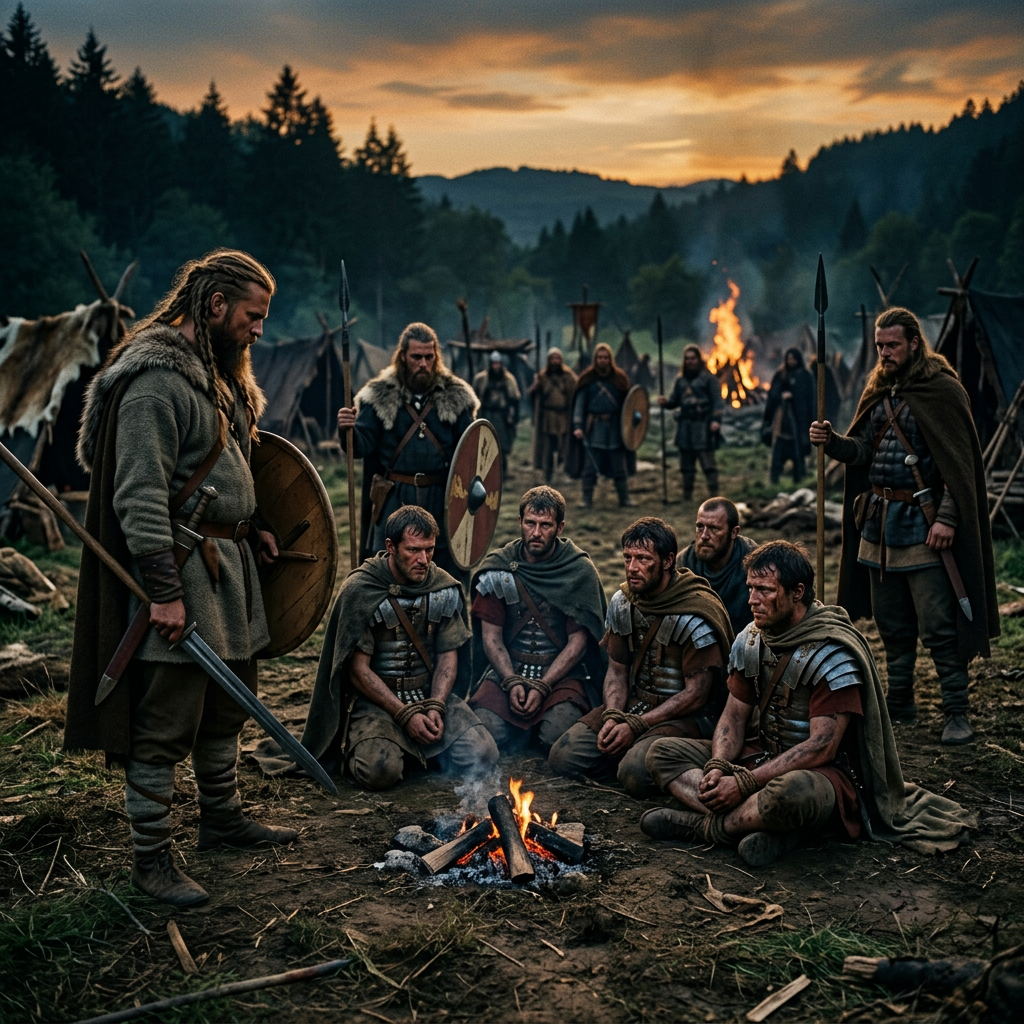
Throughout the long history of the Roman Empire, one of the more uncertain and often brutal outcomes for soldiers was capture by so-called “barbarian” peoples—Roman terminology for non-Roman groups such as Germanic tribes, Sarmatians, Goths, Vandals, and others beyond the imperial frontiers.
The fate of these captured soldiers varied widely depending on the time period, the captors, and the broader political situation.
Rather than a single outcome, captivity could lead to slavery, ransom, forced integration, or death, and in some cases, unexpected long-term survival within foreign societies.
Capture in Battle: How Romans Became Prisoners
Roman soldiers were typically captured during:
- Large-scale battles where formations collapsed
- Ambushes along frontier regions like the Rhine or Danube
- Failed campaigns deep into enemy territory
- Naval defeats or shipwrecks
Once isolated from their unit, Roman soldiers often had limited options. The Roman army valued discipline and cohesion, but once that structure broke, individuals could be overwhelmed and taken prisoner.
Slavery: The Most Common Outcome
For many captured soldiers, the most likely fate was enslavement.
Germanic and other tribal societies frequently used captives as:
- Agricultural laborers
- Household servants
- Skilled workers
- Trade commodities for exchange
Roman soldiers, especially those in good physical condition or with technical skills, could be highly valuable. Some were sold across vast trade networks reaching the Mediterranean and beyond.
However, slavery among “barbarian” groups was often less standardized than Roman slavery, meaning treatment varied significantly from harsh exploitation to relatively integrated servitude within households.
Ransom and Prisoner Exchanges
Not all captured Romans remained in captivity permanently. In many cases, prisoners were:
- Ransomed back to Rome
- Exchanged in diplomatic agreements
- Returned after peace treaties
This was especially common during periods of ongoing frontier diplomacy, where both Rome and neighboring peoples recognized the value of negotiating prisoner returns.
High-ranking officers were far more likely to be ransomed than ordinary soldiers.

Integration into Captor Societies
Some Roman soldiers did not return at all—not because they were killed or enslaved in the traditional sense, but because they became integrated into the societies of their captors.
This could happen through:
- Marriage into local families
- Adoption into tribal groups
- Service as warriors for their captors
Over time, some former Roman soldiers became fully embedded in “barbarian” military structures, sometimes even bringing Roman tactics, discipline, and engineering knowledge with them. This transfer of military expertise would later influence the development of post-Roman European kingdoms.
Death in Captivity
Not all outcomes were survivable. Some Roman prisoners faced:
- Execution as punishment or deterrent
- Death from harsh conditions or wounds
- Sacrificial or ritual killing in rare cultural contexts (as described in some Roman sources, though often exaggerated)
Roman writers frequently emphasized the brutality of enemy peoples, but modern historians note that such accounts often reflect Roman propaganda as much as reality.
The Psychological Dimension of Captivity
For Roman soldiers, capture was considered one of the most dishonorable outcomes, though not always permanent. Roman military culture valued courage and endurance, and captivity could create a profound psychological burden.
However, Rome also maintained a pragmatic approach:
- Captured soldiers were often reintegrated if returned
- Some who survived captivity went on to continue military service
- Loss of equipment and status could sometimes be restored
Famous Episodes of Mass Captivity
Several historical events highlight the scale of Roman prisoner losses:
- The defeat and capture of Roman forces during conflicts with Germanic tribes along the Rhine frontier
- The capture of soldiers during the crisis of the 3rd century CE, when the empire faced repeated invasions
- Later conflicts with Gothic and Vandal groups during the decline of the Western Empire
These events sometimes resulted in thousands of Roman soldiers living for years—or permanently—outside imperial control.
Legacy: The Blurred Line Between “Roman” and “Barbarian”
Over time, the fate of captured Roman soldiers contributed to a broader historical transformation. As Rome’s borders became more porous, the movement of prisoners, deserters, and settlers helped blur the distinction between Roman and non-Roman societies.
By the late empire and early medieval period:
- Roman military practices influenced tribal warfare
- Former Romans served in “barbarian” armies
- Cultural exchange became widespread
In this sense, captivity was not only an end for individual soldiers—it was also one of the many channels through which the Roman world gradually transformed into post-Roman Europe.

Fortisetliber’s View
From a Fortis Liber perspective, the fate of Roman soldiers captured by so-called “barbarian” peoples reveals a reality often more complex than the stark language of ancient sources suggests.
When Roman soldiers fell into the hands of groups such as the **Alaric I’s Visigoths or other frontier peoples, their outcomes were rarely uniform. Some were killed in the immediate aftermath of battle, especially during moments of chaos or retaliation.
Others entered systems of slavery or forced labor, where their skills as trained soldiers could make them valuable beyond simple manual work.
Yet captivity was not always a one-way descent. In many cases, Roman prisoners were ransomed, exchanged, or gradually absorbed into the societies that held them.
The Roman frontier was not a rigid wall but a shifting zone of interaction, where warfare, diplomacy, and migration overlapped. A captured soldier might one day find himself serving in a foreign warband, carrying with him traces of Roman discipline and tactics.
Fortis Liber views this phenomenon not merely as a series of individual misfortunes, but as part of a larger historical process.
The movement of captured Romans across cultural boundaries contributed—slowly and unevenly—to the transformation of the late Roman world. What began as captivity could, in some cases, become adaptation, survival, or even reinvention.
In this sense, the fate of Roman prisoners reminds us that empire was never a closed system.
Even in defeat, Roman soldiers remained part of a wider exchange of people, ideas, and military practices that shaped the world beyond Rome’s frontiers.
Leave a Reply